Alwin Goh
The best personal loan is not necessarily the one with the lowest advertised interest rate. A loan may look inexpensive at first but cost more once its effective interest rate (EIR), processing fee, repayment tenure and early settlement charges are included.
Your eligibility matters too. A salaried employee with a stable income and strong credit history may qualify for a competitive bank loan. Someone with a lower income, a limited credit history or an urgent short-term need may have to consider other options.
This guide explains how personal loans work in Singapore, what to compare and how to assess whether borrowing is manageable. It covers bank personal loans and loans from licensed moneylenders without treating them as equivalent products.
The main differences become clearer when you compare the factors that affect each loan’s cost and suitability.
| Comparison Point | What To Check | Why It Matters |
|---|---|---|
| Interest Cost | EIR, not only the advertised rate | EIR provides a more realistic view of the borrowing cost |
| Repayment Tenure | Monthly instalment and total repayment | A longer tenure may reduce each instalment but increase the total interest |
| Fees | Processing, late-payment, cancellation and early repayment fees | Fees can make an apparently cheaper loan more expensive |
| Eligibility | Income, residency, employment and credit history | Published rates may be available only to qualifying applicants |
| Loan Amount | What you need and what you can comfortably repay | Approval for a larger amount does not make that amount affordable |
| Lender Type | Bank, digital bank or licensed moneylender | Costs, limits, approval processes and regulations differ |
| Repayment Flexibility | Early settlement terms and repayment schedule | A flexible loan may be preferable even if its EIR is slightly higher |
| Lender Verification | Official bank website or Registry of Moneylenders | Verification reduces the risk of dealing with an impersonator or unlicensed lender |
Table Of Contents
- What Is A Personal Loan?
- How Personal Loans Work In Singapore
- What Does “Best Personal Loan” Really Mean?
- How To Compare Personal Loan Interest Rates
- What Other Personal Loan Fees Should You Check?
- What Types Of Personal Loans Are Available?
- Banks vs Licensed Moneylenders
- How Much Can You Borrow?
- Who Can Apply For A Personal Loan?
- How Lenders Assess Your Application
- How To Choose A Suitable Loan Tenure
- When Might A Personal Loan Be Useful?
- When Should You Avoid Taking A Personal Loan?
- How To Apply Safely
- The Bottom Line
- Frequently Asked Questions
What Is A Personal Loan?
A personal loan allows you to borrow a lump sum and repay it through scheduled instalments over an agreed period. Most personal loans are unsecured, which means you do not pledge an asset, such as a home or vehicle, as collateral.
This makes it different from secured products such as a home loan or a vehicle loan, where the property or car itself backs the borrowing.
Because there is no collateral, lenders assess the risk mainly by reviewing your income, credit history, existing debts, employment circumstances and ability to repay. Unsecured borrowing may also cost more than secured borrowing because the lender cannot rely on a pledged asset if you default.
Crawfort’s guide to secured versus unsecured personal loans in Singapore explains how the two categories differ and when each may suit you. Loans are also structured either as term loans or as revolving credit. A personal term loan generally has a defined repayment period, while a line of credit allows repeated borrowing up to an approved limit.
This distinction matters. A fixed personal loan may suit a known, one-off expense. Revolving credit can offer greater flexibility, but it may also make it easier to carry an outstanding balance for longer.
How Personal Loans Work In Singapore
After a lender approves your application, you receive the agreed loan amount, less any permitted upfront deductions or applicable fees. You then repay the loan according to the terms of the contract.
Each instalment typically covers part of the principal and the borrowing cost. The contract should state:
- The principal amount
- The interest rate
- The EIR, where applicable
- The repayment frequency
- The number of instalments
- The amount of each instalment
- The total repayment amount
- Applicable fees and penalties
- Early settlement conditions
Do not assess affordability based only on the amount disbursed or the monthly instalment. You should also consider what the loan will cost from beginning to end.
A S$10,000 loan with a low monthly instalment may still be costly if the repayment period is long. Conversely, a shorter tenure may reduce the total interest but leave too little room in your monthly budget.
Before deciding, calculate how the instalment would affect your essential expenses, existing debt payments and emergency savings. Crawfort’s personal loan calculator guide explains how repayment estimates can support this assessment. However, the lender’s official repayment schedule and loan contract remain the definitive sources of information.
What Does “Best Personal Loan” Really Mean?
There is no single personal loan that is best for every borrower. The right option depends on what you qualify for and what you need the loan to cover.
For one borrower, “best” may mean the lowest EIR. For another, it may mean a shorter tenure without an early settlement penalty. Someone with an irregular income may place greater importance on eligibility and a manageable repayment schedule.
A Useful Comparison Should Address Five Questions
- What is the total amount you will repay?
- Can you meet every instalment without relying on further borrowing?
- Do you satisfy the lender’s eligibility requirements?
- What happens if you repay the loan early or miss an instalment?
- Is the lender properly regulated and verified?
Before committing, gather quotations from at least two or three lenders, whether banks, digital banks or licensed moneylenders. Comparing the offers side by side makes it easier to spot differences in EIR, fees and repayment terms.
Remember that published or promotional rates do not replace an individual loan quotation. Promotional rates change, and the rate offered to you may differ from the lowest rate displayed.
How To Compare Personal Loan Interest Rates
Interest rates are where most borrowers start, and it’s tempting to simply pick the lowest number you see. The catch is that two loans with the same advertised rate can cost very different amounts once fees and repayment schedules are factored in.
To compare loans fairly, always look at the effective interest rate (EIR) and the total amount you will repay, not just the headline figure. Here’s how the two rates differ and what to request from each lender.
Advertised Rate vs EIR
An advertised or nominal rate may not represent the full cost of a loan. For many personal term loans, interest is calculated on the original principal even as you gradually repay that principal.
The EIR reflects the interest calculation method and repayment schedule more accurately. MoneySense recommends using the effective interest rate to compare borrowing costs across different loan packages.
Suppose two lenders advertise similar rates. One loan may have a higher processing fee or require more frequent repayments. Its EIR and total repayment may therefore be higher, despite the similar headline rate.
When you request a quotation, ask each lender to put the following in writing so you can compare the offers accurately:
- The advertised rate
- The EIR
- The monthly instalment
- The total interest payable
- The total amount repayable
- A complete repayment schedule
Compare quotations for the same loan amount and tenure. Comparing a two-year loan with a five-year loan can make one option appear cheaper simply because its monthly instalment is lower.
For a closer explanation of how these figures differ, see Crawfort’s guide to effective interest rates.
The Lowest EIR Does Not Always Settle The Decision
A lower EIR is generally preferable when the other terms are comparable. However, another offer may suit you better if it has:
- No early settlement charge
- A more manageable repayment schedule
- Lower upfront fees
- A shorter commitment period
- Clearer or more flexible repayment conditions
You should not pay substantially more merely for convenience. Nevertheless, compare the complete loan terms instead of ranking offers by one number alone.
Learn more about how to calculate interest on a loan in Singapore here.
What Other Personal Loan Fees Should You Check?
Fees vary across lenders and products. Review the loan terms for:
- Processing or administrative fees
- Annual fees, where applicable
- Late-payment charges
- Late interest
- Early repayment charges
- Cancellation fees
- Fees for changing the repayment arrangement
- Legal costs arising from recovery action
Ask whether each fee will be deducted from the approved amount or charged separately. If a lender approves a loan of S$10,000 but deducts an upfront fee, you may receive less than S$10,000 even though your repayment obligation is based on the approved principal.
The loan contract should also explain what happens if a GIRO deduction fails or an instalment falls due on a public holiday. Small administrative details can lead to late charges if you do not plan for them.
What Types Of Personal Loans Are Available?
Bank Personal Loans
A bank personal loan usually provides a lump sum that you repay through fixed monthly instalments. Banks commonly assess your income, residency status, employment and credit history.
Applicants who meet the lender’s requirements may secure a lower-cost loan than they would from a licensed moneylender. However, the lowest published rate is not necessarily the rate that every applicant will receive.
Digital Bank Personal Loans
Digital banks may offer loans or credit lines through mobile applications. Their application and disbursement processes can be convenient, but convenience does not remove the need to compare the EIR, fees and repayment conditions.
Check whether the product is a term loan or a revolving credit line. The way you borrow and repay can differ considerably between the two.
Licensed Moneylender Loans
Licensed moneylenders operate under Singapore’s moneylending laws and the Ministry of Law’s regulatory framework. They are separate from banks and may serve applicants who do not meet conventional bank criteria.
Their loans may involve higher borrowing costs and shorter repayment schedules. A short repayment period can result in demanding weekly or monthly instalments, even when the principal is modest.
Products such as payday loans and short-term loans are designed to be repaid within weeks or a few months. Check that the schedule fits your pay cycle before committing.
Before dealing with a licensed moneylender, verify its business name, address and website against the Ministry of Law’s official list of licensed moneylenders.
Personal Lines Of Credit
A personal line of credit allows you to draw funds up to an approved limit. Interest is generally charged on the amount used rather than the full credit limit.
This arrangement can be useful for uncertain or recurring expenses, but revolving access can make debt harder to clear. A term loan may provide more repayment discipline when you need a specific amount.
Balance Transfers And Debt Consolidation Plans
A balance transfer moves eligible debt to a facility with different repayment terms. It may offer a promotional rate, but you should check what happens after the promotional period ends and whether processing fees apply.
A Debt Consolidation Plan is intended for certain borrowers who have substantial unsecured debt across several financial institutions. The Association of Banks in Singapore sets out the current Debt Consolidation Plan eligibility requirements and application process.
A DCP is not a general-purpose cash loan, and not every type of debt can be included. If you do not meet the DCP criteria, some licensed moneylenders also offer debt consolidation loans that combine several smaller debts into one repayment, so compare the total cost carefully before switching.
Banks vs Licensed Moneylenders
Banks and licensed moneylenders both provide credit, but their eligibility requirements, borrowing costs and approval processes differ. If you are exploring non-bank credit, first understand how a licensed moneylender in Singapore operates and what safeguards apply before comparing loan offers.
Banks generally offer lower borrowing costs to applicants who meet their income and credit requirements. Licensed moneylenders may consider applicants who do not qualify for a bank loan, although their loans may cost more and have shorter repayment periods.
The comparison below summarises the main differences. Actual terms depend on the lender, the product and the borrower’s circumstances.
| Factor | Banks And Digital Banks | Licensed Moneylenders |
|---|---|---|
| Regulation | Regulated as financial institutions | Licensed and regulated under the Ministry of Law’s moneylending framework |
| Typical Cost | Often lower for qualifying applicants | May be higher, subject to statutory limits |
| Eligibility | Usually involves stricter income and credit assessments | May include applicants who do not meet bank criteria |
| Loan Size | Depends on the product, income and credit assessment | Unsecured limits are determined by annual income and residency status |
| Repayment Period | May offer longer tenures | Often shorter, depending on the contract |
| Application | Commonly completed through the bank’s official digital channels or branches | Initial enquiries may be made online, but identity verification must take place in person at the approved place of business before a loan is granted |
| Generally Suited To | Applicants who qualify and want a conventional instalment loan | Applicants who understand the higher potential cost and need a regulated non-bank option |
| Main Caution | The final offered rate may be higher than the promotional rate | Verify the licence and examine the interest, fees and repayment frequency carefully |
A licensed moneylender should not be treated as equivalent to a bank. A bank’s rejection of your application also does not mean that the next loan offered to you will be affordable.
If a conventional bank loan is unavailable and you need funds quickly from a regulated non-bank option, you may review the terms of a Crawfort instant loan. Check the repayment schedule, interest, fees and total repayment before accepting an offer. Approval and loan terms remain subject to assessment.
How Much Can You Borrow?
Bank Borrowing
A bank determines the approved amount based on its product rules, your income, existing commitments, credit profile and applicable regulatory requirements. The maximum amount displayed on a product page is not a promise that you will receive that sum.
A bank may also offer you more than you initially intended to borrow. Use the amount you genuinely need, rather than the lender’s maximum offer, as your starting point.
Borrowing an additional S$2,000 simply because it is available still means repaying that S$2,000 with interest.
Licensed Moneylender Borrowing Limits
For unsecured loans from licensed moneylenders, the maximum total amount you may borrow at any one time across all licensed moneylenders is based on your annual income and residency status.
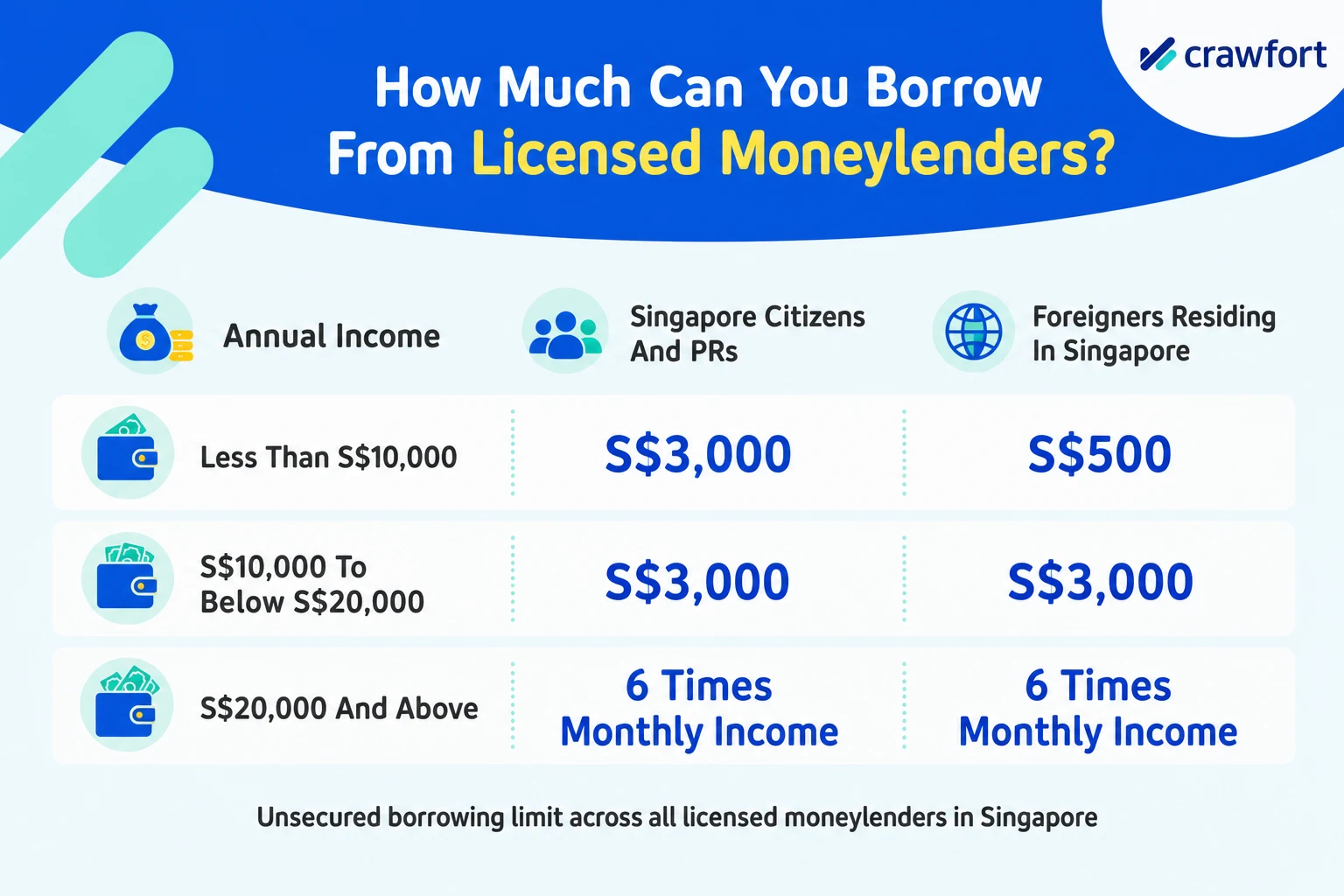
The infographic above summarises the limits stated in the Ministry of Law’s guide for borrowers using licensed moneylenders.
These figures are legal maximums across licensed moneylenders, not recommended borrowing amounts. The lender must still assess your application, and you should borrow less if the maximum amount would strain your budget.
The same Ministry of Law guidance states that licensed moneylenders may charge interest of up to 4% per month. Permitted charges include an administrative fee of up to 10% of the loan principal when the loan is granted, a fee of up to S$60 for each month of late repayment and legal costs ordered by a court for a successful recovery claim.
The total charges imposed by a licensed moneylender, including interest, late interest, upfront administrative fees and late fees, cannot exceed an amount equal to the loan principal. Conditions apply, so review the official guidance and loan contract carefully.
Who Can Apply For A Personal Loan?
Eligibility requirements differ across lenders. A lender may consider:
- Your age
- Your citizenship or residency status
- Your annual or monthly income
- Your employment status
- The length of your employment
- The consistency of your income
- Your existing loans and credit limits
- Your credit history
- The requested amount and tenure
- Your supporting documents
Banks often publish minimum income requirements, but meeting the stated threshold does not guarantee approval. Similarly, falling within the borrowing limits for licensed moneylenders does not mean that a lender must grant you a loan.
Foreigners may face different income, pass validity and documentation requirements. Self-employed workers, commission earners and gig workers may need additional records to show that their income is regular enough to support the repayments.
If your working hours vary from month to month, Crawfort’s guide on whether part-time workers can get a personal loan in Singapore explains how lenders assess irregular income.
Review the lender’s current criteria rather than relying on a general figure from an older article. Crawfort’s guide to personal loan eligibility in Singapore covers common documents and assessment factors in more detail.
How Lenders Assess Your Application
Income And Employment
A lender needs evidence that your income can support the proposed instalment after your existing obligations are considered. Depending on your circumstances, the lender may request:
- Recent payslips
- CPF contribution records
- Notices of Assessment
- Bank statements
- Employment documents
- Business or commission records for non-salaried applicants
An irregular income does not necessarily prevent you from applying, but you may need to provide records covering a longer period. Organise your documents before applying so that the lender can assess your actual income rather than an incomplete snapshot.
Credit History
Banks and other financial institutions may use a credit report alongside information about your income and financial commitments. MoneySense explains that creditworthiness assessments may consider your repayment history, outstanding credit, account delinquency, recent applications and number of active credit facilities.
Submitting several loan applications within a short period can generate multiple credit enquiries. This activity may indicate that your debt exposure is increasing. Compare suitable options first and avoid submitting applications indiscriminately.
If your credit record is weaker than expected, review it for errors and focus on making regular, timely repayments. Crawfort’s guide on getting a personal loan with a bad credit score explains practical steps, but there is no legitimate shortcut that will repair a credit history immediately.
Existing Commitments
Your rent or mortgage, car loan, credit card balances, existing personal loans and regular household expenses affect how much you can reasonably afford to repay.
A lender’s approval is only one part of the assessment. Your own affordability check should go further because the lender does not make your everyday spending decisions for you.
How To Choose A Suitable Loan Tenure
A longer tenure usually reduces the monthly instalment but increases the total interest paid. A shorter tenure reduces the time spent in debt but creates a higher monthly commitment.
Suppose you need to borrow S$12,000. A four-year tenure may appear easier to manage each month than a two-year tenure. However, if the longer arrangement costs considerably more overall, the lower instalment may not be a worthwhile trade-off.
A tenure only works if the monthly instalment fits comfortably into your real budget, not just your best-case one. Before you commit to a repayment period, run through these quick checks:
- Set aside money for essential household expenses.
- Include all your current debt repayments.
- Allow for irregular but predictable costs, such as insurance premiums and school expenses.
- Keep a buffer for unexpected bills.
- Check whether you could continue paying if your income temporarily fell.
- Compare the total repayment across at least two tenures.
Do not choose an unrealistic short tenure merely to minimise interest. Missed repayments can result in fees, damage your credit record and create a larger financial problem.
When Might A Personal Loan Be Useful?
A personal loan may be considered for a necessary expense when you know the amount required and have a credible repayment plan.
Urgent Medical Or Family Costs
A loan may help cover an unavoidable shortfall after you have checked your insurance coverage, MediSave eligibility, available subsidies, payment plans and savings.
Borrow only enough to cover the remaining shortfall. Do not assume that you must finance the entire bill.
Essential Home Repairs
Urgent electrical, plumbing or safety work may not be deferrable. Obtain quotations first and distinguish essential repairs from optional improvements.
For a planned renovation, compare a dedicated renovation loan with a general personal loan. The products may have different permitted uses, rates and tenures.
Education Or Skills Training
Before borrowing, check whether grants, employer support, school instalment plans or other funding options are available. Consider whether the likely benefit justifies the full repayment cost.
Consolidating More Expensive Debt
Replacing several high-cost debts with one lower-cost instalment may simplify repayment, but only if:
- The new EIR is genuinely lower
- The fees do not cancel out the savings
- The old facilities are fully repaid
- You stop adding new balances
- The repayment period is not unnecessarily extended
If you are already struggling to meet the minimum payments, speak to your financial institution instead of automatically taking another loan. Credit Counselling Singapore provides counselling for unsecured debt problems and can help eligible individuals assess possible repayment arrangements.
A Specific Expense With A Defined Budget
Personal loans are easier to assess when the cost is known. If the expense is open-ended, borrowing a lump sum may not solve the underlying cash-flow problem.
For milestone occasions with a defined budget, such as your big day, a dedicated wedding loan may also be worth comparing against a general personal loan. Look at the permitted amounts, tenure and total repayment for each option.
When Should You Avoid Taking A Personal Loan?
Sometimes the wisest financial decision is not to borrow at all, or at least not yet. It’s best to avoid or postpone taking a personal loan if any of the following apply to you:
- You do not know how you will make the first few repayments
- You intend to use the loan to cover routine monthly expenses without addressing an ongoing income shortfall
- You need a new loan to repay another loan but have not compared the total costs
- The expense is discretionary and can be delayed
- The lender will not provide a clear contract or repayment schedule
- You are being pressured to decide immediately
- Someone asks you to make a payment before disbursing the loan
- Your repayment plan depends on an investment return, bonus or other uncertain future income
- Your existing repayments are already unmanageable
A personal loan should not be used to fund speculative investments. Investment returns are uncertain, while loan repayments are contractual obligations.
Borrowing for recurring expenses is also risky. If your monthly income repeatedly falls short of your rent, food, utilities and transport costs, another instalment will add pressure without resolving the underlying problem.
How To Apply Safely
Step 1. Confirm The Amount You Need
Prepare an accurate estimate of the expense. Deduct any available cash, grants, insurance payouts or amounts covered by payment plans before deciding how much to borrow.
Step 2. Check Your Monthly Budget
Calculate the maximum instalment you can afford while protecting your essential expenses and maintaining a reasonable buffer. Do not commit every remaining dollar to loan repayments.
Step 3. Compare Like With Like
Request quotations for the same principal amount and tenure. Compare:
- The EIR
- The total repayment
- The instalment amount
- The processing fee
- Late-payment charges
- Early settlement terms
- The amount to be disbursed
Step 4. Verify The Lender
Use a bank’s official website, mobile application or branch. For a licensed moneylender, check its exact name, approved address and website against the Registry of Moneylenders.
ScamShield warns that unsolicited loan offers and requests for upfront transfers are signs of loan scams. A licensed moneylender must conduct face-to-face identity verification at its approved place of business before granting a loan.
For more warning signs, see Crawfort’s guide to protecting yourself from personal loan scams.
Learn more about whether personal loans online are safe to use here.
Step 5. Review The Contract
The contract is your final safeguard, so take your time with it and never feel pressured to sign on the spot. Do not put pen to paper until you fully understand:
- How the interest is calculated
- The amount that will be disbursed
- Every repayment date
- The total repayment amount
- All applicable fees
- The consequences of late payment
- The early settlement conditions
- The actions the lender may take if you default
Licensed moneylenders must explain the loan terms in a language you understand and provide you with a copy of the contract.
Step 6. Keep Your Documents
Retain the contract, repayment schedule, account statements and receipts. Check every payment record and report discrepancies promptly.
Step 7. Act Early If Repayment Becomes Difficult
Contact the lender before the arrears increase. The lender may be able to discuss available repayment arrangements with you.
Ignoring messages from the lender does not stop interest, fees or recovery action from accumulating.
The Bottom Line
Start with the amount you genuinely need, then compare individual offers for the same principal and tenure. Check the EIR, total repayment, fees and early settlement conditions before considering speed or promotional benefits.
If you qualify for a competitively priced bank or digital bank loan, compare those options first. If you are considering a licensed moneylender, verify the lender through the Ministry of Law’s registry and make sure you understand the potentially higher cost and shorter repayment schedule.
Above all, remember that approval is not the same as affordability. An approval only tells you what a lender is willing to offer, not what your budget can comfortably carry.
The right loan is one whose terms you understand from the first instalment to the last, and whose repayments still leave room for your essential expenses, existing commitments and a little breathing space. If an offer passes that test, you can borrow with confidence. If it doesn’t, walking away is the smarter financial move.
Ready to get started? Apply for a loan with Crawfort and get approved in as fast as 8 minutes.
Important note: This article is for general information only and does not consider your personal financial situation. Before taking a loan, review the loan contract carefully and make sure the repayments are manageable.