

 Alwin Goh

A low advertised rate looks good. It does not tell you what the loan will actually cost you. Fees, repayment frequency, loan tenure and early settlement terms all change the final figure. A small monthly instalment can also hide a longer and more expensive commitment.
So there is no single best personal loan. The right one gives you the amount you actually need, at a cost you understand, with repayments you can keep up. If borrowing is the right move, the six checks below let you compare offers on the same terms instead of picking the loudest promotion.
Each check exists to catch a specific problem. Here is what to look at and what it protects you from.
| Check | What To Compare | Why It Matters |
|---|---|---|
| Borrowing Need | Purpose and exact amount required | Stops you borrowing more than you need |
| Full Cost | EIR, fees and total repayment | Shows what the loan costs overall |
| Loan Tenure | Monthly instalment and number of payments | Balances affordability against total cost |
| Credit Position | Credit report, eligibility and recent applications | Avoids applications that were never likely to work |
| Provider Terms | Loan amount, documents, repayment and settlement clauses | Lets you compare like with like |
| Lender Legitimacy | Official registration, approved address and loan process | Protects you from unlicensed lenders and scams |
For a broader look at loan types and comparison criteria, see Crawfort’s complete guide to choosing a personal loan in Singapore.
Table of Contents
- Start With The Amount You Actually Need
- Compare EIR, Fees And Total Repayment
- Pick A Tenure You Can Keep Up With
- Check Your Credit Position Before Applying
- Compare Providers And Contract Terms
- Verify The Lender And Spot Scam Signs
- How To Compare Two Loan Offers Side By Side
- Choose By Full Cost And Repayment Fit
- Frequently Asked Questions
1. Start With The Amount You Actually Need
Do not start from the maximum a lender will give you. Start from the bill. Then subtract whatever cash you can put in yourself without missing essentials or wiping out your emergency savings.
Say the expense is S$4,800 and you can safely contribute S$1,300 without touching rent, food, utilities or existing repayments. Your gap is S$3,500. Compare S$3,500 offers. Taking S$5,000 just because it is on the table means paying interest on S$1,500 you never needed.
Three questions to ask first:
- Do you need this now, or can it wait while you save?
- Is there a cheaper route that avoids borrowing, such as an instalment plan with the service provider?
- Is this a one off shortfall, or a monthly deficit that will come back?
A loan bridges a one off gap well. It rarely fixes a recurring one, because the instalment simply becomes another monthly bill. If your budget is already short before the repayment, fix that first.
Learn more: Our guide on how to avoid overborrowing when you need cash urgently walks through narrowing a request down to the real shortfall.
The size of the gap usually points to the right product. A large, planned commitment spread over years is a different decision from a small, urgent shortfall you expect to clear quickly. Longer borrowing gives you a bigger sum and a smaller instalment but costs more in total, while a short term loan clears faster and costs less overall, provided the repayment fits your month.
It is also worth knowing what else exists before you settle on a personal loan. Compare the main types of personal loans in Singapore, and if your employer offers one, check whether a salary advance costs less than a loan for a short gap. If the pressure is coming from several existing debts rather than one bill, a debt consolidation loan may be the more sensible structure.
2. Compare EIR, Fees And Total Repayment
The advertised rate, also called the nominal rate, is only part of the price. The effective interest rate, or EIR, reflects how the interest is calculated and how you repay. It is the fairer number when two loans have the same amount and tenure. Fees still need checking separately.
Ask each provider for the EIR. Do not try to work out the real cost from the headline rate. A 4% flat rate and a 4% EIR are not the same thing, and the gap grows once fees and repayment frequency are added.
Learn more: Our explainer on what the effective interest rate is and how to calculate it shows why two loans with identical advertised rates can cost you different amounts.
Then write the figures down in dollars, not percentages:
- Principal stated in the contract
- Cash you will actually receive after any permitted deductions
- Size and number of instalments
- Total scheduled repayment
- Processing or administrative fees
- Late charges and late interest terms
- Early repayment fee, notice period and how settlement works
This matters because two offers at similar rates can hand you different amounts of usable cash. Be careful not to count a fee twice. If it is deducted before disbursement, it already shows up as lower cash received.
Four lines are enough for a quick comparison:
Net Cash Received = Principal Minus Upfront Deductions
Total Scheduled Repayment = Instalment Amount Multiplied By Number Of Instalments
Total Cash Outflow = Total Scheduled Repayment Plus Any Fees Paid Separately
Cost Above Cash Received = Total Cash Outflow Minus Net Cash Received
These do not replace the EIR or the contract. They catch differences that a monthly instalment hides.
Also read: The same method works across products. See how it plays out in a worked comparison of a credit card cash advance and a personal loan.
3. Pick A Tenure You Can Keep Up With
A longer loan tenure lowers the monthly instalment because the repayment is spread further. It usually raises the total interest. A shorter tenure normally costs less overall but squeezes your monthly cashflow harder.
Test the instalment against a normal month, not a good one. Start with stable net monthly income and take out:
- Housing, food, transport and utilities
- Insurance and medical costs
- Support for children or family
- Existing loan and credit card payments
- Irregular but predictable costs, averaged out
- Savings or an emergency buffer
Do not count bonuses, overtime or commission unless they are reliable. You should still have room left after the new instalment. If a single medical bill, school expense or late salary would cause a missed payment, the amount or the tenure is too tight.
The question is not “can I pay this month?” It is “can I pay every month, on time, and still cover the essentials?”
Learn more: These two selling points pull in opposite directions, and our comparison of a low interest rate and a low monthly instalment explains why the cheaper looking option often is not. A personal loan calculator lets you test different tenures before you commit.
4. Check Your Credit Position Before Applying
Banks and other financial institutions look at your credit report alongside your income and other details. Check your own position first, especially if you have recently missed payments, opened new credit facilities or applied for several products.
Checking your own report does not count as an application enquiry. A run of real applications in a short window is treated differently, because it suggests your debt is about to grow.
If you do pull your report, the score comes with a risk grade. Here is what each grade means.
| Score Range | Risk Grade | Probability Of Default |
|---|---|---|
| 1911 to 2000 | AA | 0.27% or less |
| 1844 to 1910 | BB | 0.27% to 0.67% |
| 1825 to 1843 | CC | 0.67% to 0.88% |
| 1813 to 1824 | DD | 0.88% to 1.03% |
| 1782 to 1812 | EE | 1.03% to 1.58% |
| 1755 to 1781 | FF | 1.58% to 2.28% |
| 1724 to 1754 | GG | 2.28% to 3.47% |
| 1000 to 1723 | HH | 3.48% or more |
A high grade does not guarantee approval and a low one does not guarantee rejection. Credit Bureau Singapore does not approve or decline anything. Each lender sets its own thresholds and weighs the grade alongside your income, employment and existing commitments.
Your report may also come back with no score at all. That is not an error. Five non-scored grades exist, and each means something different.
| Grade | What It Means |
|---|---|
| HX | A past or existing writ of summons or bankruptcy record is on file |
| HZ | An outstanding balance of S$300 or more sits in default, write off, restructuring or 90 days past due |
| GX | Only enquiries appear, with no credit file behind them |
| BX | All accounts are closed, or only a bridging loan, margin trading or “other” account exists |
| CX | Too little credit activity to calculate a score |
CX and GX are common for younger borrowers and anyone who has never held a credit card or loan. Neither is a black mark, but some lenders treat a thin file cautiously because there is nothing to assess.
Five things move the score: how much of your available credit you use, whether payments are late, how long your credit history runs, how many accounts are open, and how many new applications you have made recently. Credit Counselling Singapore’s explainer on credit scores, contributed by Credit Bureau Singapore, sets out each factor in full.
Also read: You may not need to pay for a copy. Our guide on how to get a free credit bureau report in Singapore explains when you qualify.
Bank loans and licensed moneylender loans are recorded in two separate places, so check the right one. Our comparison of Credit Bureau Singapore and the Moneylenders Credit Bureau explains which report to pull before your next application.
Check the eligibility criteria before anything else. Income thresholds, residency status, employment history, documents and existing commitments vary between providers. Meeting the published criteria does not guarantee approval, but it stops you applying for something that was never going to fit.
An enquiry and an application are not the same thing. You can ask about general terms without submitting a formal credit application. Since multiple loan applications can affect your CBS credit score, shortlist first, confirm what will be assessed, and apply only when you are comfortable with the cost and the repayment structure.
If your credit position is the weak spot, work on it before borrowing rather than after. There are practical steps to improve your credit score in Singapore, and if you have already been turned down, it helps to understand the common reasons a personal loan application is rejected before trying again.
5. Compare Providers And Contract Terms
Banks and licensed moneylenders both offer personal loans, but they work under different rules, assess applications differently and price differently. Do not assume a rate, approval process or borrowing limit from one applies to the other.
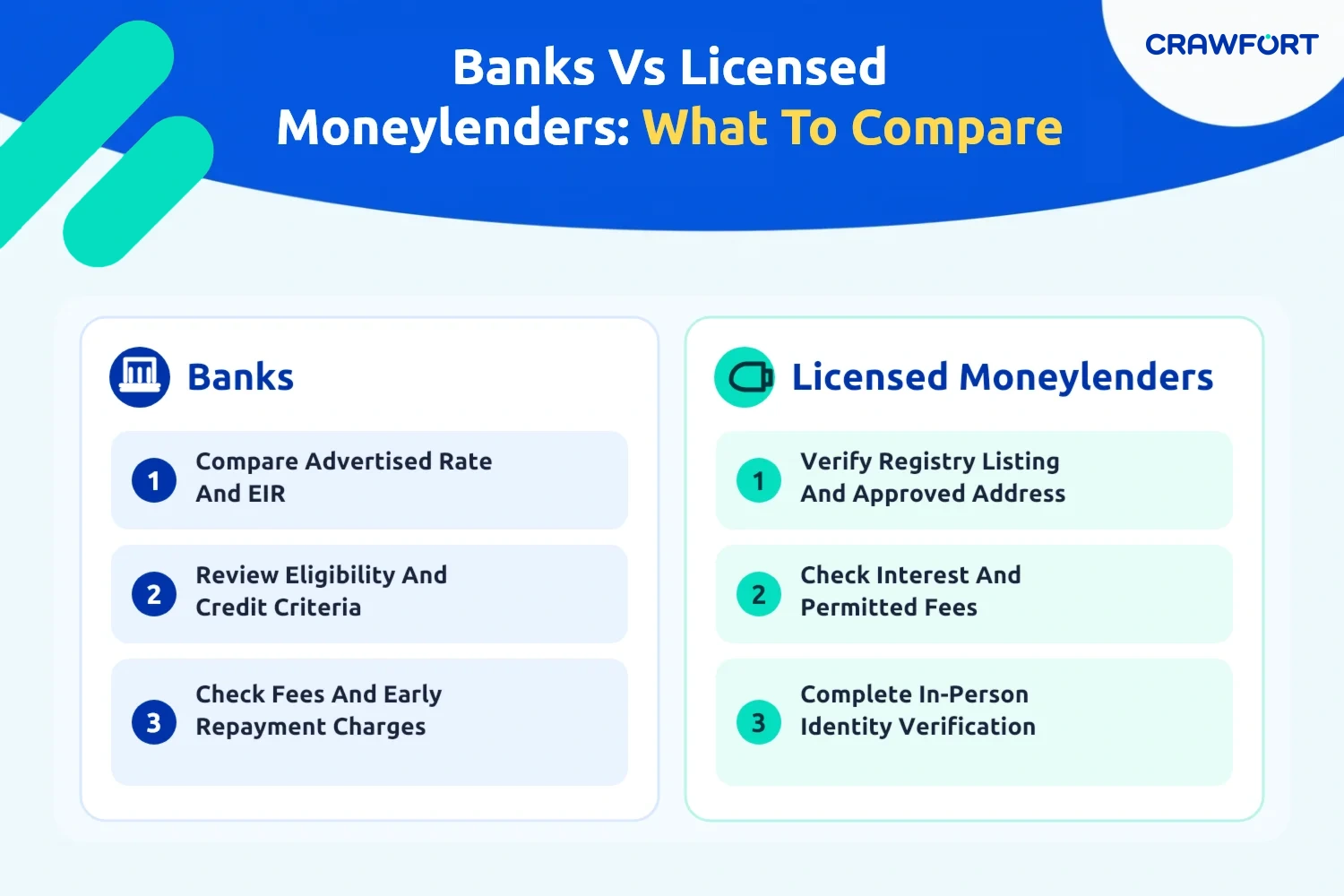
Read more: How banks and licensed moneylenders differ in Singapore
Compare using the same amount and a similar tenure. For each offer, check:
- Eligibility and supporting documents
- Net amount disbursed
- EIR or how the interest is calculated
- Instalment amount and repayment dates
- Total repayment if you follow the schedule
- Late payment charges
- Early repayment and cancellation terms
- How disputes, receipts and account statements are handled
Documents are often where an application stalls, so get them ready early. This guide to proving your income for a loan covers what salaried, self employed and irregular income applicants are usually asked for.
If you are considering a licensed moneylender, compare the actual offer against your budget and your other options. The Registry of Moneylenders’ FAQs on borrowing from licensed moneylenders set out the borrowing limits, the charges that are allowed and what the lender owes you. They also tell borrowers to shop around and not commit until the terms are clear.
As of September 2026, these caps apply to every licensed moneylender in Singapore. They have not changed since 1 October 2015.
| Charge | Statutory Cap | What To Check In Your Contract |
|---|---|---|
| Interest | 4% per month | Must be worked out on the principal still owing, not the original amount |
| Late Interest | 4% per month | Only on the instalment repaid late, never on amounts not yet due |
| Late Fee | S$60 for each month of late repayment | Ask how a part month is treated |
| Loan Approval Fee | 10% of the principal, charged when the loan is granted | Taken upfront, so check the cash you actually receive |
| Combined Total | Cannot exceed the principal | Covers interest, late interest, the upfront fee and late fees together |
How much you can borrow depends on your annual income, and the limit applies across all licensed moneylenders combined rather than per lender. These figures are current as of September 2026.
| Annual Income | Singapore Citizens And Permanent Residents | Foreigners Residing In Singapore |
|---|---|---|
| Less than S$10,000 | S$3,000 | S$500 |
| At least S$10,000 and less than S$20,000 | S$3,000 | S$3,000 |
| At least S$20,000 | 6 times monthly income | 6 times monthly income |
These caps are ceilings, not target prices, and a legal offer is not automatically an affordable one. Court ordered legal costs sit outside the combined cap. Judge the contract in front of you, and borrow only if the repayment fits your budget.
If any part of the rules is still unclear, our complete guide to licensed moneylender FAQs answers 100 common questions on borrowing limits, interest caps, permitted fees, MLCB records and borrower rights.
Comparing lenders rather than products is a separate exercise, and the criteria are not the same. Our guide on how to choose the best licensed money lender in Singapore covers what to weigh beyond the advertised rate.
Also read: Before signing, run through a loan contract checklist so you are reviewing the final numbers rather than the advertised instalment.
6. Verify The Lender And Spot Scam Signs
Check the lender yourself before you hand over any personal information. For a licensed moneylender, use the Ministry of Law’s list of licensed moneylenders and approved business addresses. Never rely on a link, phone number or address sent to you by whoever is offering the loan.
The Registry is clear that licensed moneylenders cannot solicit loans by text message, phone call or social media. They must meet you in person at their approved place of business and verify your identity before granting a loan. A loan completed entirely online is not allowed.
Treat these as warning signs:
- An unsolicited loan offer arrives by SMS, WhatsApp, Telegram or social media
- Someone asks for a payment before disbursement to release or secure the loan
- The website or contact details do not match the Registry listing
- You are asked for your Singpass password, banking password or a one time password
- You are told the loan is approved with no proper checks and no in person verification
- You are asked to sign a blank or incomplete Note of Contract
- The lender wants to hold your NRIC or another identity document until you repay
The Singapore Police Force makes the same point about upfront payments in its advisory on unlicensed moneylending and loan scams. A licensed moneylender will not ask you to pay anything before the loan is disbursed, whatever it is called: GST, admin fee or processing fee.
Do not confuse an online application step with a fully online loan. A licensed moneylender may let you submit details online, but the identity check and the granting of the loan still have to follow Ministry of Law rules. The same distinction applies to lenders advertising round the clock service, and our explainer on 24 hour money lenders in Singapore sets out which stages genuinely run at any hour and which do not.
Also read: If you want the full picture, here is how to tell a licensed money lender apart from an unlicensed one, and how to protect yourself from personal loan scams in Singapore.
How To Compare Two Loan Offers Side By Side
Take two hypothetical offers for the same need. Offer A is a S$5,000 principal with a S$100 fee deducted and 12 instalments of S$450. You receive S$4,900 and repay S$5,400, so the gap between what you repay and what you received is S$500.
Offer B gives you the full S$5,000 with nothing deducted, repaid in 18 instalments of S$310. The monthly payment is lower, but the total repayment is S$5,580. The gap is S$580, and you carry the debt for six months longer.
This does not prove Offer A is better. The EIR, repayment dates and early settlement terms still matter. It does show why the smallest instalment and the smallest headline rate are the wrong things to compare on their own.
When you are looking at real offers, put them in one worksheet. Use the same amount and tenure where you can, record the net cash received, and ask the provider to explain anything you cannot match to the contract.
Choose By Full Cost And Repayment Fit
Choosing a personal loan is mostly elimination. Rule out borrowing you do not need, instalments you cannot sustain, contracts you do not understand and lenders you have not verified. Compare whatever is left on EIR, net cash received, total repayment and tenure.
Read the contract properly and ask for anything unclear in writing. A good comparison leaves you knowing exactly how much you will receive, when each payment falls due, what you will repay in total, and what happens if you settle early or miss a payment.
If a structured loan still makes sense after all that, apply for a personal loan today and put the offer you receive against the figures you have already worked out.
Important note: This article is for general information only and does not consider your personal financial situation. Before taking a loan or agreeing to a restructuring plan, review the contract carefully and make sure the repayments are manageable.
Frequently Asked Questions
What Makes A Personal Loan The Best Choice?
There is no best personal loan for everyone. A good one covers a real need without tempting you to borrow more, and its total cost, monthly repayment, tenure and contract terms fit your finances. Compare the same figures across offers instead of trusting rankings or promotions.
Is The Loan With The Lowest Interest Rate Always Cheapest?
No. The advertised rate may not reflect the repayment structure or every charge. Compare the EIR where you can get it, the net cash received, the total scheduled repayment and the early settlement terms. A longer tenure lowers the instalment while raising what you pay overall.
What Documents Do I Need To Apply?
Most providers ask for proof of identity, proof of income and proof of address. That usually means your NRIC, recent payslips or CPF contribution history, and a recent utility bill or bank statement. Self employed applicants are commonly asked for an IRAS Notice of Assessment and business bank statements instead of payslips.
Should I Apply To Several Lenders To Improve My Chances?
Applying widely in a short period is not a comparison method. Check eligibility, ask for general information and shortlist first. A burst of application activity can read as a sign that your debt is about to rise.
Can I Still Borrow With A Poor Credit Score?
Possibly, though your options narrow and the terms are usually less favourable. Banks weigh the credit score heavily, while licensed moneylenders tend to place more weight on income and repayment history. If that is your situation, read up on borrowing options with bad credit and compare the total cost carefully, because a higher risk offer is where affordability matters most.
Is A Bank Always Better Than A Licensed Moneylender?
Not automatically. The two operate under different rules and assess applications differently. Compare the offer you actually receive, including costs, tenure, documents and repayment obligations. If you are considering a licensed moneylender, check its details in the Registry first.
How Much Can I Borrow From A Licensed Moneylender?
For unsecured loans the limit depends on your annual income and applies across all licensed moneylenders combined. As of September 2026, Singapore Citizens and Permanent Residents earning under S$20,000 a year can borrow up to S$3,000. Anyone earning at least S$20,000 can borrow up to six times monthly income. Secured loans are not capped this way.
How Much Should I Borrow?
Borrow the amount that closes your specific shortfall, not the maximum on offer. Test the instalment against stable income, essential expenses and existing debts. If the repayment depends on uncertain income or leaves no buffer, borrow less or think again.
Can A Loan Calculator Tell Me Which Offer Is Best?
A calculator estimates instalments and total repayment based on what you type in. It will not capture every fee, deduction or settlement condition. Use it to shortlist, then check the numbers against the repayment schedule and the contract.



