

 Alwin Goh
Finding the best licensed money lender in Singapore is not a matter of choosing the lender with the loudest advertisement, the highest star rating or the fastest stated approval time. A lender must first hold a licence. After that, the useful comparison is whether its offer is clear, whether its costs are competitive when measured on the same basis, and whether the repayments fit your budget.
There is no official government ranking of the best licensed moneylender. This guide therefore does not award that label to any one company. It gives you a practical scorecard based on current borrower rules, 2026 regulatory developments and the documents you should examine before signing.
The checks below separate the essentials from the marketing claims. They also show what to do after receiving a loan and where to report conduct that does not look right.
Before comparing individual offers, use these six areas to screen out unsuitable options. A lender that fails a licence or conduct check should not remain on your shortlist, even if its quoted rate looks attractive.
| Check | What A Strong Option Looks Like | Warning Sign |
|---|---|---|
| Licence Verification | Exact business name, website and address match the official Registry | The name looks similar, but the website or address does not match |
| Loan Cost | Principal, cash disbursed, fees, instalments and total repayment are itemised | The promotion focuses only on a low rate or a small instalment |
| Affordability | The repayment schedule fits your income and existing commitments | The offer is based on the maximum available rather than what you need |
| Contract | Terms are explained in a language you understand and a complete copy is provided | Blank fields, rushed signing or unclear fee calculations |
| Conduct | No unsolicited loan offer, advance transfer request or request for account passwords | Contact begins through SMS, WhatsApp, a call or social media |
| Account Service | Receipts, statements and clear settlement information are available | Payments or balances cannot be verified in writing |
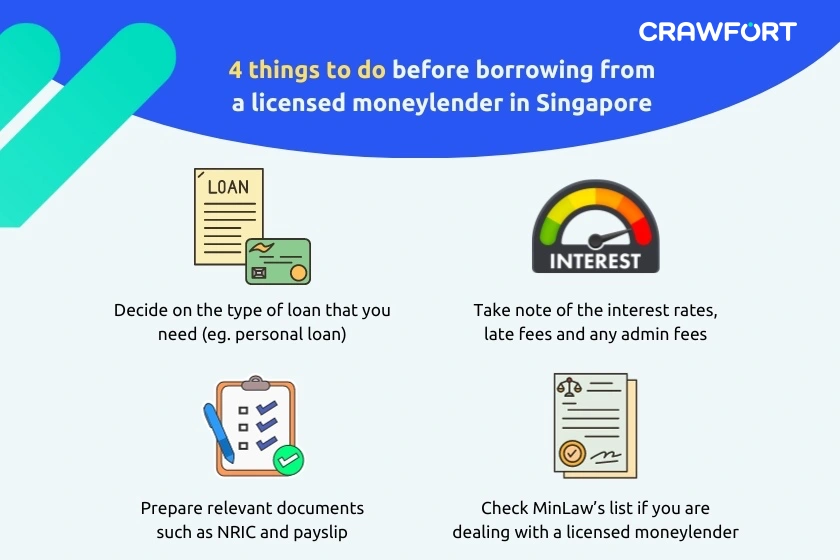
Table of Contents
- What Best Should Mean For A Borrower
- Step 1: Verify The Lender Through The Official Registry
- Step 2: Compare The Total Cost, Not One Headline Number
- Step 3: Test The Repayment Against Your Budget
- Step 4: Read The Contract And Check The 2026 Cooling-Off Rule
- Step 5: Reject Harmful Loan Structures And Sales Claims
- Step 6: Keep Records And Monitor The Account
- What To Do If Repayment Becomes Difficult
- Choose With A Written Comparison
- Frequently Asked Questions
What Best Should Mean For A Borrower
Licensing is the starting point, not a quality award. It confirms that the business appears on the Registry of Moneylenders and is permitted to conduct moneylending under Singapore law. It does not prove that a particular loan is affordable, that one lender is cheaper than another, or that every interaction will be trouble free.
A defensible meaning of best is the offer that passes all legal and identity checks, gives you the amount you actually need, states every cost clearly and produces a repayment schedule you can manage. That answer can differ between borrowers, because loan amount, tenure, income timing and existing obligations differ.
Use customer reviews only as a secondary signal. Recent, detailed reviews may reveal patterns in communication or account servicing, but star ratings are not a substitute for the official licence list, a written quotation or the loan contract. A review platform may also have commercial relationships that are not obvious from the rating alone.
Step 1: Verify The Lender Through The Official Registry
Start with the Ministry of Law’s official list of licensed moneylenders. Do not rely on a search advertisement, a map listing, a social media profile or an online directory as proof of licensing.
Match all of these details:
- The lender’s exact registered business name
- Its licence details
- Its approved place of business
- Its telephone number
- Its website address
The website and physical address matter because scammers can copy a legitimate lender’s name or branding. Type or open the website shown on the Registry rather than trusting a link sent by an unknown contact.
Licensed moneylenders cannot solicit loans through SMS, WhatsApp, phone calls or social media platforms. Their permitted advertising channels are business or consumer directories, their own websites, and advertisements at their approved business premises. An unsolicited message may come from an unlicensed operator, a scammer impersonating a licensed business, or a licensed lender breaching the advertising restrictions. None of these is a sound basis for sharing personal information.
An online form may begin an enquiry, but the loan cannot be completed entirely online. The lender must meet you at its approved place of business and verify your identity face to face before granting the loan. Do not meet at an unrelated location, and do not transfer money for GST, a processing fee or any other advance charge before disbursement.
The lender may verify your identity and supporting records, but it should not ask for your Singpass password, internet banking password or ATM card. It should also return your NRIC or other identification documents after checking them.
Step 2: Compare The Total Cost, Not One Headline Number

The phrase low interest tells you very little on its own. Compare offers using the same principal and the same tenure, then look at the cash you will receive, every instalment and the total amount repayable if you pay on time.
The Registry’s borrower guide on interest, fees and loan conduct sets the legal ceilings. A ceiling is not a standard price that every lender must charge. The figures below are current as of September 2026.
| Charge | Current Legal Ceiling | How To Read It |
|---|---|---|
| Interest | 4% per month | Calculated on the principal remaining after payments allocated to principal |
| Late Interest | 4% per month | Applies only to the amount that is overdue, not to instalments that are not yet due |
| Late Fee | S$60 for each month of late repayment | A maximum, not an automatic charge that must always be S$60 |
| Upfront Administrative Or Loan Approval Fee | 10% of the principal | May be deducted before the balance is disbursed |
| Legal Costs Ordered By The Court | As ordered by the court | Applies to a successful recovery claim |
Interest, late interest, the upfront administrative fee and late fees together cannot exceed an amount equal to the original principal. Legal costs ordered by the court sit outside those four categories.
The fee deduction changes how much cash reaches you. If a S$5,000 loan carries an 8% approval fee, the fee is S$400 and the initial cash disbursed would be S$4,600. You still need the full repayment schedule to understand the borrowing cost. A smaller monthly instalment can also result from a longer tenure and may produce a higher total repayment.
Ask each shortlisted lender for the same written details:
- Principal stated in the contract
- Upfront fee and cash to be disbursed
- Interest rate and calculation method
- Number, amount and due date of instalments
- Total repayment if every instalment is paid on time
- Late payment charges and when they apply
- Early settlement terms and any rebate or charge
- Order in which each payment is allocated to principal, interest, late interest and late fees
Also read: how to compare loan rates, fees and terms on the same basis, which is more useful than comparing one promotional figure from each lender.
Step 3: Test The Repayment Against Your Budget
The statutory borrowing limit is not a recommended amount and does not guarantee approval. For unsecured loans, it is the total maximum you may borrow at any one time across all licensed moneylenders.
| Annual Income | Singapore Citizens And Permanent Residents | Foreigners Residing In Singapore |
|---|---|---|
| Less Than S$10,000 | S$3,000 | S$500 |
| At Least S$10,000 But Less Than S$20,000 | S$3,000 | S$3,000 |
| At Least S$20,000 | Six Times Monthly Income | Six Times Monthly Income |
For a secured loan, the Registry guide states that a loan of any amount may be obtained. That does not remove the need for affordability checks or make approval automatic.
A responsible assessment should consider more than your annual income band. The Registry’s Professional Service Handbook points to income frequency, disposable income, existing financial commitments and creditworthiness as relevant factors. Prepare accurate payslips, income records and identity or residency documents instead of assuming one fixed checklist applies to every applicant.
Run your own stress test before applying. Deduct essential household expenses, existing debt payments and a reasonable buffer from your monthly income after CPF contributions and other deductions. Then test whether you could still make the instalment after a drop in overtime, a weaker month for commission income or an unexpected bill. If the answer depends on taking another loan, the amount or tenure is not workable.
Learn more: how much of your salary should go towards loan repayments, which helps you test due dates and instalments against your actual cash flow rather than the largest sum available.
Step 4: Read The Contract And Check The 2026 Cooling-Off Rule

Before signing, the lender must explain the loan terms in a language you understand and give you a complete copy of the Note of Contract. Do not sign a blank or incomplete document. Check that the principal, amount disbursed, fee, interest, instalments, due dates and total repayment match the written quotation.
Pay particular attention to any clause that allows a caveat over the sale proceeds of your property after default. The Registry warns that such a caveat can prevent a sale from proceeding until the lender is repaid, and it may consume a substantial part of the net proceeds. Obtain independent legal advice if you do not understand the effect of a clause that touches your property.
Also read: a loan contract checklist to work through before you sign. Photograph or retain the final signed pages and the repayment schedule.
Cooling-Off Protection From 15 September 2026
On 31 August 2026, the Ministry of Law announced a new rule that starts on 15 September 2026. The mandatory cooling-off period of three business days will cover unsecured loans from licensed moneylenders, except business loans. Saturdays, Sundays and Singapore public holidays do not count as business days.
If an eligible loan is cancelled within the period, no interest is charged. The lender may retain only a limited part of the loan approval fee:
- For a principal of S$5,000 or less: up to S$50, but never more than the approval fee actually charged
- For a principal above S$5,000: up to 3.5% of the principal, but never more than the approval fee actually charged
The repayment on cancellation consists of the principal disbursed after the upfront fee deduction, plus the permitted part of the fee retained by the lender. The total cannot exceed the loan principal. On a S$1,000 loan with a S$100 approval fee, for example, you would receive S$900 and repay up to S$950 if you cancelled within the window.
Do not assume the framework covers a loan taken before 15 September 2026 or a loan outside the stated categories. The announcement also does not establish one universal cancellation channel or a daily cut off time. Ask the lender to identify the expiry date, the time and the cancellation method in writing, then keep proof of submission and repayment.
Also read: what the new cooling-off rule changes for borrowers
Step 5: Reject Harmful Loan Structures And Sales Claims
The Registry lists Registrar’s Directions No. 1 of 2026 among the current rules that licensees must follow. Its subject matter, including re-loans, split loans and how repayments are allocated, adds useful detail to the usual licence and rate comparison.
Walk away and seek clarification, or report the matter, if a lender:
- Makes a false or misleading claim in order to push you into a payment or a further loan
- Describes due dates only as a week or a month, rather than giving you exact calendar dates
- Offers a very short loan that is repeatedly renewed while another administrative fee is charged and the debt does not reduce
- Uses a new loan or re-loan to clear an existing debt to the same lender, resetting fees instead of genuinely restructuring the account
- Splits one loan into several components without a clear economic or lawful purpose, exposing you to multiple late fees
- Does not explain in writing how payments will be allocated among principal, interest, late interest and late fees
These are not merely poor customer service signals. The Handbook names re-loans, split loans and very short loans as examples of disadvantageous arrangements that a lender should not steer a borrower into, and misleading representations made to induce payment can attract regulatory or legal consequences. A genuine restructuring should improve repayment feasibility rather than create another cycle of charges.
Also read: what borrowers should compare between a bank loan and a licensed moneylender loan
Step 6: Keep Records And Monitor The Account

Your checks should continue after disbursement. Confirm that the cash received matches the contract after the disclosed approval fee deduction. Obtain a receipt for every repayment and check the name, amount and date.
The Registry guide says borrowers should receive a statement of account for all loans at least once every January and July. Retain those statements, the receipts, the contract and any messages about an agreed change. If you settle early, request an itemised settlement figure, pay through a verified channel and obtain written confirmation that the account is closed.
Good servicing is a meaningful comparison point. Clear balances, accessible statements and a documented response to repayment difficulty are more useful than a promise of speed at the application stage.
What To Do If Repayment Becomes Difficult
Contact the lender before the next payment is missed. Explain the change in circumstances and ask for an itemised balance and any restructuring option in writing. Do not take another loan from the same lender merely to reset the old debt and incur another fee.
The old claim that debt collection in Singapore is unregulated is no longer correct. The Singapore Police Force states that the Debt Collection Act 2022 took effect on 1 December 2023. It introduced licensing and approval requirements, with exclusions and class licensing arrangements for specified businesses.
Debt recovery can include reasonable contact and legal action. It does not permit violence, vandalism, threatening conduct or harassment. If conduct appears criminal or you feel unsafe, make a police report. For unfair practices, contract issues or possible offences involving a licensed moneylender, keep the contract, receipts, screenshots and call records, then report the matter through the appropriate Registry or police route.
Also read: what to record and report if you face debt collector harassment
If the repayments are no longer manageable, consider speaking with Credit Counselling Singapore or an appropriate social service agency. Bankruptcy is a serious legal process, not an ordinary repayment strategy, so obtain professional advice rather than treating an unpaid balance as an automatic route to it.
Choose With A Written Comparison
Searching for the best lender is reasonable, but it does not mean accepting an unsupported ranking. For a borrower, the best licensed moneylender is the one that passes the official identity checks and offers the most suitable verified terms among the quotes you have compared.
Build a short written comparison before deciding. Record the principal, cash disbursed, approval fee, instalments, total repayment, late payment terms, early settlement position and cooling-off details. Then remove any offer that relies on pressure, an unsolicited approach, unclear documents or a repayment plan with no room for normal expenses.
Ready to compare a written offer instead of an advertisement? Get a personal loan approved in as fast as 8 minutes today, with a clear repayment schedule and terms set out in full before you sign.
Important note: This article is for general information only and does not consider your personal financial situation. Before taking a loan or agreeing to a restructuring plan, review the contract carefully and make sure the repayments are manageable.



