Alwin Goh

Two loans can advertise similar interest rates and still leave you with very different repayment costs. The difference may come from how interest is calculated, an upfront fee, a longer tenure or a penalty that applies when you repay early.
A useful comparison therefore needs more than the headline rate. Put each offer into the same format and examine what you will receive, what you must pay each month, the full amount repayable and the terms that apply if your plans change.
The main comparison points below show what each figure can reveal. Treat them as a connected set: no single number gives you the complete cost or tells you whether a repayment plan is manageable.
| Comparison Point | What To Check | Why It Matters |
|---|---|---|
| Advertised Rate | Whether it is flat, monthly rest, fixed or floating | The calculation method changes the cost |
| Effective Interest Rate | The EIR for offers of the same amount and tenure | It gives a more comparable view of borrowing cost |
| Fees And Charges | Upfront, processing, late and early repayment fees | Fees can raise the amount paid or reduce cash received |
| Tenure | Number and frequency of repayments | A longer tenure can lower instalments but increase total interest |
| Monthly Instalment | Amount due and payment date | The payment must fit your normal monthly budget |
| Total Repayment | Principal, interest and known compulsory charges | This shows the overall cash commitment |
| Contract Terms | Early repayment, late payment, variation and default clauses | These terms matter if your circumstances change |
Table of Contents
- Start With The Same Comparison Basis
- Compare How Interest Is Calculated
- Add Every Relevant Fee And Charge
- Test The Tenure And Monthly Instalment
- Compare The Total Repayment Amount
- Read The Terms That Apply When Plans Change
- Use A Seven-Point Loan Comparison Checklist
- Extra Checks For Licensed Moneylenders
- Frequently Asked Questions
- Compare The Full Loan Offer, Not Just The Advertisement
Start With The Same Comparison Basis
Before deciding which offer looks cheaper, make the inputs consistent. Compare the same loan amount over the same tenure and, where possible, the same repayment frequency. Otherwise, a lower instalment may simply reflect a longer repayment period.
This applies whether you are weighing up two banks, two licensed moneylenders or one of each. Our guide to the key differences between a bank loan and a licensed moneylender loan explains what each option typically offers, so you can compare them on equal footing.
Record the net amount you will actually receive as well. If an upfront fee is deducted before disbursement, the approved principal and the cash reaching your account are not the same. This can make an offer look more generous than it is.
A simple worksheet should have one column for each lender and separate rows for the principal, net disbursement, advertised rate, effective interest rate (EIR), fees, instalment, number of payments and total repayment. If a figure is missing, ask for it before signing.
Compare How Interest Is Calculated
An advertised rate cannot be interpreted properly without its calculation method. A flat rate generally applies interest to the original principal throughout the tenure. A monthly rest rate applies interest to the outstanding balance as it reduces. The same advertised percentage can therefore produce a different cost.
For a fairer comparison, look at the EIR alongside the advertised rate. MoneySense explains that the effective interest rate reflects how interest is calculated and the repayment schedule. It can be higher than the headline rate, particularly where a flat-rate calculation is used. You can also read our guide on what EIR is and how to compute it for worked examples.
EIR is useful, but it is not the only decision factor. Two offers with similar EIRs can have different instalments, exit charges or consequences for a missed payment. Use it to narrow the comparison, then read the full repayment terms.
Fixed And Floating Rates Need Different Stress Tests
A fixed rate provides more payment certainty for the stated fixed period. A floating rate can change according to the benchmark or pricing mechanism in the contract. For a floating-rate loan, compare the current repayment and ask what the instalment could become if the rate rises.
Do not treat the stress-tested figure as a prediction. Its purpose is to check whether your budget still works under a less favourable scenario.
Add Every Relevant Fee And Charge
List fees in Singapore dollars rather than leaving them as footnotes. Depending on the product, costs may include processing, administrative, legal, valuation, cancellation, late payment or early repayment charges. Some apply at the start, some only if an event occurs, and others may be bundled into the amount financed.
Check These Points First:
- Is an upfront fee deducted from the principal before disbursement?
- Is a fee compulsory, conditional or avoidable?
- Does the advertised EIR include the compulsory fee?
- What charge applies if a payment is late?
- Is there a penalty or notice requirement for early repayment?
Separate unavoidable charges from contingent charges. Add unavoidable charges to your base comparison. Then examine contingent charges as risks: you may never pay them, but you need to know the financial consequence if you do.
Test The Tenure And Monthly Instalment
A longer tenure usually spreads the principal across more payments. That may make the monthly instalment easier to handle, but it can also keep you in debt longer and increase the total interest paid. A shorter tenure often does the reverse, with higher monthly payments but a lower overall interest cost.
The right instalment is not merely the highest amount a lender offers. It must fit after housing, food, transport, insurance, existing debts and other essential commitments. Understanding how lenders assess how much you can borrow against your income is a helpful starting point, but your actual limit should reflect the stability of your income and the expenses you cannot defer.
Test the repayment against an ordinary month and a difficult month. Consider a temporary income reduction, an urgent household bill or a rate increase where relevant. If one disruption would make you miss a payment, the proposed instalment leaves too little room.
Learn more about your eligibility for a personal loan in Singapore here.
Compare The Total Repayment Amount
The total repayment amount is often the clearest final check. It should show the sum of all scheduled instalments and any compulsory amount payable under the loan. Compare it with both the approved principal and the net cash you receive.
For example, do not compare Loan A’s monthly instalment with Loan B’s interest rate. Compare both loans across four figures: net amount received, monthly instalment, number of instalments and total scheduled repayment. This exposes the trade-off between immediate cash flow and overall cost.
Ask for a repayment schedule when the documents do not show the breakdown. The schedule should let you see the due dates, payment amounts and, where available, how each payment is allocated between principal and interest.
Read The Terms That Apply When Plans Change
A loan may suit your budget today but become expensive if you repay early, pay late or need to change the schedule. Read the contract for lock-in periods, prepayment charges, late fees, late interest, payment allocation, variation clauses and default consequences.
Check whether partial repayment is allowed and whether it reduces the tenure, the instalment or both. If you expect a bonus or irregular income, this flexibility may matter more than a small difference in the headline rate.
Also check what happens if you face repayment difficulty. Contacting the lender early may leave more options than ignoring a due date. If you are already juggling several unsecured debts, taking another loan can worsen the problem, though a debt consolidation loan may help simplify repayments in some situations. Credit Counselling Singapore also provides counselling and facilitated debt repayment arrangements for suitable borrowers, subject to assessment.
Use A Seven-Point Loan Comparison Checklist
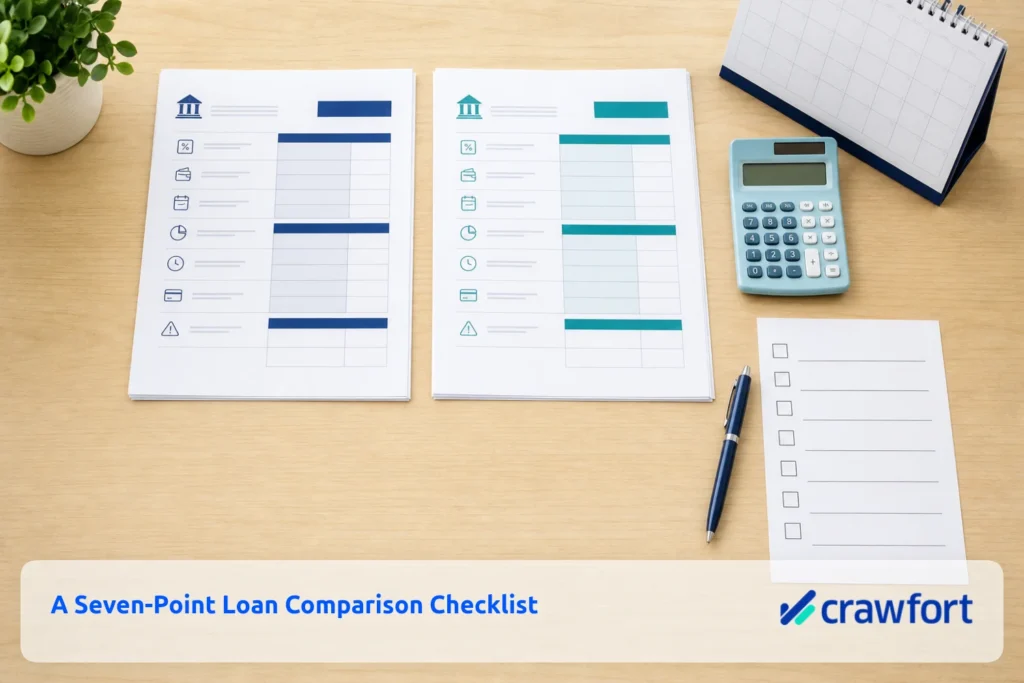
Work through the same seven checks for every offer. Do not remove an item simply because one lender does not display it prominently.
- Confirm The Net Loan Proceeds. Record the principal and the amount that reaches you after upfront deductions.
- Record Both Interest Rates. Note the advertised rate, its calculation method and the EIR.
- Total The Known Fees. Separate compulsory upfront costs from conditional charges.
- Check Every Instalment. Record the payment amount, frequency, first due date and final due date.
- Calculate The Total Repayment. Add all scheduled payments and compulsory charges.
- Test Repayment Flexibility. Review early repayment, partial payment and schedule-change terms.
- Read The Default Terms. Understand late charges, late interest and the lender’s contractual remedies.
If the numbers still feel tight after this exercise, pause rather than adjusting the spreadsheet to justify the loan. Our guide to avoiding overborrowing when cash is needed urgently explains how to narrow the amount to the actual shortfall.
Extra Checks For Licensed Moneylenders
A licensed moneylender is not a bank or a government scheme, but it operates under rules set by the Ministry of Law, unlike loan sharks, who do not. If you are considering one, verify its name, approved business address and website against the Ministry of Law’s current list of licensed moneylenders before sharing personal information.
The Registry of Moneylenders’ official borrowing guide advises borrowers to understand the repayment schedule, interest rate and applicable fees, and to shop around rather than rush into a contract. Read the completed Note of Contract, make sure the terms have been explained in a language you understand and retain your copy.
You may also want to understand how a licensed moneylender loan differs from other borrowing options. Do not rely on an advertisement or a private message as proof that a lender is licensed.
Compare The Full Loan Offer, Not Just The Advertisement
A sound loan comparison ends with two questions. What will this borrowing cost in total, and can you meet every payment without compromising essential expenses? The interest rate matters, but so do the cash you actually receive, the fees, the repayment period and the terms that apply when circumstances change.
If you decide to proceed, keep the offer, repayment schedule and signed contract. Review the figures one final time against your budget before accepting the loan.
Ready to put your comparison into action? Apply for a loan with Crawfort and get a clear repayment schedule, transparent terms and approval in as fast as 8 minutes, so you know exactly what you’re committing to before you sign.
Important note: This article is for general information only and does not consider your personal financial situation. Before taking a loan, review the loan contract carefully and make sure repayments are manageable.