

 Alwin Goh
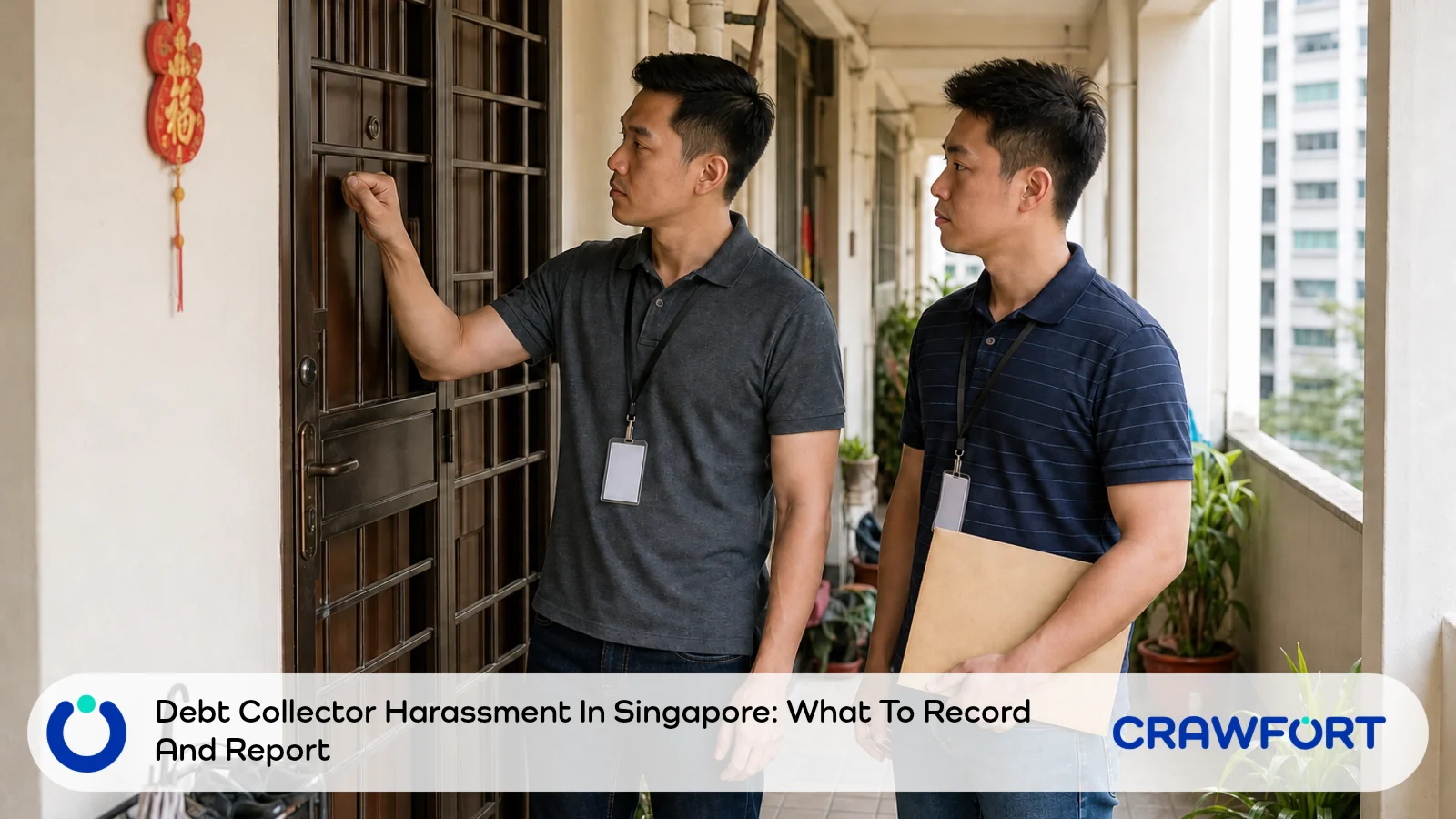
A debt collector may ask you to repay a genuine debt. That does not give the collector permission to threaten you, damage property, stalk you or use conduct that may break the law. If an incident is happening now and you fear for your safety, call 999. Use SMS 70999 if it is unsafe to speak or you cannot make a voice call.
For a non-emergency, your first job is to preserve a clear account of what happened. A useful report identifies the collector, connects each incident to a date and time, and supports the account with original messages, call records, photographs, CCTV footage or witness details where available. You do not need to decide which offence may have occurred before reporting the facts.
The practical distinction is between the debt and the collection conduct. A complaint about harassment does not automatically cancel a debt, and a genuine debt does not excuse unlawful behaviour.
The table below separates the main situations from the sensible first response. It can help you act without treating every collection attempt as a crime or dismissing serious conduct as normal pressure.
| Situation | First Response | Evidence To Preserve |
|---|---|---|
| Immediate danger, violence or damage in progress | Move to safety and call 999; use SMS 70999 if it is unsafe to speak | Location, description, photographs or video if safely available |
| Threatening words, conduct or messages | Do not argue; preserve the exact communication and make a police report | Original message, audio, call log, number, date and time |
| Repeated visits or contact that causes alarm or distress | Build a chronology and keep each incident as a separate entry | Visit log, CCTV, messages, witnesses and prior requests to stop |
| A home or workplace visit without threats | Verify the collector and creditor; keep a factual record | Name, agency, approval details, letter and purpose of visit |
| Wrong person or disputed debt | State the dispute in writing and ask for supporting account details | Written dispute, creditor response and identity or account mismatch |
Table of Contents
- Is Debt Collection Contact The Same As Harassment?
- What Debt Collection Conduct Should You Record?
- What Should You Do During An Incident?
- Which Evidence Should You Keep?
- How Should You Make A Police Report?
- Where Else Can You Report The Conduct?
- How Should You Handle The Debt Separately?
- What To Do Next
- Frequently Asked Questions
Is Debt Collection Contact The Same As Harassment?
No. Contact about repayment, a written demand or a visit is not automatically harassment. The Ministry of Law explains that a licensed moneylender may take reasonable steps to recover a debt, and that approaching a borrower at home or at work does not necessarily constitute an offence. It also states that vandalism, violence and threatening words or behaviour may infringe criminal law, depending on the facts. Its guidance says you should lodge a police report where harassment, threats or violence are involved.
This is why your record should describe conduct rather than rely only on labels. “The collector harassed me” gives little detail. “At 8.20 pm, the collector sent three messages saying he would damage my door unless I paid by midnight” tells the receiving officer or investigator what was said, when it happened and what evidence exists.
A collector asking for payment can still be acting on a disputed or mistaken account. Conversely, proving that you owe the money does not settle whether the collector’s methods were lawful. Keep those two questions separate throughout your records and complaints.
If you are unsure what a licensed moneylender and its collectors are permitted to do in the first place, this complete guide to licensed moneylender FAQs covers borrowing limits, permitted fees, repayment records, debt collection and borrower rights in one place.
What Debt Collection Conduct Should You Record?
Record any conduct that creates a safety concern, appears threatening, targets third parties or forms a repeated pattern. Do not wait until you are certain it meets a legal definition.
Conduct Worth Documenting Includes
- Threats of violence, threatening gestures or messages that make you fear unlawful violence
- Property damage, obstruction, forced entry attempts or items left at your premises
- Repeated calls, messages, following or visits after the collector knows the message has been received
- Attempts to shame you publicly or reveal debt details to neighbours, colleagues, relatives or customers
- Abuse, intimidation or conduct directed at your family members, employer or other third parties
- False claims of being a police officer, court officer or other public authority
- Refusal to identify the agency, creditor or account while continuing to demand payment
Context matters. A single firm request for payment is different from a threat. Several calls may reflect ordinary follow-up or, depending on their timing, content and persistence, support a wider account of harassment. Record the facts and let the relevant authority assess them.
Under the current Debt Collection (General) Regulations 2023, a debt collector deployed by a licensed collection business must produce the approval letter or an electronic copy when required by the debtor, and the regulations prohibit specified debt collection activities. The licensing framework has exemptions and class-licence arrangements, so do not assume that the absence of one document proves the entire claim is fraudulent. Start by checking how to verify a licensed debt collection agency.
Learn more about what happens if you ignore a debt collector in Singapore.
What Should You Do During An Incident?
Step 1: Put Safety Before Evidence
Move away from the collector if you feel unsafe. Go inside a secure place, alert building security or ask a trusted person to stay with you. Do not prolong a confrontation merely to obtain a better recording.
Step 2: Keep The Exchange Short And Factual
Ask for the collector’s name, agency, contact details, creditor and account reference. If it is safe, state that you want future communication in writing. Do not hand over cash, disclose passwords or give Singpass credentials during an unexpected encounter.
Step 3: Avoid Escalating The Situation
Do not threaten, touch or block the collector. You can decline to debate the debt at your doorstep or workplace. If the person refuses to leave private premises, or the situation becomes threatening, seek police assistance instead of trying to remove the person yourself.
Step 4: Preserve What Already Exists
Save messages before blocking or muting a number. Export chats where possible, retain the original email, and download relevant CCTV promptly before the system overwrites it. Photograph damage only when it is safe to do so.
Step 5: Write The First Note Immediately
Record the date, start and end time, place, words used, actions taken, people present and how the incident ended. Separate what you personally saw or heard from what another person later told you.
For a fuller explanation of visits, access and workplace contact, see whether a debt collector can visit your home or workplace.
Also read: can debt collectors seize your belongings in Singapore.
Which Evidence Should You Keep?
Strong evidence is organised, dated and preserved in its original form. The Singapore Courts’ guidance on evidence for protection from harassment cases lists items such as emails, websites, photographs, CCTV footage, police reports and medical reports. What matters in your case will depend on the conduct alleged.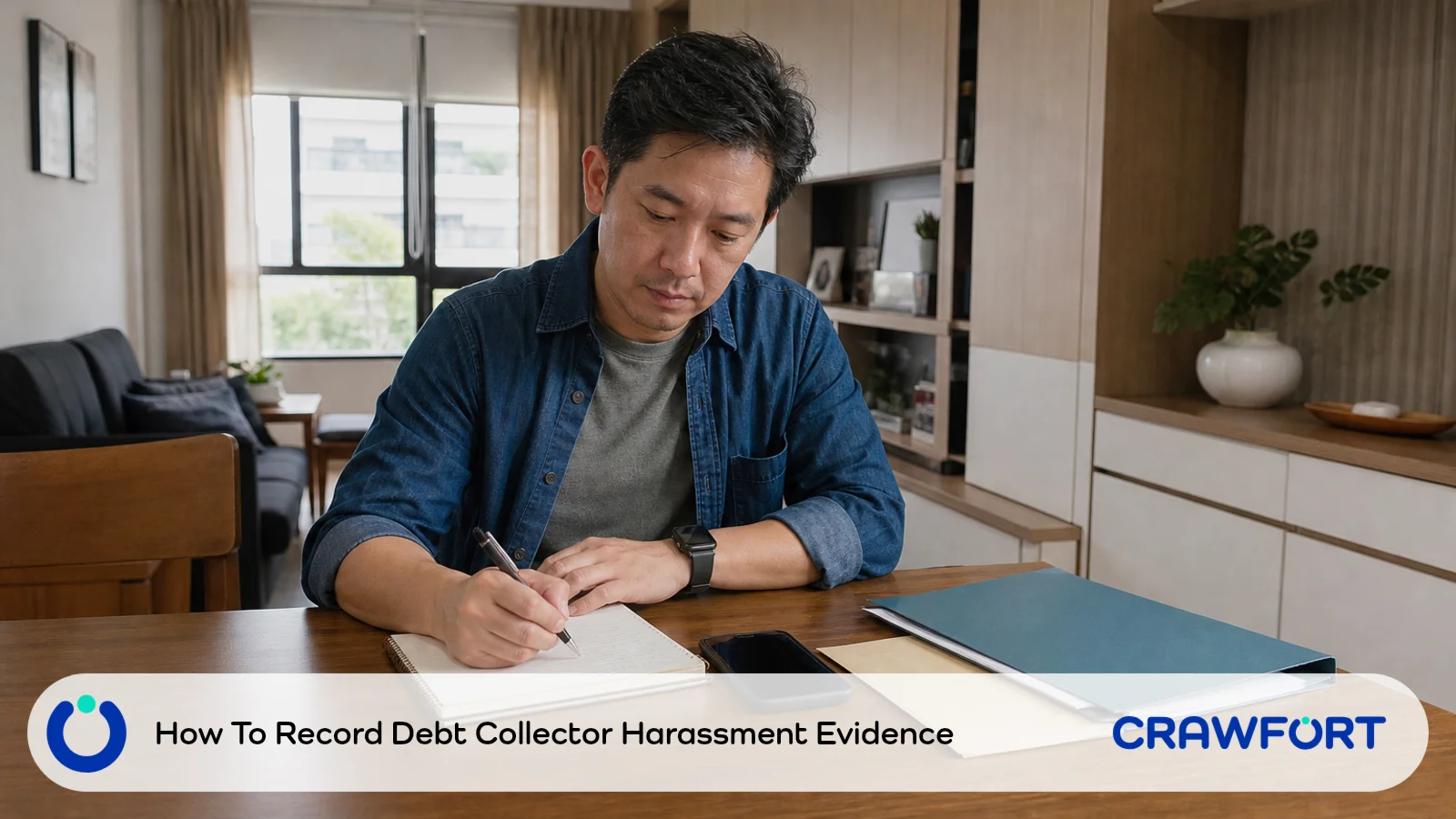
Collector And Debt Details
Keep the person’s name, agency, phone number, email address, vehicle number if relevant, approval details shown, the name of the creditor, and the account or reference quoted. Retain the original demand letter and its envelope.
A Chronology Of Separate Incidents
Use one entry per call, message or visit. A filename such as 2026-08-19_2020hrs_whatsapp-threat.png is easier to follow than a folder of files named “screenshot”. Keep full NRIC numbers and unmasked account information out of filenames.
For each entry, record:
- Date, time and location
- People present
- Exact words or conduct, as closely as you can recall
- Evidence filename
- Witness name and contact details, with their permission
- Action taken, and any police or complaint reference
Original Communications
Keep full message threads, call logs, voicemails, emails and letters. A cropped screenshot can omit the sender, date or surrounding context, so retain the original and create a separate marked-up copy if you need to highlight a sentence.
Visit, Damage And Impact Evidence
Preserve doorbell footage, CCTV, photographs and repair records. If anyone was injured or sought medical attention, retain the relevant medical documents. Ask a witness to write an independent note while the event is fresh, rather than agreeing on one combined version.
Account And Payment Records
Keep the contract, statements, payment receipts, settlement correspondence and written disputes. Crawfort’s guide to loan repayment records and proof of closure explains how to connect the contract, the payments and the running balance. These documents help identify whether the claimed debt, the amount and the collector match your account, even though they do not by themselves decide whether the conduct was lawful.
Back up the folder in a protected location. Do not edit original audio, video or message files. If you create a shorter clip for easy review, keep the complete original as well.
How Should You Make A Police Report?
Use the reporting channel that matches the urgency. The Singapore Police Force online police report service is for crimes that do not require immediate police action, and it allows you to attach supporting documents. For an emergency, call 999. SMS 70999 is for emergency assistance when it is not safe to call or you cannot speak.
Start the report with the latest or most serious incident, then provide the chronology. Include:
- Who contacted or approached you
- Which agency and creditor they claimed to represent
- What was said or done, using exact words where possible
- When and where it happened
- Why you felt threatened, alarmed or unsafe
- Whether anyone else witnessed it
- Which files support each part of the account
- Whether the conduct is continuing or likely to recur
State uncertainty honestly. Write “the caller said he was from Agency X, but I have not verified this” instead of presenting an assumption as fact. If you do not know the collector’s identity, provide the number, profile, physical description, vehicle details or any other identifiers you have.
You do not need a complete evidence bundle before seeking urgent help. Submit what is available, keep the report number, and follow the instructions on providing additional material. Preserve any new contact after the report as another dated entry.
Where Else Can You Report The Conduct?
A police report is not always the only step, and it is not a substitute for raising the matter with the creditor or the regulator. The table below shows which route usually fits which problem.
| Where To Report | Best Suited For | What To Provide |
|---|---|---|
| Singapore Police Force | Threats, violence, damage, impersonation or conduct causing alarm | Chronology, original messages, call logs, CCTV and witness details |
| Collection agency and original creditor | Collector conduct, wrong person, disputed amount or unwanted contact | Written complaint, account reference, dates and the specific conduct |
| Registry of Moneylenders | Conduct by a licensed moneylender or its appointed collectors | Loan contract, receipts, statements, advertisements and messages |
| Protection from Harassment Court | Civil remedies such as a protection order or damages | Evidence prepared and filed as required by the Singapore Courts |
The Collection Agency And Original Creditor
Send a written complaint to both. Identify the collector, the date, the account reference and the conduct, attach only the necessary evidence, and request an acknowledgement plus a case number. Ask the creditor to confirm whether the agency was instructed to act, and where future communications should be sent.
The Registry Of Moneylenders
If the debt is from a licensed moneylender, you may also complain to the Registry of Moneylenders with relevant documentary evidence. The Ministry of Law’s moneylender complaint guidance says that harassment during debt collection should be reported to the Police in addition to informing the Registry. Crawfort’s guide on reporting a licensed moneylender can help you separate a conduct complaint from a contract or account dispute.
The Protection From Harassment Court
A police report concerns possible criminal conduct; it is not the same as applying for civil relief. Depending on the facts, a person affected by harassment may consider a protection order, damages or another civil remedy under the Protection from Harassment Act 2014. Court procedures and evidence requirements matter, so use the Singapore Courts’ current guidance and seek independent legal advice where the conduct is serious or continuing.
How Should You Handle The Debt Separately?
Continue dealing with the account through a verified, written channel. Ask the creditor for an itemised balance, the contract details, and the authority under which the agency is collecting. If the debt is not yours, say so clearly and request a correction. If the amount is disputed, identify the exact entry and attach the record that contradicts it.
Do not assume that a complaint pauses interest, fees, proceedings or contractual deadlines. Ask the creditor in writing what remains due while the complaint is reviewed. A collector’s misconduct does not prove that the balance is wrong, and a correct balance does not legitimise misconduct.
If the debt is genuine but several repayments have become difficult to manage, compare restructuring, counselling and consolidation routes separately from the complaint. You may review Crawfort’s debt consolidation loan option as one commercial possibility, but approval and suitability depend on assessment. Taking another loan may increase total borrowing costs and will not resolve a harassment report.
Discover also: how long a creditor can pursue a debt in Singapore and what to do after receiving a letter of demand.
What To Do Next
Use a simple sequence: secure your immediate safety, preserve the original evidence, write a dated chronology, and report through the route that fits the conduct. Keep the complaint file separate from the account file, so that a dispute about collection methods does not obscure the balance, the payments or the contractual deadlines.
Harassment and affordability are two different problems, and they need two different responses. Reporting the conduct protects you; a realistic repayment plan protects your budget. If the underlying repayments are the part you cannot manage, look at the numbers before the next due date rather than after it.
Need a clearer view of your repayments? Crawfort is a licensed moneylender in Singapore with transparent terms and repayment schedules you can check before you commit. See how a licensed moneylender loan works and review the total repayment against your monthly budget before applying.
Important note: This article provides general information, not legal or financial advice. Whether conduct amounts to an offence or supports a civil claim depends on the facts. If you face immediate danger, contact the Police. For advice on your rights, deadlines or court options, consult a qualified lawyer.



