

 Alwin Goh
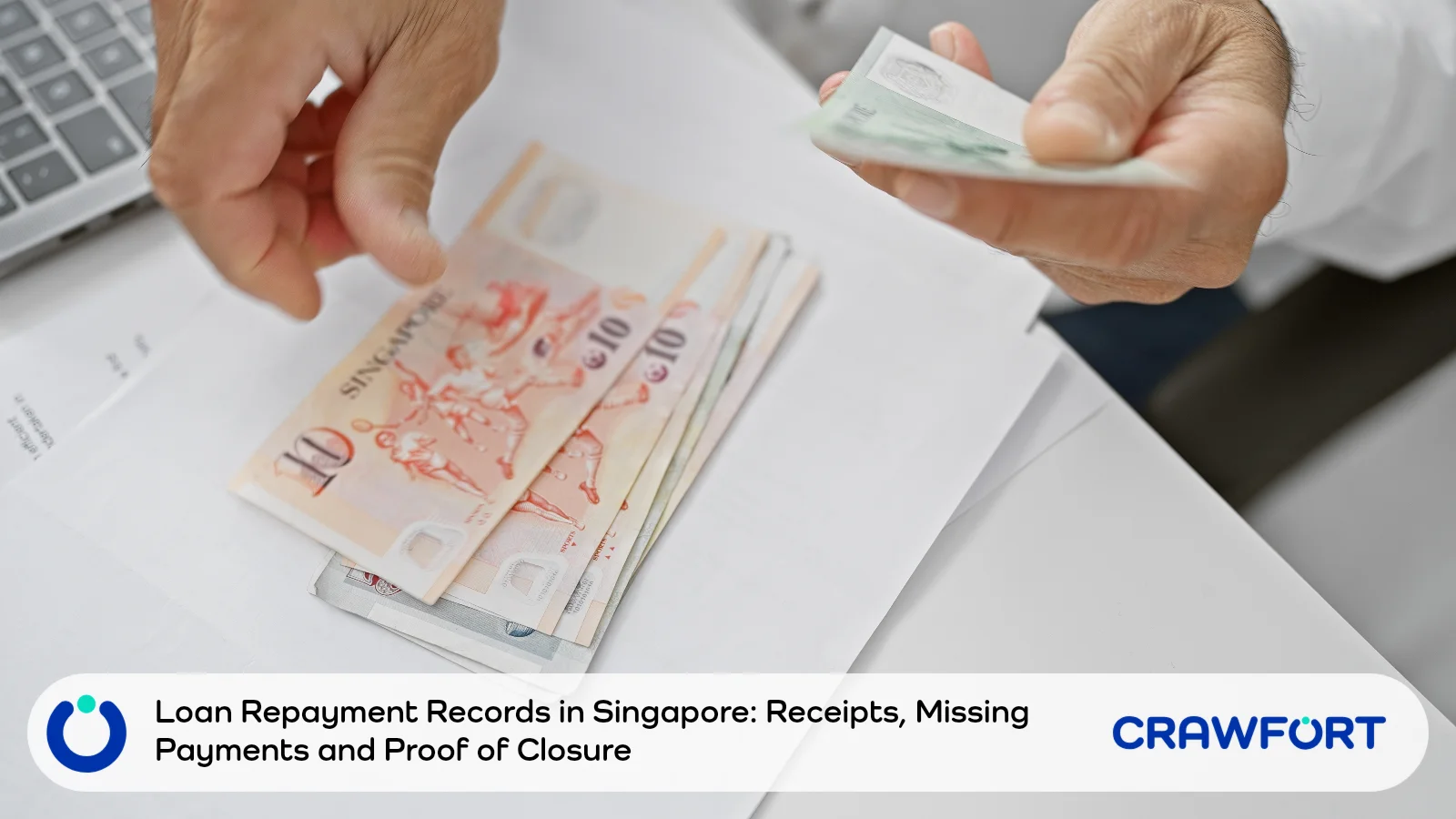
A payment leaving your bank account does not, by itself, prove that your lender credited it to the correct loan. You need a simple chain of evidence: what you agreed to repay, what you paid, how the lender recorded it and what remained afterwards.
Good records can help you challenge a missing payment, understand an unexpected charge and show that a loan has been fully settled. The method below is a practical baseline for bank, finance-company and licensed moneylender loans, but your contract and lender-specific procedures still apply.
The main records and checks are summarised here. Treat the table as a filing plan rather than a substitute for reviewing your actual loan documents.
| Record Or Check | What To Keep Or Confirm | Why It Matters |
|---|---|---|
| Contract Pack | Signed agreement, repayment schedule, fee terms and later variations | Establishes what was agreed |
| Payment Evidence | Lender receipt plus bank or payment-channel record | Connects money sent with money received |
| Account History | Itemised statements and corrected versions | Shows how payments and charges were posted |
| Communications | Emails, messages, call notes and case references | Preserves the lender’s explanations and commitments |
| Closure Pack | Final settlement quote, last payment proof and written closure confirmation | Shows that no balance remains |
Table of Contents
- Which Loan Records Should You Keep?
- How To Organise Your Loan Records
- What Should An Itemised Statement Show?
- How To Report A Missing Or Wrongly Recorded Payment
- Evidence Log Template
- How To Confirm Full Loan Closure
- How Long Should You Keep Loan Records?
- Close The File Only When The Evidence Agrees
- Frequently Asked Questions
Which Loan Records Should You Keep?
Build the file from the start of the loan, not only when something goes wrong. If you already have an active loan, download what is available now before older statements disappear from an app or portal.
Contract And Repayment Documents
Keep the complete signed agreement, not just the signature page. Save the repayment schedule, product terms, fee schedule, disbursement advice and any security or guarantee documents. Add every later variation, such as a revised repayment plan, deferment, restructuring arrangement, fee waiver or early-settlement quote.
The agreement is the reference point for due dates, payment allocation and charges. Compare it with your full loan contract checklist rather than relying on one clause in isolation.
For a licensed moneylender loan, retain the completed Note of Contract and repayment schedule. Our licensed moneylender borrower guidance explains that borrowers should receive a receipt for every repayment, check each receipt and statement for correctness, and retain statements and receipts as evidence.
Statements And Transaction Histories
Download each periodic statement and any full transaction history the lender provides. Do not replace an earlier statement with a corrected one. Keep both versions, label the correction date and note what changed.
For licensed moneylender loans, the official Note of Contract form states that, while a loan is subsisting, the half-yearly statement should show the charges imposed, the payments made and the amount outstanding. Other lenders may use different statement cycles and formats.
Learn more about which parts of a licensed moneylender loan can be completed online.
Receipts And Independent Payment Proof
Keep evidence from both sides of each transaction:
- The lender’s receipt or payment acknowledgement
- Your bank statement, FAST or GIRO record, PayNow confirmation, cheque image or cash receipt
- The transaction reference, payment date, value date, amount and destination account
- Any reversal, rejection or refund notice
Preserve the original files where possible. If you paid in cash, obtain the receipt before leaving and check the account name, amount and date immediately.
Messages And Call Notes
Save emails, letters, secure-app messages and relevant chats. After an important call, record the date, time, staff member, case reference and agreed next action. Ask for material instructions in writing, especially those concerning changed due dates, disputed charges, settlement or closure.
How To Organise Your Loan Records
Use one folder per loan and include the lender name plus a masked account identifier. Separate it into:
- Contract And Variations
- Statements
- Payments And Receipts
- Communications
- Disputes
- Closure
Name your files in date order, for example
2026-07-15_payment_S$350_ref1234.pdf. Keep full NRIC numbers, passwords and unmasked bank details out of filenames, and store a protected backup.
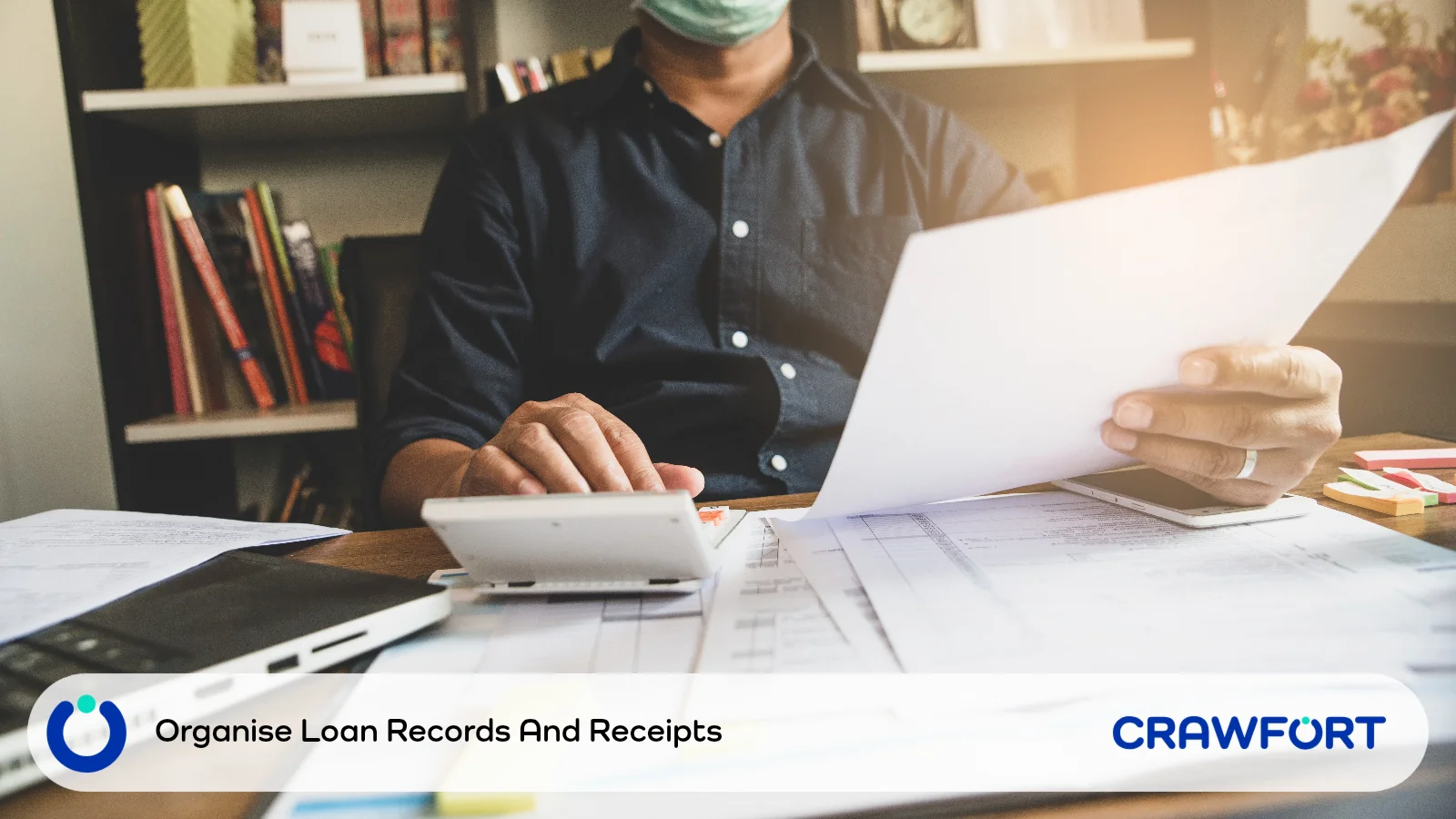
Maintain a repayment tracker beside the documents. Record the contractual due date, the payment date, the amount, the reference and the date credited. This makes it easier to spot a gap and supports a practical repayment plan around your monthly salary.
What Should An Itemised Statement Show?
An itemised statement should let you start with one balance, follow every payment and charge, and arrive at the next balance without guessing. There is no single layout used by every lender, so focus on whether the entries can be reconciled.
Reconcile Each Entry
Check For:
- Lender name, borrower name and masked loan account number
- Statement period and opening balance
- Each transaction date, posting or value date, description, amount and reference
- Each repayment and, where applicable, how it was allocated to principal, interest and fees
- Interest, late interest, fees, waivers, reversals and adjustments as separate entries
- Closing principal and total outstanding balance
- Next instalment amount and due date, if the loan remains active
- Contact or dispute instructions
If a statement combines several amounts into one unexplained line, ask for a breakdown. Allocation matters because two statements can acknowledge the same payment but show different outstanding balances. The distinction is particularly relevant when checking
how licensed moneylender repayments are applied.
How To Report A Missing Or Wrongly Recorded Payment
Act promptly, but first make sure the discrepancy is real. A transfer may be pending, rejected, reversed or posted under a different date.
Step 1: Freeze The Evidence
Download the current loan statement and the payment proof. Save the original message or receipt, not only a cropped screenshot. Record when you discovered the problem. Do not alter the source files; create marked-up copies separately if you need to highlight an entry.
Step 2: Reconcile The Transaction
Match the amount, destination, reference, loan account and payment date. Check whether the transfer completed or was later reversed. Compare the lender’s transaction and value dates, and confirm that the payment was not credited elsewhere.
Step 3: Request A Fresh Itemised Statement
Ask for a statement covering the payment date through to the present. Identify the missing or incorrect entry. If the balance is wrong, show your expected figure and calculation, labelled as your own reconciliation.
Step 4: Send A Written Discrepancy Notice
Use the lender’s official complaint or servicing channel. Include only the personal information needed to locate the account, and redact unrelated transactions from the supporting documents.
You can adapt this wording:
I am reporting a repayment discrepancy for loan account [masked account number]. I paid S$[amount] on [date] through [channel], transaction reference [reference]. The attached payment evidence shows [status]. The payment is missing, or recorded as [incorrect entry], on the statement dated [date]. Please acknowledge this report, provide a case reference, investigate the transaction and send me a corrected itemised statement or a written explanation of the outcome. Please also confirm how any related interest or fees will be treated.
Step 5: Protect The Next Due Date
A dispute does not automatically pause the contract. Ask the lender in writing what to do about the next instalment and any disputed late charge. Do not assume that silence, a pending investigation or a complaint cancels your payment obligations. If the lender asks you to pay the same amount again, request written confirmation of how a duplicate will be credited or refunded.
Learn more about what to do when multiple loan repayments are draining your salary.
Step 6: Track The Case To A Verifiable Outcome
Log every contact and promised response date. When the lender replies, do not close your record merely because it says the matter is resolved. Obtain the corrected statement, check the payment date and allocation, recalculate the balance and confirm that the related fees or interest have been reversed where the lender agreed to do so.
Step 7: Escalate Through The Correct Route
For a dispute with a financial institution subscribed to FIDReC, complain to the institution first. If it does not resolve the matter satisfactorily, the FIDReC complaint guidance says an eligible claim must be filed within six months of the institution’s final reply.
For a licensed moneylender, you may report the matter to the Registry of Moneylenders with documentary evidence. Reporting to the Registry does not replace urgent police assistance where threats, harassment or violence are involved.
If the lender’s wrong entry is inaccurate personal data, you may also ask the organisation to correct it. The PDPC explains the right to request correction of personal data, subject to the PDPA’s exceptions. Use this as a defined correction request, not as a substitute for pursuing the payment or contractual dispute through the appropriate lender channel.
After a correction, check any downstream record that may have been affected. If the discrepancy involved reported arrears, review your credit information and follow the relevant dispute process. A guide to checking your credit score and report can help you identify where to start.
Learn more about how to get a free Credit Bureau report in Singapore.
Evidence Log Template
Copy this table into a spreadsheet or document. Use one row for each payment, call, message, document received or promised follow-up.
| Field | Record |
|---|---|
| Date And Time | [DD/MM/YYYY, HH:MM] |
| Event Or Action | [Payment made / discrepancy reported / reply received] |
| Amount | S$[amount] |
| Channel And Reference | [FAST / GIRO / email] — [reference] |
| Evidence Filename | [filename] |
| Contact Or Case ID | [name or case ID] |
| Response Or Next Deadline | [date and expected action] |
| Status | [Open / corrected / escalated / closed] |
Keep your notes factual. Write “no reply received by [date]” instead of guessing why nobody responded. If a call changes the agreed next step, send a short written recap and add it to the log.
How To Confirm Full Loan Closure
The last scheduled instalment is not always the final amount required. An adjustment or a pending payment can change the figure, so confirm closure separately.
Step 1: Obtain A Final Settlement Figure
Before paying, ask for an itemised settlement quote showing the amount, the calculation date, the payment instructions and how long the quote remains valid. Check whether it includes all principal, interest and fees, plus any rebate, waiver or refund.
Step 2: Pay Through A Traceable Channel
Follow the verified instructions, reference the correct loan account, save the transaction evidence and obtain a receipt. Verify any sudden change of payment account through the lender’s official contact channel.
Step 3: Request A Final Statement And Closure Confirmation
Once the payment has posted, request both the final itemised statement and written confirmation that the account is closed. A zero-balance statement proves the arithmetic at a point in time. A closure confirmation should also state the account’s status.
A Strong Closure Pack Should Show:
- Lender and borrower names with a masked account number
- Final payment amount and date credited
- Principal, interest, fees and a total outstanding balance of zero
- Any refund, credit or pending adjustment
- Effective closure or settlement date
- A clear statement that no further amount is due under the loan
- Status of any GIRO instruction, security, collateral or surety, where relevant
- Any further administrative step, including an applicable credit-record update
There is no universal phrase or certificate used for every loan. If the document says only “paid” or shows a zero without identifying the account and date, ask for a clearer confirmation.
Step 4: Check For Residual Activity
Before cancelling a standing instruction, confirm that the final payment has cleared and that nothing remains due. Watch for another deduction, refund or collection message. Save the closed-status screen, but do not rely on portal access remaining available.
How Long Should You Keep Loan Records?
There is no single retention period that fits every borrower, loan and purpose. Do not discard records merely because the app marks the account closed.
Keep the full working file throughout the loan. After closure, retain the core contract, statements, receipts, dispute correspondence and closure pack while any deduction, refund, complaint, correction or credit-record update remains unresolved. Before deleting anything later, consider:
- Retention or dispute terms in the contract
- How long your bank and lender make statements available
- Any active complaint, FIDReC deadline or court matter
- Tax, business, insolvency, estate or audit requirements that apply to you
- Advice from a qualified professional where the sum or dispute is material
The PDPA’s retention limitation governs organisations; it is not a universal timetable telling borrowers when to destroy loan evidence. Export what you may need instead of assuming the lender will store it for you.
Close The File Only When The Evidence Agrees
A reliable repayment file tells one consistent story across the contract, your payment proof, the lender’s receipt and the running balance. If one part does not match, document the gap and pursue a corrected statement. When the last payment is made, treat the zero balance and the account closure as facts to verify in writing, not as assumptions.
If your records show that a loan has been settled and you are planning your next step, borrow only on terms you can evidence and repay. You can review the repayment schedules, instalment amounts and total repayment figures on the Crawfort personal loan page before you apply, so the paperwork is clear from the first payment onwards.
Important note: This article is for general information only and does not consider your personal financial situation. Loan terms and dispute routes differ. Review your contract and seek appropriate professional advice if a dispute is material or may affect your legal rights.



