Alwin Goh

Payday should give you room to cover the month ahead. If most of your salary disappears into credit cards, personal loans and other instalments within days, the problem is no longer just awkward cash flow — it is an affordability problem that will keep repeating.
What you need is a recovery plan that protects essential expenses, stops the debt from growing and directs every spare dollar towards the right balance. Depending on your numbers, that may mean repaying the debts yourself, restructuring them with your creditors, consolidating suitable balances or seeking independent debt counselling.
The stages below show what to focus on and when to consider outside help. Treat them as a decision sequence rather than a list of isolated budgeting tips, and work through your own figures before applying for another loan.
| Recovery Stage | What To Do | Desired Outcome |
|---|---|---|
| Stabilise | Protect essential bills and stop new borrowing | Prevent the shortfall from worsening |
| Diagnose | Record every balance, rate, instalment and due date | See the full repayment burden |
| Prioritise | Keep all required payments current and target one debt | Reduce interest or remove a repayment |
| Restructure | Ask creditors about revised repayment arrangements | Bring instalments within your budget |
| Consolidate | Compare the new total cost with your existing debts | Replace several suitable debts with one manageable payment |
| Escalate | Approach a debt counsellor if minimum payments remain unaffordable | Work towards a formal, sustainable repayment arrangement |
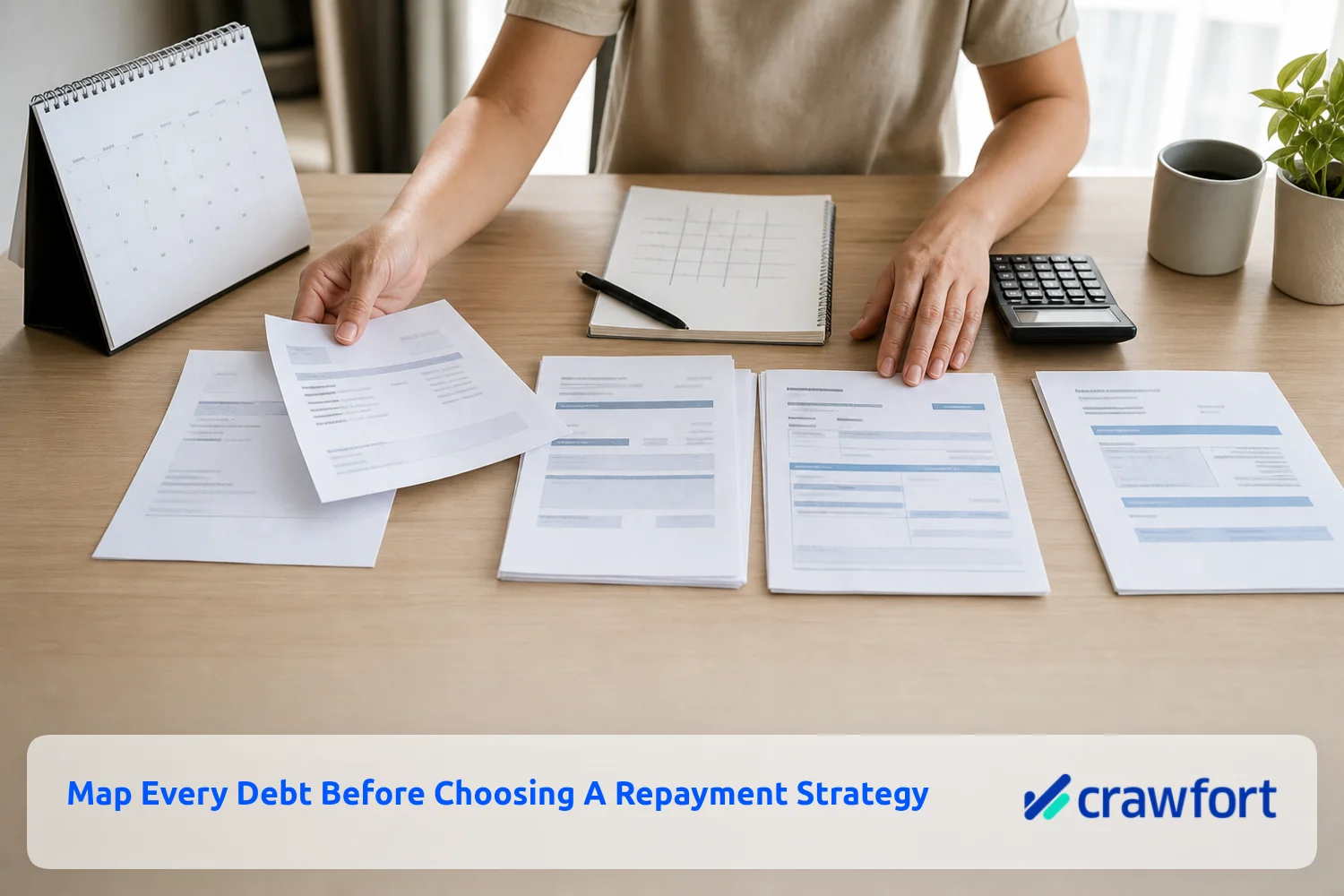
Table Of Contents
- Step 1: Protect Essential Expenses First
- Step 2: Build A Complete Debt List
- Step 3: Measure The Real Salary Shortfall
- Step 4: Stop The Debt From Growing
- Step 5: Choose Which Debt To Target First
- Step 6: Contact Creditors Before Missing Payments
- Step 7: Decide Whether Consolidation Fits
- Step 8: Get Independent Help When Repayments Do Not Fit
- Step 9: Build A Repayment System Around Payday
- Your Next Move Depends On The Shortfall
- Frequently Asked Questions
Step 1: Protect Essential Expenses First
Do not start by sending every available dollar to your loans. Set aside enough for the expenses that keep your household running:
- Housing
- Basic food
- Utilities
- Transport to work
- Insurance premiums you have decided to maintain
- Essential healthcare
- Necessary childcare or family support
This is not permission to ignore your repayments. It prevents an aggressive debt payment from leaving you unable to buy groceries or travel to work, which would only force you to borrow again before the month ends.
If you cannot cover both essential expenses and the contractual minimum repayments, that is an affordability problem. Cutting discretionary spending may help, but it will not solve a large structural shortfall. Contact your creditors and seek help early rather than quietly rolling balances from one facility to another.
A more detailed approach to sequencing urgent expenses is available in Crawfort’s guide to prioritising bills without falling further into debt.
Learn when to use your emergency fund instead of a personal loan here.
Step 2: Build A Complete Debt List
Gather the latest statement or contract for every credit facility. Do not rely on memory or on the instalment amount shown in your banking app.
Create a list with these fields:
- Creditor
- Outstanding balance
- Interest rate or effective interest rate
- Monthly instalment or minimum payment
- Payment due date
- Remaining tenure
- Late fees
- Early repayment charges
- Whether the rate is fixed or revolving
- Whether the debt is secured, unsecured or jointly held
Include instalment plans and buy-now-pay-later commitments if they reduce your usable salary. Small payments are easy to overlook, but five S$100 instalments still remove S$500 from your monthly cash flow.
Separate the monthly instalment from the total amount still repayable. A low instalment can disguise a long tenure and a high overall cost. If you later compare refinancing or consolidation, the outstanding balance, settlement cost and total future repayment will matter far more than the advertised monthly figure.
Step 3: Measure The Real Salary Shortfall
Use take-home pay rather than gross salary. CPF contributions and other deductions are not available for monthly spending.
Take-home pay − essential expenses − required debt payments = monthly balance
Suppose your take-home pay is S$4,200. Essential expenses total S$2,550, while four loan and card payments require S$1,500. That leaves S$150 for irregular expenses, emergencies and everything else.
Technically, the payments fit. In practice, one medical bill or household repair could push you straight back into credit. Your plan therefore needs both faster repayment and a small cash buffer.
If the result is already negative, do not build your recovery on an optimistic month. A S$400 recurring shortfall cannot be repaired by cancelling a S$15 subscription. You need a larger expense reduction, more reliable income, revised creditor terms or a structured debt solution.
You can also compare your figures against a broader framework for assessing how much of your salary is going towards loan repayments. Treat any percentage as a warning signal rather than a universal affordability rule, since household commitments differ.
Find out how the Total Debt Servicing Ratio affects your borrowing capacity here.
Step 4: Stop The Debt From Growing
Repayment efforts will stall if cleared balances are simply used again.
Pause discretionary credit card spending and remove stored card details from shopping and food delivery apps. Cancel non-essential instalment purchases that have not started, where the merchant’s terms allow it. Avoid cash advances, and do not take a new loan simply to meet this month’s instalments.
MoneySense’s guidance on managing multiple debts recommends avoiding further use of unsecured credit, speaking to your financial institution when repayments become difficult and prioritising debts that carry higher interest charges.
Keep a small working buffer for genuine irregular expenses. Without one, a transport repair, school payment or medical cost can undo your progress. The buffer does not need to become a fully funded emergency account immediately; its first job is to keep ordinary surprises off your credit cards.
Step 5: Choose Which Debt To Target First
Continue making every required payment you can afford. Direct any additional money towards one selected debt rather than spreading small extra amounts across all of them.
The Highest-Interest Method
Pay extra towards the debt with the highest effective interest rate while maintaining required payments on the rest. Once it is cleared, redirect the released payment to the next-highest-rate debt.
This usually reduces interest most efficiently. Before making a lump-sum or early payment, check for penalties and confirm how the creditor will apply the payment.
The Smallest-Balance Method
Target the smallest outstanding balance first. Clearing it removes one due date and releases its monthly instalment sooner.
This may cost more than targeting the highest-rate debt, but it can help when the sheer administrative burden of several repayments is causing missed due dates.
A Practical Hybrid
If one small balance can be cleared within a month or two, eliminate it first and then switch to the highest-interest method. You gain immediate breathing room without spending the entire repayment period on small, low-rate debts.
Whichever method you choose, calculate the effect before acting. Crawfort’s overview of debt repayment strategies can help you compare the approaches, but your contracts and current settlement amounts should determine the final order.
Step 6: Contact Creditors Before Missing Payments
Do not wait until several instalments are overdue. Contact each affected bank or lender as soon as you know a payment will be difficult.
Explain the amount you can realistically pay and ask whether the creditor offers:
- A revised repayment schedule
- A longer tenure with a lower monthly instalment
- Conversion of revolving debt into fixed instalments
- A temporary hardship arrangement
- A change of payment date to match payday
- A settlement figure for early repayment
A lower instalment can improve immediate cash flow, but extending the tenure may increase the total interest paid. Ask for the revised repayment schedule and the total repayment amount in writing before you agree to anything.
Keep records of calls, emails, statements and payments. If your debts include licensed moneylender loans, the Ministry of Law’s borrower guidance for licensed moneylenders explains why you should understand the repayment schedule, interest and fees, and keep every statement and receipt.
See how a licensed money lender in Singapore is required to treat borrowers here.
Step 7: Decide Whether Consolidation Fits
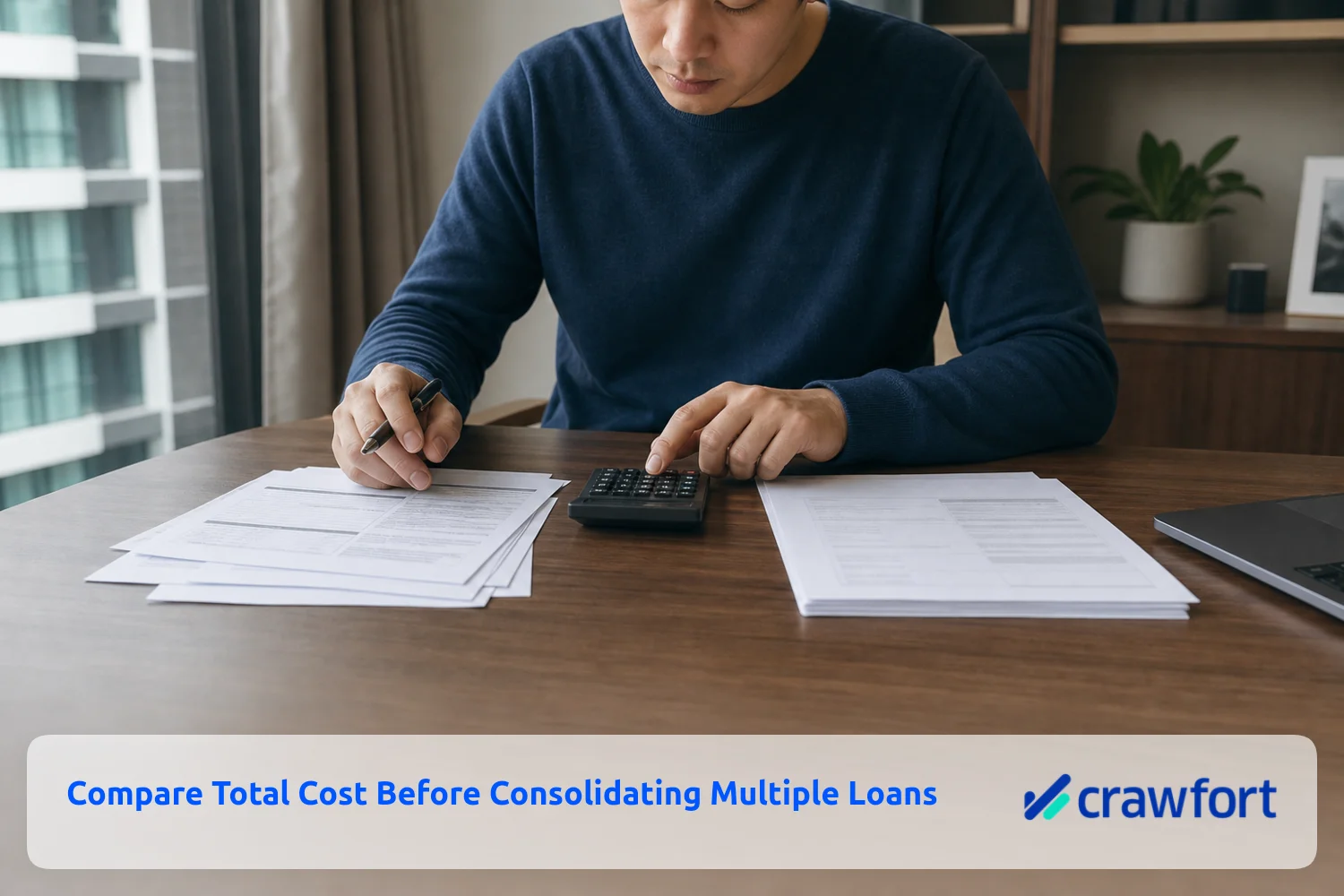
Consolidation replaces several eligible debts with a new facility. Its clearest practical benefit is one repayment instead of several. It may also reduce the monthly burden or the borrowing cost, but neither outcome is automatic.
Before accepting a consolidation offer, compare:
| Comparison Point | Existing Debts | Proposed Consolidation |
|---|---|---|
| Settlement Amount | Total required to close the included accounts | Amount the new facility will settle |
| Effective Cost | Remaining interest and applicable charges | Interest and all new fees |
| Monthly Commitment | Combined required repayments | New monthly instalment |
| Repayment Period | Remaining tenures | New tenure |
| Excluded Debts | Facilities that remain payable | Confirm what is not consolidated |
| Early Repayment Terms | Existing settlement penalties | New early settlement conditions |
| Total Repayment | Amount payable if current debts run to term | Amount payable over the full new tenure |
A lower monthly instalment can be the result of a longer repayment period rather than a cheaper loan. Compare the total amount payable, not only the monthly relief.
Consolidation is more likely to help when the new payment fits comfortably after essential expenses, the total cost is reasonable, and you stop using the facilities that created the original balances. It is less suitable when the new facility excludes your major debts, carries substantial fees or merely delays an unaffordable situation.
If you are comparing lender-based options, you can review Crawfort’s debt consolidation loan details alongside other available routes. Approval and terms remain subject to the provider’s assessment. Read the contract carefully and confirm which debts will be settled before proceeding.
Read more about how a debt consolidation plan works in Singapore here.
A lender’s consolidation loan should not be confused with the banking industry’s formal Debt Consolidation Plan. According to the Association of Banks in Singapore’s DCP criteria, the plan generally covers qualifying interest-bearing unsecured debts from financial institutions. Applicants must be Singapore Citizens or Permanent Residents, earn from S$20,000 to below S$120,000 annually, hold net personal assets below S$2 million and owe more than 12 times their monthly income in qualifying unsecured debt. Meeting these criteria does not guarantee an offer, and some debts are excluded.
Step 8: Get Independent Help When Repayments Do Not Fit
If your essential expenses and minimum repayments consistently exceed your take-home pay, repayment tactics alone will not be enough.
Credit Counselling Singapore facilitates formal arrangements for suitable debt-distressed borrowers. Its Debt Management Programme may involve an extended repayment period or moderated interest, subject to assessment and the creditors’ approval. Under such an arrangement, borrowers generally continue making monthly payments directly to their respective creditors.
Consider seeking independent help if:
- You are using one credit facility to pay another
- Several accounts are already overdue
- Collection activity has started
- Creditors have rejected affordable restructuring requests
- You cannot see a realistic way to meet the minimum payments
- Debt stress is affecting your health, family or ability to work
Crawfort also has an overview of how credit counselling and debt management programmes work. Use it for general orientation, then confirm the programme requirements and procedures directly with the organisation administering the arrangement.
Understand how Singapore’s Debt Repayment Scheme works here.
Step 9: Build A Repayment System Around Payday
Once you have chosen a workable route, turn it into a monthly routine.
On payday, move money for essential bills and required repayments into separate accounts or budget categories. Schedule payments ahead of their due dates, but leave enough time to correct a failed transaction.
Use a repayment calendar containing:
- Salary date
- Every payment due date
- Required amount
- Extra payment target
- Expected balance after payment
- Contract review or promotional-rate expiry dates
Review the plan once a month, updating balances from actual statements rather than estimates. When one debt is cleared, redirect its full instalment to the next target before the extra cash is absorbed into everyday spending.
Use bonuses and other irregular income deliberately. Decide in advance how much will go towards overdue essentials, your small emergency buffer and debt reduction. Check the early repayment terms before sending a lump sum.
Most importantly, do not judge progress by whether you survived another payday. Track whether your total balance, total required instalments and borrowing cost are falling. Those three figures show whether the plan is actually repairing your finances.
Your Next Move Depends On The Shortfall
If all required payments fit after essential expenses, choose a repayment order and automate it. If the payments only fit because you keep using credit for daily costs, reduce the instalment burden or compare suitable consolidation routes. If the minimums do not fit at all, speak to your creditors and a debt counsellor now.
Do not choose a recovery option simply because it offers the lowest monthly figure. The workable plan is the one that covers your essential expenses, clears the debt within a defined period and does not depend on borrowing again next month.
If consolidation is the right fit for your numbers and the total cost stacks up, you can compare Crawfort’s debt consolidation loan or apply for a personal loan with a licensed money lender regulated by the Ministry of Law. Borrow only what your budget can absorb after essential expenses, and confirm which debts the new facility will settle before you sign.
Important Note: This article is for general information only and does not consider your personal financial situation. Before taking or consolidating a loan, review the contract carefully, compare the total repayment amount and make sure the instalments are manageable.