Alwin Goh

An unexpected bill can throw even the most careful budget off course. Whether it’s a medical emergency, an urgent home repair, or a sudden car breakdown, the question hits fast, should you dip into your emergency fund or take a personal loan?
If you’re weighing an emergency fund vs personal loan in Singapore, you’re not alone. Many Singaporeans face this exact dilemma, especially with the rising cost of living putting pressure on household budgets.
The good news is that there’s a sensible way to decide. Both options have their place, and knowing when to use each one can save you money, stress, and sleepless nights.
In this article, we’ll break down what each option is, when to use your emergency fund first, when a personal loan in Singapore makes more sense, and how to decide with confidence.
What Is An Emergency Fund In Singapore?
An emergency fund in Singapore is a pool of cash savings, typically 3 to 6 months of living expenses, set aside strictly for unexpected costs such as medical bills, urgent repairs, or income loss. It sits in an accessible account and acts as your first line of financial defence.
Think of it as self-insurance. Because it’s your own money, using it costs you nothing in interest or fees.
The Monetary Authority of Singapore (MAS) and financial educators on MoneySense generally encourage Singaporeans to build this buffer before taking on other financial goals. For a family spending S$4,000 a month, that means keeping S$12,000 to S$24,000 within easy reach.
Do note that your CPF savings don’t count here. CPF savings are locked for retirement, housing, and healthcare purposes, so your emergency fund needs to be in cash you can withdraw immediately.
What Is A Personal Loan In Singapore?
A personal loan in Singapore is a sum of money borrowed from a bank or licensed moneylender, repaid in fixed instalments with interest over an agreed tenure.
Personal loans are generally unsecured, which means you typically do not have to pledge any assets as security. Lenders will usually review factors such as your income and credit history when deciding whether you qualify.
Banks assess your application using your Credit Bureau Singapore (CBS) report, while licensed moneylenders refer to the Moneylenders Credit Bureau (MLCB).
It’s worth stressing the difference between licensed moneylenders and loan sharks. Licensed moneylenders adhere strictly to rules set by the Ministry of Law, including caps on interest and fees, while loan sharks operate illegally and should never be an option.
Emergency Fund vs Personal Loan: What’s The Difference?
The key difference is cost and replenishment. An emergency fund is your own money, so it’s free to use but must be rebuilt afterwards. A personal loan is borrowed money, so it costs interest and fees but preserves your savings and spreads the expense over time.
Here’s a side-by-side comparison:
| Factor | Emergency Fund | Personal Loan |
| Cost | Free to use (no interest) | Interest and fees apply |
| Speed of access | Immediate | Fast with licensed moneylenders; banks may take days |
| Impact on savings | Depletes your buffer | Keeps your buffer intact |
| Repayment | None, but fund must be rebuilt | Fixed monthly instalments |
| Credit record | No effect | Repayment behaviour is recorded with CBS or MLCB |
| Best for | Small to moderate, one-off expenses | Large, urgent expenses beyond your fund’s size |
In short, neither option is “better” in every situation. The right choice depends on the size of the expense, the health of your fund, and how quickly you can recover.
When Should You Use Your Emergency Fund First?
Use your emergency fund first when the expense is a genuine one-off emergency that your fund can absorb without falling below roughly 3 months of living expenses. Because your own savings cost nothing to use, they should generally come before any form of borrowing.
Your emergency fund is the right tool when:
- The expense is unexpected and necessary, such as a medical bill, urgent dental work, or a broken fridge
- The amount is small relative to your fund, ideally less than a third of it
- You have stable income to rebuild the fund within a few months
- Borrowing would cost you meaningful interest for a sum you can comfortably cover
There’s a psychological benefit too. Handling an emergency with your own money keeps you debt-free and avoids adding a monthly repayment to an already stressful period.
That said, don’t treat your fund as a free-for-all. Holidays, gadgets, and festive spending are not emergencies, and using your buffer for wants leaves you exposed when a real crisis arrives.
When Does A Personal Loan Make More Sense?
A personal loan makes more sense when the expense is larger than your emergency fund, when draining your savings would leave you with no buffer, or when your income has stopped and you need to preserve every dollar of cash. Borrowing spreads a big shock into manageable monthly instalments.
Consider a personal loan in Singapore when:
- The emergency exceeds your fund, for instance a S$15,000 medical bill against S$8,000 in savings
- Using your fund would empty it completely, leaving you vulnerable to unexpected expense
- You’ve just lost your job and need your remaining cash to stretch as far as possible
- You’re juggling multiple high-interest debts, where a debt consolidation loan could simplify repayments
Speed matters in emergencies too. Banks can take days to process applications, while licensed moneylenders can often approve an instant loan on the same day, with applications made easier through Singpass.
If your credit history is patchy, don’t lose heart. Licensed moneylenders place less weight on your CBS score, and options like a loan for bad credit exist precisely for situations like this.
Learn more about your eligibility for a personal loan in Singapore here.
How Do You Decide Which To Use First?
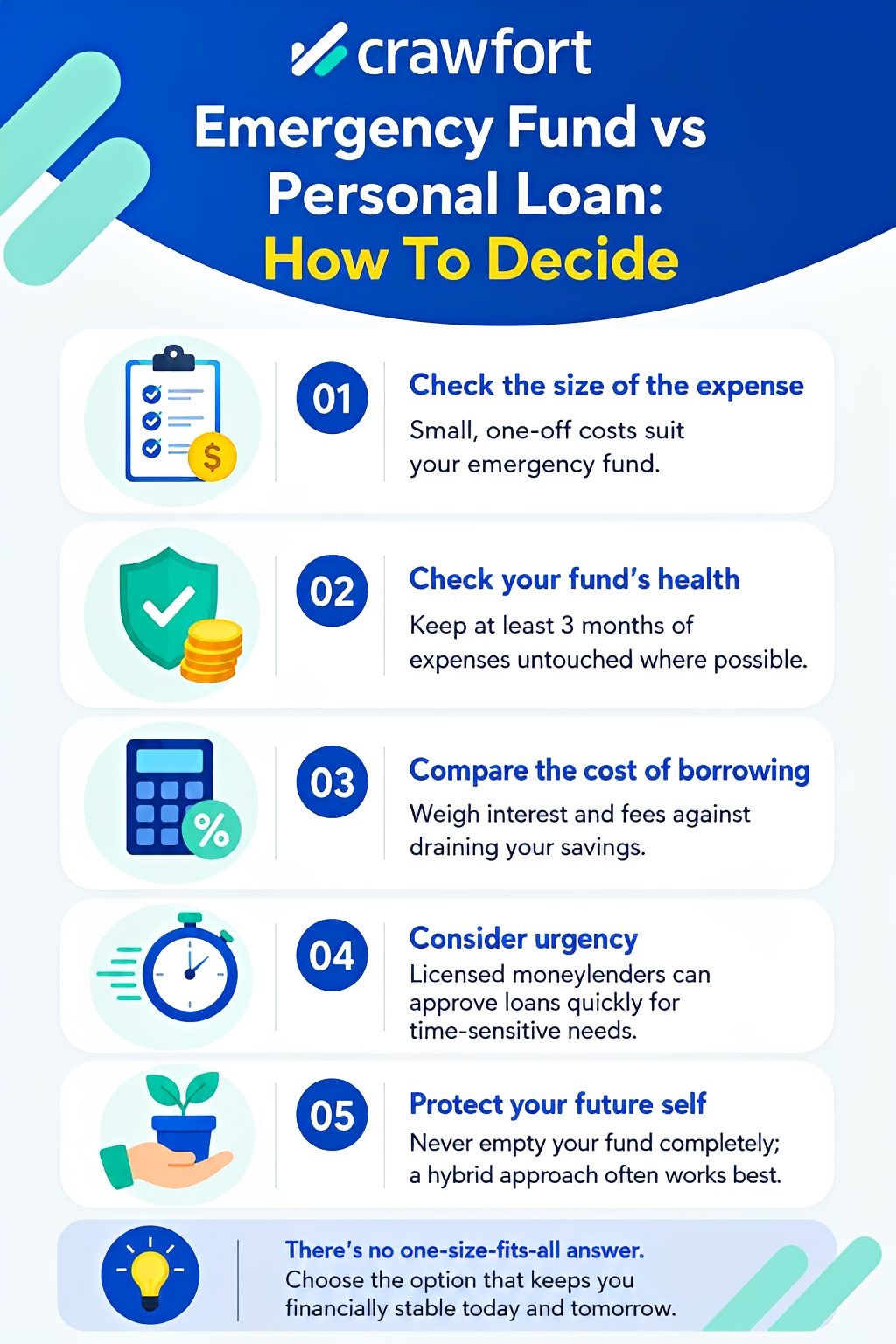 A simple five-step check can help you decide calmly before you touch your savings or take on debt.
The simplest rule is savings first, borrowing second, but never to zero. Cover what you comfortably can from your emergency fund, then borrow only the shortfall, so you keep a safety buffer while minimising the interest you pay.
Here’s a practical 5-step process:
Step 1. Check The Size Of The Expense
Small, one-off costs are usually best covered by your emergency fund, while larger expenses may justify a personal loan. As a rule of thumb, if the expense would wipe out more than half your fund, borrowing part of the amount is worth considering.
Start by getting the exact figure, not an estimate. A S$500 dental bill and a S$5,000 home repair calls for very different strategies.
Ask yourself whether the cost is truly one-off or the start of ongoing expenses. Recurring costs (like ongoing medical treatment) deserve a longer-term plan rather than a quick raid on your savings.
Step 2. Check Your Fund’s Health
Before touching your emergency fund, check how many months of expenses it currently covers. Financial planners generally recommend keeping at least 3 months of living expenses untouched, so if withdrawing would leave you below that line, think twice.
Tally your monthly essentials such as your rent or mortgage, utilities, food, transport, insurance premiums, and any loan repayments.
If your fund covers 6 months and the expense only dents it slightly, using savings is likely the cheaper route. If it barely covers 3 months, preserving it gives you a safety net in case something else goes wrong.
Step 3. Compare The Cost Of Borrowing
The real comparison is the interest and fees you’d pay on a loan versus the security you lose by draining your savings. Licensed moneylenders in Singapore are capped by Ministry of Law rules at a maximum of 4% interest per month, so you can calculate the total cost upfront.
Work out the full repayment amount over your intended tenure, not just the monthly instalment.
Then weigh that against the risk of having no buffer. Being caught without savings when a second emergency strikes can force you into rushed, more expensive borrowing later. Always borrow from a licensed moneylender, and not from unlicensed lender or loan shark, as only licensed lenders follow MinLaw’s caps on interest and fees.
Step 4. Consider Urgency
If the expense is time-sensitive, speed matters as much as cost. Legal lenders can typically approve and disburse loans within the same day, which makes them a practical option when a hospital deposit or urgent repair can’t wait.
Banks may offer lower rates but often take days to process an application, especially if your credit history is thin.
If you need funds immediately, an instant loan from a licensed lender can bridge the gap while keeping your savings intact.
Step 5. Protect Your Future Self
Never empty your emergency fund completely, even for a genuine emergency. A hybrid approach often works best, and this is to use part of your savings to reduce the loan amount, then borrow the remainder so you keep a buffer.
For example, on a S$4,000 expense, you might use S$1,500 from savings and borrow S$2,500. You pay less interest overall while staying protected.
Whatever you borrow, make sure the monthly instalment fits your budget. Remember that missed repayments hurt your credit record with CBS or MLCB and make future borrowing harder.
How Do You Rebuild Your Emergency Fund After Using It?
Rebuild your emergency fund by treating it like a fixed monthly bill, automating a transfer of 10% to 20% of your income into a separate account the day your salary arrives. Most Singaporeans can restore a 3-month buffer within 6 to 18 months this way.
A few tips to speed things up:
- Park the fund in a separate high-interest savings account so it earns while it waits
- Put extra cash such as bonuses, tax refunds, straight into the fund
- Trim one or two discretionary expenses temporarily, like food delivery or subscriptions
- If you took a loan, prioritise repayments first, then rebuild the fund alongside
If you’re a homeowner, remember that big-ticket commitments interact with your buffer too. Our guide on HDB loan vs bank loan explains how your mortgage choice affects your monthly cash flow and, by extension, how much emergency cushion you need.
The Bottom Line: Savings First, Borrow Smart
Facing an emergency is stressful enough without agonising over the money. The healthy rule of thumb is simple, lean on your emergency fund first, borrow only the shortfall, and never leave yourself with an empty buffer.
A personal loan in Singapore isn’t a failure of planning. Used wisely, it’s a bridge that protects your savings, spreads a shock over manageable months, and keeps your family’s finances steady.
Ready to get started? Apply for a loan with Crawfort and get approved in as fast as 8 minutes.