Alwin Goh

A loan instalment can look affordable on paper and still cause trouble if it falls at the wrong point in your pay cycle. The practical fix is to plan from payday to payday: reserve the repayment first, protect essential bills and keep a small cash buffer before deciding what is left to spend.
This method works whether your loan is from a bank, a finance company or a licensed moneylender. Your contract still controls the due date, amount, fees and payment method. The calendar simply helps you make those terms fit your monthly cash flow.
The whole method can be reduced to a few decisions. Set them once, then review the plan whenever your salary, bills or instalment changes.
| Point In The Salary Cycle | What To Do | Why It Matters |
|---|---|---|
| On Payday | Confirm your take-home pay and reserve the required instalment. | The repayment is kept separate from everyday spending money. |
| Within The First Three Days | Set aside essential bills and a small cash buffer. | Rent, food, transport and household needs remain visible. |
| Every Seven Days | Compare actual spending with the amount left for the cycle. | You can correct an overspend before it becomes a repayment shortfall. |
| Seven Days Before The Due Date | Check the repayment account, payment instructions and expected balance. | There is still time to fix an administrative problem or raise a shortfall. |
| After Payment | Verify that the payment cleared and keep the receipt or statement. | A scheduled transfer is not proof that the lender received the money. |
Table of Contents
Map Your Salary Cycle Before You Spend
Start with dates, not percentages. Record the date your salary normally reaches your account, the contractual repayment date and every essential bill due between those two points. Use take-home pay that you can rely on. Do not build the plan around a possible bonus, overtime payment or commission.
The basic calculation is:
Take-home pay − essential bills − required loan instalment − small cash buffer − other fixed commitments = amount available for flexible spending
Suppose your take-home pay is S$3,200. Essential bills and household costs total S$1,850, your loan instalment is S$450, and you keep S$200 as a small monthly buffer. That leaves S$700 for flexible spending until the next salary arrives. Four equal checkpoints would give you a starting limit of about S$175 per week, although you should adjust it for the actual number of days and any known expenses.
If the result is negative, the instalment is not currently fitting into the cycle. Cutting optional spending may close a small gap. A recurring or substantial gap needs early contact with the lender and possibly debt counselling; it should not be hidden by borrowing again.
This calculation complements, rather than replaces, a fuller budget. MoneySense recommends listing reliable monthly income, debts and expenses when preparing and reviewing a household budget.
Build Your Repayment Plan In Six Steps
Step 1: Confirm The Income Date And Amount
Use the date the salary is credited, not the date on your payslip. If the date moves when payday falls on a weekend or public holiday, check your employer’s usual practice and mark the expected credit date for each month.
Workers with variable income can base the plan on a conservative amount that has arrived consistently. Treat anything above it as irregular income until it is actually in the account.
Step 2: Record The Contractual Repayment Date
Check the loan contract, repayment schedule and lender’s latest statement. Record the due date, required amount, payment channel and any cut-off time. If you use GIRO or another automatic method, note when the deduction is normally attempted.
If the due date falls before payday, reserve the instalment from the previous salary cycle. You can ask the lender whether a different date is available, but a request is not an approval. Continue following the existing contract unless the lender confirms a change, preferably in writing.
Step 3: Protect Essential Bills
List the expenses that keep your household running: housing, utilities, basic groceries, transport to work, insurance premiums, childcare, medical needs and agreed family support. Enter the amount and date of each item.
If cash is tight, rank these costs by consequence and timing rather than paying whichever notification appears first. A separate guide on prioritising repayments without falling further into debt can help with that exercise.
Step 4: Keep A Small Monthly Cash Buffer
The buffer covers modest timing surprises, such as higher transport costs, medicine or an essential household purchase. It should be held separately from the instalment, even if both amounts remain in the same bank account.
Choose an amount that your budget can support. The aim is not to name a universal figure; it is to stop every small variation from affecting the repayment. This monthly buffer is also different from a full emergency fund. MoneySense’s broader guidance suggests building emergency funds equal to several months of expenses, but that is a longer-term goal rather than a condition for starting this calendar.
Step 5: Divide The Flexible Amount Across The Remaining Days
Once the instalment, essentials and buffer are reserved, divide what remains across the weeks or days until the next payday. Mark any predictable higher-cost period, such as a school expense or family commitment, before setting the limits.
If you are unsure whether the instalment itself is taking too much of your income, work through a separate
salary-based repayment affordability check. The result should be treated as a budgeting signal, not as a guarantee that a lender will approve or change any loan.
Step 6: Use Two Reminders And Verify The Payment
Set one reminder seven days before the due date and another one or two days before it. The first is for checking the balance and raising problems; the second is for confirming that the repayment money has not been spent.
After the due date, verify that the payment cleared and keep receipts and statements. The Registry of Moneylenders’official borrower guide specifically tells borrowers to pay instalments on time, check repayment receipts and retain payment records when dealing with a licensed moneylender.
Copyable 30-Day Salary-Cycle Worksheet
Make Day 1 your payday, even if it is not the first day of the calendar month. Add the actual dates, amounts and completion marks. Move the repayment checks to match your real due date; the sample placement below assumes payment falls late in the cycle.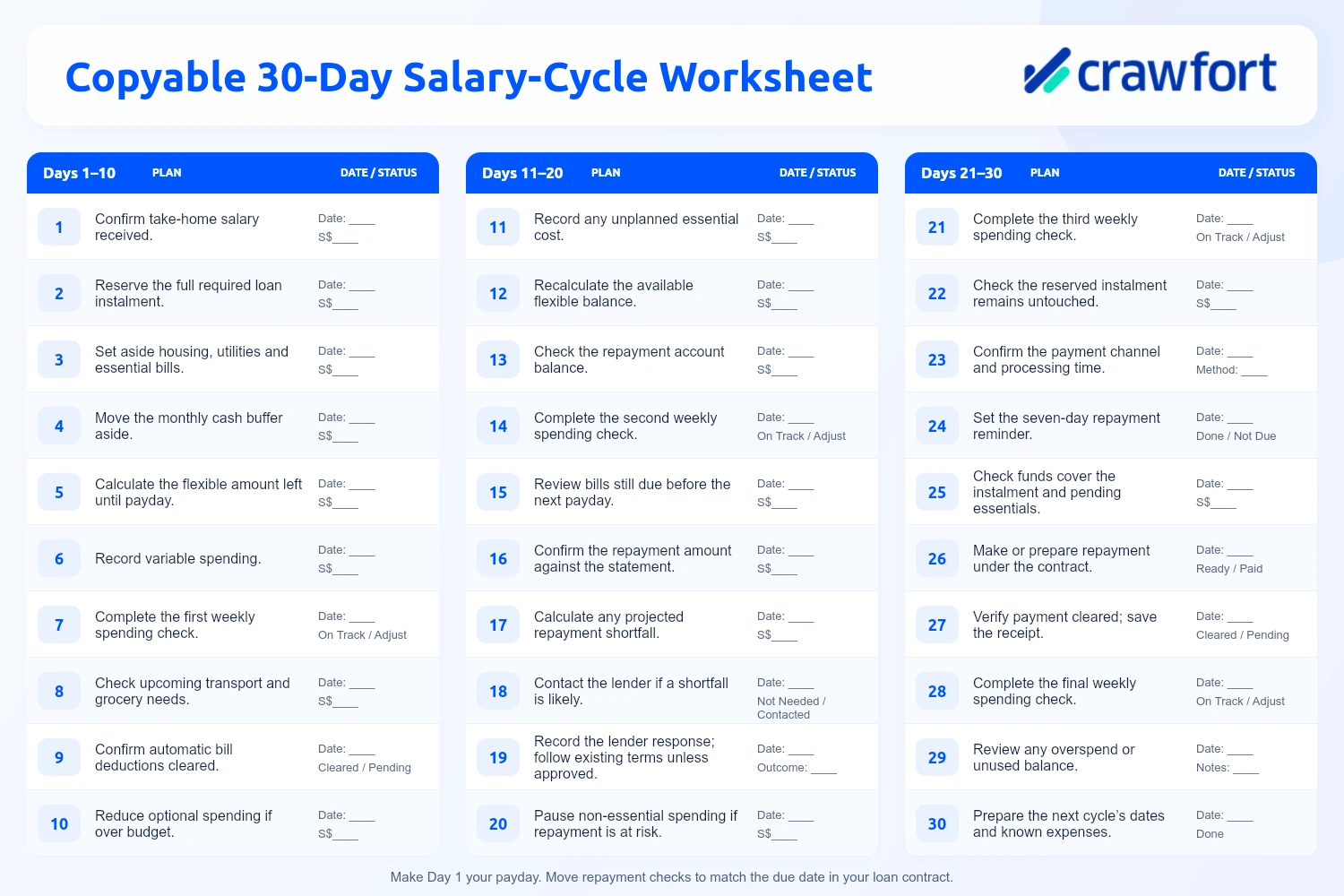
- Day 1: Confirm your take-home salary has arrived.
Actual date: ____
Amount: S$____ - Day 2: Reserve the full required loan instalment.
Actual date: ____
Amount: S$____ - Day 3: Set aside housing, utilities and other essential bills.
Actual date: ____
Amount: S$____ - Day 4: Move the monthly cash buffer aside.
Actual date: ____
Amount: S$____ - Day 5: Calculate the flexible amount left until payday.
Actual date: ____
Amount: S$____ - Day 6: Record your variable spending.
Actual date: ____
Amount: S$____ - Day 7: Complete the first weekly spending check.
Status: On Track / Adjust - Day 8: Check upcoming transport and grocery needs.
Actual date: ____
Amount: S$____ - Day 9: Confirm that automatic bill deductions have cleared.
Status: Cleared / Pending - Day 10: Reduce optional spending if the plan is over budget.
Adjustment: S$____ - Day 11: Record any unplanned essential cost.
Amount: S$____ - Day 12: Recalculate the available flexible balance.
Balance: S$____ - Day 13: Check the repayment account balance if payment is within 14 days.
Balance: S$____ - Day 14: Complete the second weekly spending check.
Status: On Track / Adjust - Day 15: Review bills still due before the next payday.
Amount Due: S$____ - Day 16: Confirm the repayment amount against the latest statement.
Amount: S$____ - Day 17: Calculate any projected repayment shortfall.
Shortfall: S$____ - Day 18: Contact the lender now if a shortfall is likely.
Status: Not Needed / Contacted - Day 19: Record any lender response. Keep following the existing terms unless a change is approved.
Outcome: ____ - Day 20: Pause non-essential spending if the repayment is at risk.
Adjustment: S$____ - Day 21: Complete the third weekly spending check.
Status: On Track / Adjust - Day 22: Check that the reserved instalment remains untouched.
Balance: S$____ - Day 23: Confirm the payment channel and processing time.
Payment Method: ____ - Day 24: Set the seven-day repayment reminder, or move this action to the correct day.
Status: Done / Not Due - Day 25: Check that the account can cover the instalment and pending essentials.
Balance: S$____ - Day 26: Make or prepare the repayment according to the contract.
Status: Ready / Paid - Day 27: Verify that payment cleared and save the receipt or statement.
Status: Cleared / Pending - Day 28: Complete the final weekly spending check.
Status: On Track / Adjust - Day 29: Review what caused any overspend or unused balance.
Notes: ____ - Day 30: Prepare the dates and known expenses for the next salary cycle.
Status: Done
For a 28-day or 31-day cycle, shorten or extend the final review period. Do not move the lender’s due date on your own; move the worksheet actions around the date in your contract.
What To Do Before A Repayment Shortfall
Check for a shortfall at least seven days before payment is due:
Expected money available on the due date − required instalment = repayment surplus or shortfall
If you expect S$320 to be available for a S$450 instalment, the projected shortfall is S$130. Acting while the amount and timing are clear gives you more options than waiting for an automatic deduction to fail.
- Recheck the numbers. Include pending essential bills and transactions that have not cleared.
- Stop optional spending. Do not use money reserved for the instalment unless an immediate essential need leaves no alternative.
- Read the contract. Check late charges, late interest, payment cut-off times and any procedure for requesting assistance.
- Contact the lender early. State the due date, expected shortfall, reason and the amount you can pay. Ask what arrangements may be considered.
- Get the outcome in writing. Asking to change a repayment date, split a payment or extend a schedule does not alter the contract. The lender must approve any change.
- Seek independent help if the gap will repeat. A recurring deficit is a debt-management problem, not merely a calendar problem.
MoneySense advises borrowers who are struggling with payments to speak to their financial institution promptly, and explains further steps for managing debt and repayment difficulties. For licensed moneylender loans, the Registry states that restructuring is a private contractual matter and that it cannot negotiate with the lender for you.
If you have several creditors or repeated shortfalls, read how credit counselling and a Debt Management Programme may work. Credit Counselling Singapore provides debt-management information and counselling; any repayment arrangement depends on your circumstances, assessment and creditor acceptance.
Avoid These Salary-Cycle Timing Mistakes
Treating The Account Balance As Spendable Money
Your bank balance may include the loan instalment, rent and bills that have not yet been deducted. Track a separate “available to spend” figure so reserved money does not look free.
Planning With Gross Or Irregular Income
Use dependable take-home income. A bonus can strengthen a buffer or reduce debt after it arrives, but it should not be required for an ordinary monthly instalment.
Relying On One Due-Date Alert
An alert on the due date only tells you that the problem has arrived. The seven-day check is where you can spot a low balance, a changed salary date or a payment instruction that needs attention.
Assuming A Repayment Date Can Be Changed
A lender may consider a request, but approval is not automatic. Until the lender confirms new terms, plan around the existing due date and keep enough money available for it.
Making Extra Payments Without Checking The Terms
Paying early or paying more may reduce debt faster, but first check for early settlement charges, notice requirements and how the payment will be applied. Compare the actual cost and terms, not only the monthly instalment. An effective interest rate guide can help you understand the wider borrowing cost.
Make The Next Salary Cycle Easier
A useful repayment plan is a repeatable sequence: salary arrives, the instalment and essential bills are reserved, a small buffer is protected, and the remaining amount is checked weekly. The 30-day worksheet gives each step a place before the due date becomes urgent.
Review the plan whenever your take-home pay, household costs or loan terms change. If the calculation remains negative after optional spending is removed, contact the lender and get independent help. A calendar can prevent timing mistakes, but it cannot make an unaffordable repayment affordable.
If you have worked through the plan and are confident the repayments fit comfortably within your salary cycle, you can explore Crawfort’s personal loan options. Compare the full cost of borrowing, understand the total amount payable and apply only for an amount you can repay on time.
Important note: This article is for general information only and does not consider your personal financial situation. Before taking a loan or changing how you repay one, review the loan contract carefully and make sure repayments are manageable.