Alwin Goh
Singapore FinTech Festival (SFF) 2026 will focus on a financial system being changed by more than technology alone. Artificial intelligence, shifting trade relationships, investment priorities, workforce pressures and regulation form the five part framework for this year’s event.
The festival runs from 18 to 20 November 2026 at Singapore EXPO. According to the official SFF 2026 announcement dated 26 August 2026, the Monetary Authority of Singapore (MAS) and the Global Finance & Technology Network (GFTN) are organising the event in collaboration with the Association of Banks in Singapore (ABS).
The central question is practical: how should financial institutions respond when technology, capital, talent, policy and geoeconomics are all changing at the same time?
The five themes cover different pressures, but they overlap closely. The table below sets out what each force means and the main issue SFF 2026 intends to examine.
| Force | Main Focus At SFF 2026 |
|---|---|
| Technology | AI adoption, AI enabled scams, cyber threats and quantum risks |
| Geoeconomics | Changing trade corridors, investment flows and payment networks |
| Capital | Whether AI led productivity and revenue can support current investment levels |
| Talent | How financial institutions can build skills as AI changes jobs |
| Policy | Keeping governance and risk controls aligned with rapid innovation |
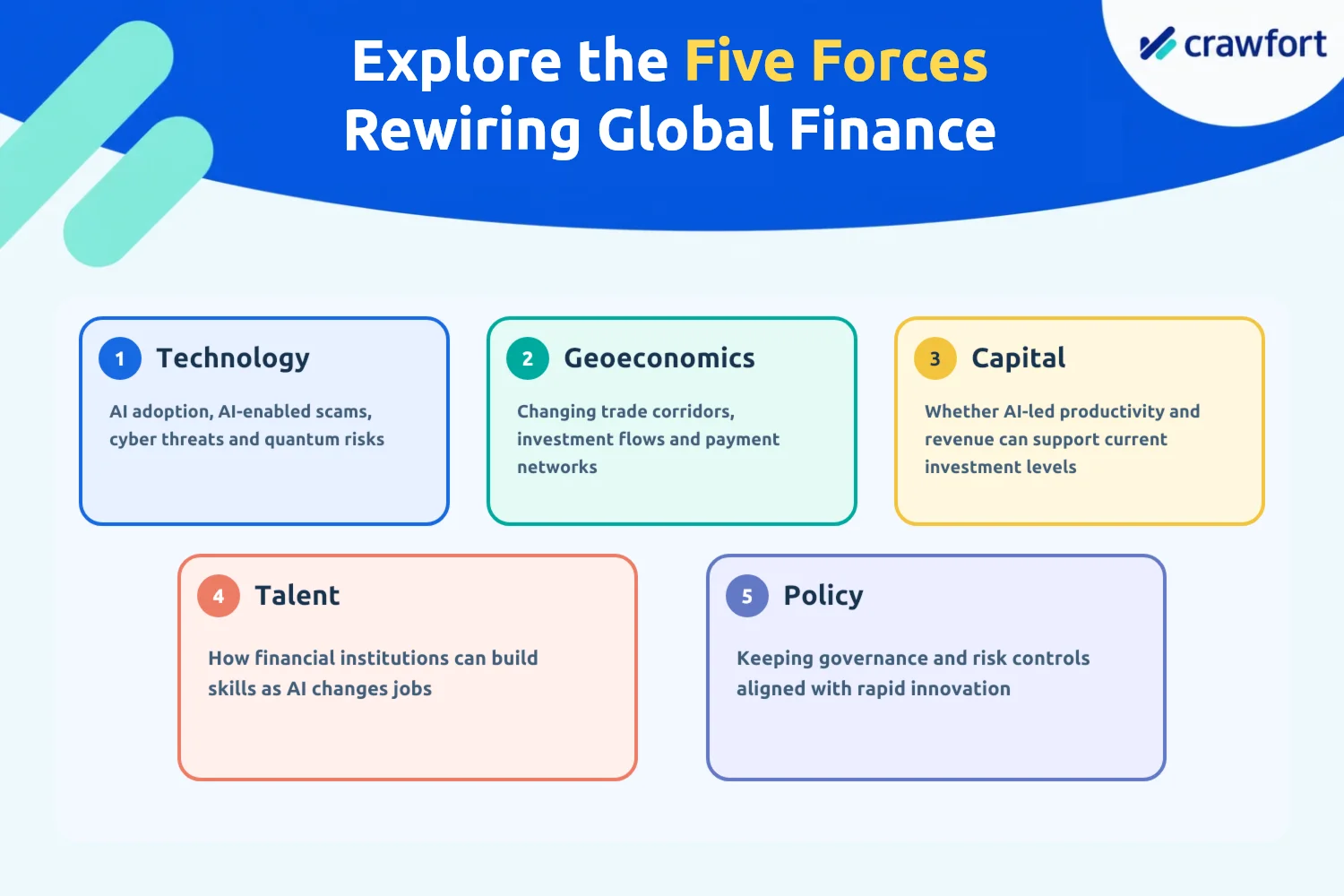
Table of Contents
What Are The Five Forces Reshaping Global Finance?
Technology
Technology discussions will move past the question of whether financial firms should adopt AI. The harder questions concern how AI can be used productively while institutions manage fraud, cyber security and governance risks. Quantum computing also matters, because firms need to prepare for future threats to the encryption standards in use today.
That consumer protection angle is especially relevant as criminals use more convincing digital tools. Knowing how to protect your Singpass credentials and spot loan scams still matters even as banks tighten their own controls.
Geoeconomics
Geoeconomics covers the way political and economic relationships are changing trade, investment, data infrastructure and payment networks. As new corridors emerge, financial institutions must decide which markets, currencies and systems they can support without weakening resilience.
This theme is what makes SFF 2026 broader than a technology conference. It asks how financial infrastructure holds up when cross border business is shaped by strategic alliances, supply chain changes and different national rules.
Capital
The capital theme examines whether heavy investment in AI and related companies is backed by durable productivity and revenue growth. The organisers noted in August 2026 that AI connected firms account for around 40% of S&P 500 market capitalisation, which makes the sustainability of the investment boom a serious question rather than a rhetorical one.
For businesses, the discussion is not limited to stock market valuations. Access to funding, the cost of capital and lenders’ risk appetite all feed into expansion plans and the suitability of options such as a working capital loan.
Also read: How invoice financing works for businesses in Singapore
Talent
AI is changing both the skills financial institutions need and the work their employees actually do. SFF 2026 will look at how firms can retrain existing teams, recruit scarce capabilities and redesign entry level roles instead of treating workforce development as an afterthought.
The issue is operational as much as social. An institution cannot deploy new systems safely if its staff do not understand the limits, risks and responsibilities that come with them.
Policy
Policy connects the other four themes. Regulators and institutions have to decide how to encourage useful innovation while preserving trust, security and financial stability. Rules that lag too far behind may leave gaps; rules written too early may not fit the way the technology eventually works.

These choices influence everyday borrowing conditions over time. Consumers can see one part of that relationship by understanding how inflation affects loans and borrowing costs.
Also read: How Singapore’s move from SIBOR to SORA changed floating rate loans
Why The Themes Need To Be Considered Together
The strongest part of the SFF 2026 framework is the link between the five forces. An AI powered financial service needs investment, people who can manage it and rules that establish accountability. If it operates across borders, it also has to work within different data, payment and regulatory systems.
That joined up view gives the programme more substance than a list of technology trends. The festival’s theme overview frames the changes as new risks, new rules and new growth that organisations need to factor into their planning for 2027.
What Else Is Planned For SFF 2026?
The three day festival will include Founders Peak sessions, Investor Hours, the Capital Meets Policy Dialogue, SFF MeetUp, the Global FinTech Hackcelerator, international pavilions and a multi hall exhibition.
The published SFF 2026 agenda already lists sessions on new economic and financial corridors, digital finance talent, operating models and human experiences with AI. Programme details may still change as the event approaches, so check the agenda page closer to November.
Before the main festival, the invite only Insights2040 Annual Meeting will be held from 16 to 17 November 2026 at Sands Expo & Convention Centre. Formerly known as the Insights Forum, it brings public and private sector leaders together to work through financial services issues that need cross sector cooperation.
What Could The Agenda Mean For Singapore?
Singapore’s role as a financial and technology centre makes these discussions locally relevant. Decisions about digital payments, AI controls, cross border finance and workforce skills shape how institutions build products and serve customers here.
For consumers and SMEs, the effects are likely to show up gradually through security checks, digital services, credit decisions and funding costs. Readers who track those costs can also review how published prime lending rates relate to borrowing, rather than assuming innovation will automatically make finance cheaper.
Also read: How to compare loan rates, fees and terms in Singapore
What To Watch As November Approaches
The value of SFF 2026 will depend on whether its broad theme produces concrete responses. Useful outcomes would include clearer AI governance, practical preparation for quantum-era security, stronger approaches to cross-border financial infrastructure and credible plans for workforce transition.
For now, the five-force framework offers a useful way to read the agenda: each new technology decision also raises questions about capital, people, policy and the international system in which finance operates.