

 Alwin Goh
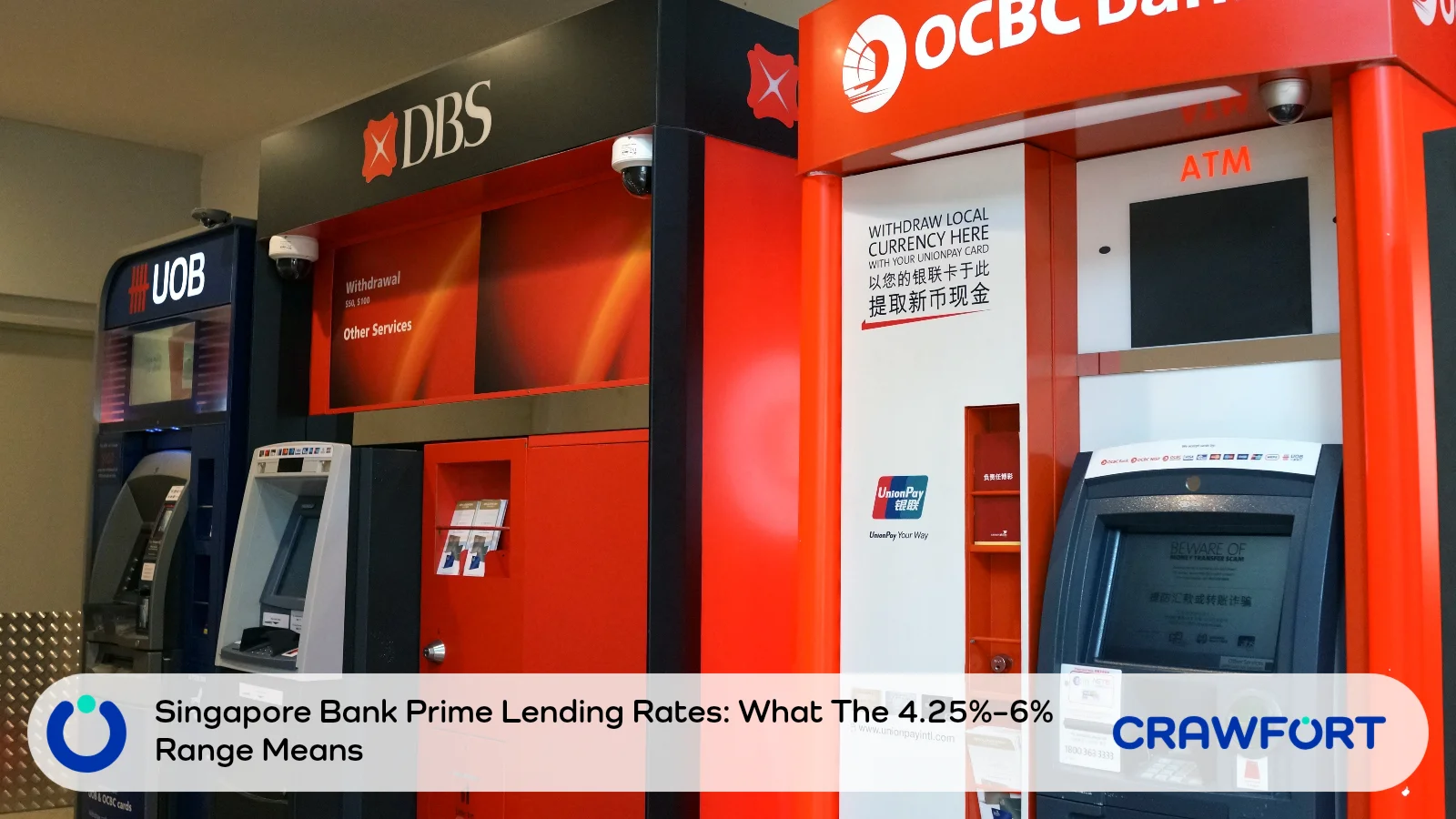
DBS and UOB had the lowest prime lending rate at 4.25%, according to the Association of Banks in Singapore’s table dated 28 August 2026. OCBC was at 5%, while the other participating banks had rates ranging from 5% to 6%.
However, a lower prime lending rate does not necessarily mean a cheaper personal loan. The prime lending rate is only a benchmark. It is not the same as a personal loan rate or the effective interest rate (EIR) you will actually pay.
Here are the key differences to understand when comparing the published rates.
| Figure Or Term | What It Represents | What It Does Not Tell You |
|---|---|---|
| 4.25%–6% | Published prime lending rates among participating banks on 28 August 2026 | The price of every loan those banks offer |
| 5.35%–6.875% | Published base lending rates among participating finance companies | A continuation of the bank prime lending rate range |
| Prime Lending Rate | A reference rate for Singapore dollar overdraft or demand lending | Your approved or guaranteed borrowing rate |
| Advertised Loan Rate | The rate used to market a particular product, subject to its terms | The full cost once fees and the repayment structure are counted |
| Effective Interest Rate | A standardised measure reflecting the repayment schedule and certain costs | Whether the instalment is affordable for you |
Table of Contents
- What The ABS Prime Lending Rate Table Shows
- What A Prime Lending Rate Means
- Why The Published Rates Differ
- Does A Lower Prime Lending Rate Mean A Cheaper Personal Loan?
- How To Compare An Actual Loan Offer
- When The Prime Lending Rate May Affect Your Loan
- Common Mistakes When Reading The Table
- What Borrowers Should Take From The Published Range
- Frequently Asked Questions
What The ABS Prime Lending Rate Table Shows
The ABS prime lending rate table is updated weekly using rates submitted by participating banks and financial institutions. As of 28 August 2026, the table included 39 banks. DBS and UOB had the lowest rate at 4.25%, while OCBC and ICBC were at 5%. The other banks had rates between 5% and 6%.
Published Prime And Base Lending Rates By Institution
| Bank | Prime Lending Rate (%) |
|---|---|
| Agricultural Bank of China Limited | 5.5 |
| Bangkok Bank Public Company Limited | 6 |
| Bank of China Limited | 5.5 |
| Bank of Communications Co., Ltd | 5.5 |
| Bank of Singapore Limited | 5.5 |
| Bank of Taiwan | 6 |
| BNP Paribas | 6 |
| Chang Hwa Commercial Bank Ltd | 5.25 |
| CIMB Bank Berhad | 5.5 |
| Citibank N.A., Singapore Branch | 5.5 |
| DBS Bank Ltd | 4.25 |
| Deutsche Bank AG, Singapore Branch | 5.5 |
| First Commercial Bank | 5.75 |
| Habib Bank Ltd | 6 |
| HL Bank | 5.75 |
| Hua Nan Commercial Bank Ltd | 5.5 |
| Indian Bank | 6 |
| Indian Overseas Bank | 5.5 |
| Industrial and Commercial Bank of China Limited | 5 |
| Korea Exchange Bank | 5.75 |
| Landesbank Baden-Wurttemberg | 5.33 |
| Malayan Banking Berhad | 5.25 |
| Mizuho Bank Ltd | 6 |
| MUFG Bank, Ltd | 6 |
| Natixis | 6 |
| Nordea Bank Finland Plc | 6 |
| Oversea-Chinese Banking Corporation Limited | 5 |
| PT Bank Mandiri (Persero) TBK | 6 |
| PT Bank Negara Indonesia (Persero) TBK | 6 |
| Raiffeisen Bank International AG, Singapore Branch | 6 |
| RHB Bank Berhad | 5.7 |
| Standard Chartered Bank | 5.75 |
| State Bank of India | 6 |
| Sumitomo Mitsui Banking Corporation | 6 |
| Sumitomo Mitsui Trust Bank, Limited | 6 |
| The Bank of East Asia Ltd | 5.75 |
| The Hongkong and Shanghai Banking Corporation Limited | 5.5 |
| UCO Bank | 6 |
| United Overseas Bank Limited | 4.25 |
| Finance Company | Base Lending Rate (%) |
|---|---|
| Hong Leong Finance | 6.875 |
| Singapura Finance (BLR) | 6.63 |
| Sing Investments & Finance | 5.35 |
Source: Association of Banks in Singapore, Prime Lending Rates, 28 August 2026.
A separate part of the table covers three finance companies. Sing Investments & Finance was listed at 5.35%, Singapura Finance at 6.63% and Hong Leong Finance at 6.875%. ABS labels these as base lending rates, or BLRs, so describing the full 4.25% to 6.875% spread as a range of bank prime lending rates would be misleading.
Submission is voluntary and opt in. If ABS receives no new advice from a contributor, the previous week’s figure is republished. The page is overwritten every week and no historical data is archived. Treat the table as a dated snapshot, not a complete lender ranking or a time series.
What A Prime Lending Rate Means
ABS defines the prime lending rate as the lowest rate at which a bank or institution is prepared to lend Singapore dollars to its clients on an overdraft or demand basis.
An overdraft lets an eligible customer draw beyond the available balance in an account, up to an agreed limit. That is a different arrangement from a personal instalment loan, where a fixed sum is drawn once and repaid over a stated loan tenure.
The word “prime” does not mean the rate is available to every applicant, and it does not act as a floor for every product. What you are actually offered depends on the product, your profile, any security, the amount, the loan tenure, any promotion in force and the lender’s credit assessment.
Why The Published Rates Differ
The table reports the rates. It does not explain why each institution chose its figure, and any claim about a single cause would go beyond what the data supports.
Institutions run different reference rate frameworks and pricing approaches. A bank can also price an individual facility off a product specific rate, a margin or a different benchmark entirely. Two different prime lending rates tell you nothing about how close the actual loan offers would be.
Read the gap as evidence that there is no single uniform prime lending rate across participating institutions. Do not read it as evidence that the lowest entry belongs to the cheapest bank for every borrower or every product.
Learn more: The main types of personal loans in Singapore and how each one is repaid
Does A Lower Prime Lending Rate Mean A Cheaper Personal Loan?

No, not on its own. A personal loan has to be judged on the terms of the actual offer, and the prime lending rate may play no part in that product’s pricing at all.
Take two offers. One has a lower advertised rate but charges a processing fee. The other has a slightly higher rate and no fee. Add different loan tenures or repayment schedules and a headline rate comparison stops meaning much.
This is where the effective interest rate earns its place. EIR reflects the repayment schedule and the frequency of instalments, which makes it far more useful than a flat advertised rate when you are comparing similar packages. Even then, check the cash you actually receive, the total repayment and every charge written into the contract.
Also read: How the effective interest rate changes the true cost of a loan
How To Compare An Actual Loan Offer

Keep the loan amount and the loan tenure constant. Change either one and you are no longer comparing like with like.
Check These Figures First
- Amount approved: the stated principal may not match the cash you receive if fees are deducted before disbursement.
- Advertised rate and EIR: record both, then use EIR to compare similar products over the same amount and loan tenure.
- Monthly instalment: check it still works alongside rent, household bills and any existing debt.
- Total repayment: add every scheduled instalment plus anything payable upfront.
- Fees and charges: look for the processing fee, late fee, early settlement charge and anything else in the contract.
- Rate structure: establish whether the rate is fixed, variable or tied to a named reference rate.
- Conditions: check whether a promotional rate depends on salary crediting through GIRO, a particular application channel or another condition.
A personal loan calculator is useful for organising the instalment and total repayment figures, but the written offer and the signed contract are the documents that govern. Before you sign, run through a loan contract checklist to catch the costs, payment dates and clauses a headline rate never shows.
Also read: A worked S$5,000 comparison of a credit card cash advance against a personal loan
When The Prime Lending Rate May Affect Your Loan
The published rate becomes directly relevant when your facility agreement names that institution’s prime lending rate as the benchmark. A contract might set interest at the prime lending rate plus or minus a stated margin. If the benchmark moves, the rate charged can move with it, subject to the wording of the agreement.
Do not assume the link exists. Search the facility letter and the loan contract for the exact benchmark name, the margin, the review frequency and the notice provisions. Ask the lender to show you how a change would alter your repayment amount or interest charge.
Keep prime lending rates separate from other benchmarks too. A loan priced off SORA, a fixed promotional rate or a lender’s own board rate follows its own formula. Percentages that look similar are not interchangeable when the underlying method differs.
Common Mistakes When Reading The Table
Do not treat the table as a live catalogue of retail offers, and do not merge the bank and finance company sections into one range. It is also wrong to assume every rate was freshly submitted that week, since ABS republishes the previous figure when a contributor sends no update.
Finally, do not take a gap of one or two percentage points in the table and use it to estimate savings on an unrelated personal loan. Without the product’s pricing method, fees, loan tenure and repayment schedule, that sum has nothing to stand on.
Learn more: Compare loan rates, fees and terms on a like for like basis
What Borrowers Should Take From The Published Range
The 4.25% to 6% range shows that banks did not use the same prime lending rate as of 28 August 2026. This is useful for understanding the market, especially if your loan agreement is linked to a bank’s prime lending rate.
For personal loans, do not rely on the prime lending rate alone. Compare offers for the same loan amount and tenure, and check the effective interest rate (EIR), fees, monthly instalments, total repayment and any rate adjustment terms. A lower rate in the ABS table does not necessarily mean a cheaper personal loan.
Ready to compare a real offer instead of a benchmark? Get a personal loan approved in 8 minutes today!
Important note: This article is for general information only and does not consider your personal financial situation. Before taking a loan or agreeing to a restructuring plan, review the contract carefully and make sure the repayments are manageable.



