Alwin Goh

Receiving S$4,600 after signing for a S$5,000 loan does not automatically mean the lender has made an error. However, you should be able to account for every dollar. The difference may be a disclosed upfront fee, but it could also mean that the lender approved less than you requested, paid part of the loan elsewhere or made only the first of several disbursements.
Start by comparing four figures such as the amount requested, the amount approved, the principal stated in the contract and the cash actually credited to you. They sound similar, but they do not always represent the same thing.
The fastest way to identify the shortfall is to establish where the amount changed. This summary separates the common explanations from the checks you should make before accepting the payout.
| Possible Reason | What It Means | What To Check |
|---|---|---|
| Lower amount approved | The lender agreed to lend less than you applied for | Approval notice and contract principal |
| Upfront fee deducted | A disclosed fee was taken from the approved amount before payment | Fee amount, percentage and contractual basis |
| Part paid elsewhere | Some proceeds were sent to a creditor, merchant or service provider | Disbursement instructions and recipient details |
| Staged disbursement | The loan is being released in more than one tranche | Drawdown schedule and release conditions |
| Unexplained shortfall | The credited amount does not match the contract or disclosed deductions | Written reconciliation from the lender |
Table of Contents
- What Do Loan Principal And Net Disbursement Mean?
- Five Reasons Your Disbursement May Be Lower
- How Upfront Fees Work For Loans In Singapore
- A Worked Example: S$5,000 Principal, S$4,600 Received
- What Should I Check Before I Sign A Loan Contract?
- What To Do If You Have Already Received Less
- Match The Cash Received To The Contract Before You Spend It
- Frequently Asked Questions
What Do Loan Principal And Net Disbursement Mean?
A loan application can pass through several amounts before any money reaches your account. Understanding that sequence is part of knowing how a personal loan works.
- Requested amount: What you asked to borrow. It is not a promise of approval.
- Approved amount: The maximum amount the lender has agreed to offer after assessing the application.
- Principal: The amount recorded as the loan principal in the contract. This is the crucial figure for understanding what you owe before interest and other charges.
- Net disbursement: The cash you receive after any disclosed upfront deduction or payment made on your behalf.
A simple reconciliation is:
Net Cash Received = Contract Principal − Upfront Deductions − Amounts Paid Directly To Others
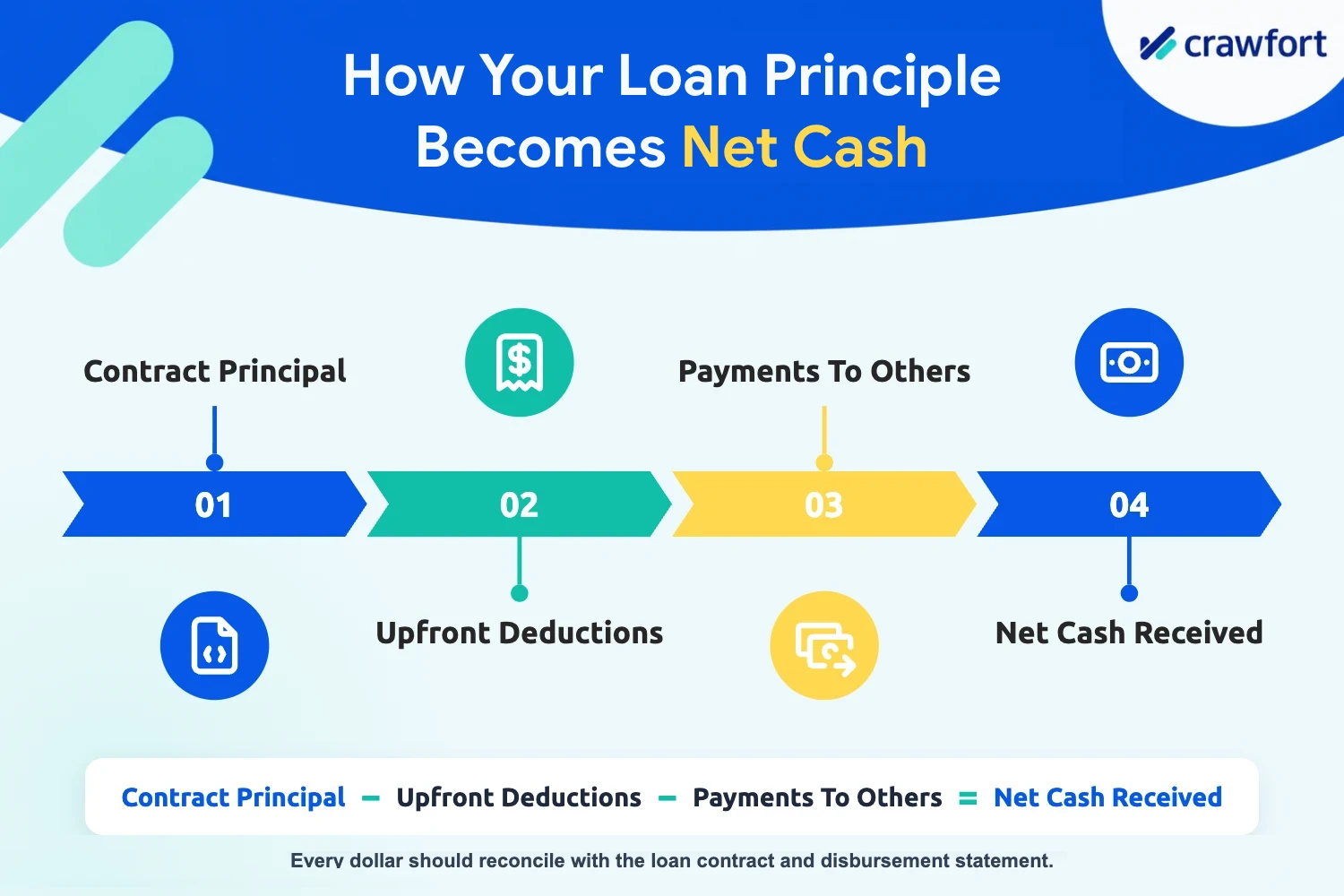
Use the contract principal as the starting point, then account for every authorised deduction or direct payment.
This is a cash-flow calculation, not the full cost of the loan. Interest, future fees and repayment timing still affect how much you eventually pay. Labels also vary between products, so use the definitions and figures in your own contract.
Five Reasons Your Disbursement May Be Lower
1. The Lender Approved Less Than You Requested
Suppose you applied for S$8,000 but the lender offered S$5,000. If the contract lists a S$5,000 principal and S$5,000 reaches you, there is no disbursement shortfall. The approval was simply lower than your application.
Do not use the requested amount as the baseline once an offer has been issued. Compare the bank credit against the amount in the final contract or approval notice.
2. A Processing Or Administrative Fee Was Deducted Upfront
Some products charge a fee when a loan is approved and deduct it before transferring the balance. MoneySense lists a processing fee as a loan cost that is usually charged upfront upon loan approval. Whether a bank loan has such a fee, and how it is collected, depends on that product’s current terms.
A legitimate deduction should not be a surprise. The contract or fee schedule should state the amount or calculation method clearly enough for you to reproduce the net payout.
3. Part Of The Loan Was Paid Directly To Someone Else
Not every loan is paid entirely into the borrower’s account. Under an agreed arrangement, some proceeds may go to an existing creditor, a merchant or another named recipient. For example, a debt consolidation loan may be structured to settle existing debts instead of giving you the whole amount as free cash.
This reduces the cash you personally receive, but it is not necessarily a fee. Check that every third-party payment was authorised, correctly recorded and included in the disbursement statement.
4. The Loan Is Released In Stages
Some housing, renovation, education or business facilities are drawn down in tranches. The contract may state a total facility or principal limit, while only the amount needed for the current stage is released.
In this situation, check the drawdown schedule rather than assuming the first credit is the final payout. Confirm what conditions must be met before the remaining amount is released and when interest begins to accrue on each portion.
5. The Difference Is An Error Or Undisclosed Deduction
A lower payout should never be accepted on the basis of a vague explanation such as “system charges”. If the figures do not reconcile, ask for a written breakdown before using the money or signing any acknowledgement that the correct amount was received.
An arithmetic error, duplicate deduction or unauthorised charge is different from a properly disclosed fee. Treat it as an unresolved discrepancy until the lender identifies the exact contractual clause and corrects any mistake.
Learn more about comparing loans in Singapore by rates, fees and terms.
How Upfront Fees Work For Loans In Singapore
For Bank And Finance Company Loans
Fees vary by lender and product. A processing fee may be a flat sum or a percentage, and it may be collected separately or deducted from the approved amount. The relevant documents are the current offer, pricing guide, fee schedule and repayment schedule—not an example from another lender.
Compare the advertised rate, the effective interest rate (EIR), the cash you will actually receive and the total amount repayable. Crawfort’s guide to effective interest rates explains why the headline rate alone does not give you a complete comparison. You still need the upfront fee line because EIR and net cash answer different questions: EIR concerns borrowing cost, while net disbursement tells you how much usable cash arrives.
For Licensed Moneylender Loans
The rule is more specific. The Ministry of Law states that a licensed moneylender may make an upfront deduction of a loan approval fee of up to 10% of the principal. “Up to” is a cap; it does not mean every lender must charge 10%.
The Registry of Moneylenders also explains the permitted interest and fees in its borrowing guide for licensed moneylender loans. Apart from the permitted approval fee, a moneylender should not withhold another part of the principal without a valid basis.
Do not confuse an approval fee with interest. The fee affects the cash received at the start. Interest is a separate borrowing cost calculated and collected according to the contract and applicable rules.

A Worked Example: S$5,000 Principal, S$4,600 Received
To illustrate the difference for a licensed moneylender loan, assume a contract states a S$5,000 principal and an upfront approval fee of 8%. This is an illustration, not a quotation or recommendation.
| Item | Calculation | Amount |
|---|---|---|
| Contract principal | Stated in the loan contract | S$5,000 |
| Upfront fee | S$5,000 × 8% | S$400 |
| Net cash received | S$5,000 − S$400 | S$4,600 |
The S$400 difference is a fee deduction; it does not change the contract principal to S$4,600. Repayment obligations must be checked against the S$5,000 principal, the interest method, the repayment schedule and every other applicable term.
Now compare that with a different scenario: you request S$5,000, but the lender approves only S$4,000 and charges no upfront fee. If S$4,000 is credited, the principal and payout match. This is a lower approval, not a fee. Asking “Where did the amount first change?” prevents these two situations from being mixed up.
What Should I Check Before I Sign A Loan Contract?
A sales summary is not enough. Put the offer, contract and repayment schedule side by side, then check whether they describe the same transaction.
Contract And Cost Checklist
Confirm These Figures In Writing:
- The approved amount and the principal stated in the contract
- The exact amount that will reach your account or be handed to you
- Every upfront deduction, shown in Singapore dollars and as a percentage where applicable
- Any portion paid directly to another party, including the recipient and purpose
- The advertised interest rate, EIR and interest calculation method
- Each instalment, repayment frequency and total amount repayable
- Late payment, cancellation and early repayment charges
- Any conditions for later tranches or further drawdowns
The practical test is affordability after all deductions. If you need S$5,000 for an expense but will receive only S$4,600, borrowing more simply to close the gap may increase your repayment burden. Work the confirmed instalment into your budget and plan repayments around your monthly salary before committing.
Learn more about what to consider before taking a personal loan in Singapore.
What To Do If You Have Already Received Less
Reconcile The Transaction Line By Line
Take the contract principal and subtract each disclosed upfront fee and authorised third-party payment. The result should match the cash, cheque or bank credit you received. Do not mix future interest or late charges into this day-one calculation.
Request A Written Breakdown
Ask the lender to set out the principal, each deduction, each third-party payment, the net disbursement and the total repayment obligation. A written response gives you something concrete to compare with the contract and account statement.
Challenge Anything That Was Not Disclosed
Ask which clause authorises the deduction and why it did not appear in the offer or fee schedule. Keep the contract, approval messages, receipts and account records. If a bank or finance company made the loan, use its formal complaint channel when the frontline response does not resolve the discrepancy.
Verify A Licensed Moneylender Independently
For a moneylender loan, confirm the business name, address, telephone number and website against the Ministry of Law’s current list of licensed moneylenders. The same official page warns that requests to transfer “GST fees” or “processing fees” before a loan is disbursed are used in loan scams.
If someone demands a separate transfer to release the balance, stop and verify the lender independently. That is different from a permitted fee deducted after a licensed moneylender grants a loan. The Registry’s borrowing guide also explains how to report complaints about moneylender conduct.
Match The Cash Received To The Contract Before You Spend It
A lower payout is not automatically a problem, and it is not automatically fine either. What matters is whether the cash you received reconciles with the approved principal, the disclosed fees and any authorised payments.
If one line is missing, ask for a written breakdown before you spend the money or sign any acknowledgement. Licensed moneylenders follow the Ministry of Law’s rules, so a legitimate deduction can always be explained clearly and in writing.
Ready to get started? Apply for a loan with Crawfort and get approved in as fast as 8 minutes, with your principal, fees and repayment schedule laid out before you sign.
Important note: This article is for general information only and does not consider your personal financial situation. Before taking a loan, review the loan contract carefully and make sure repayments are manageable.