Alwin Goh
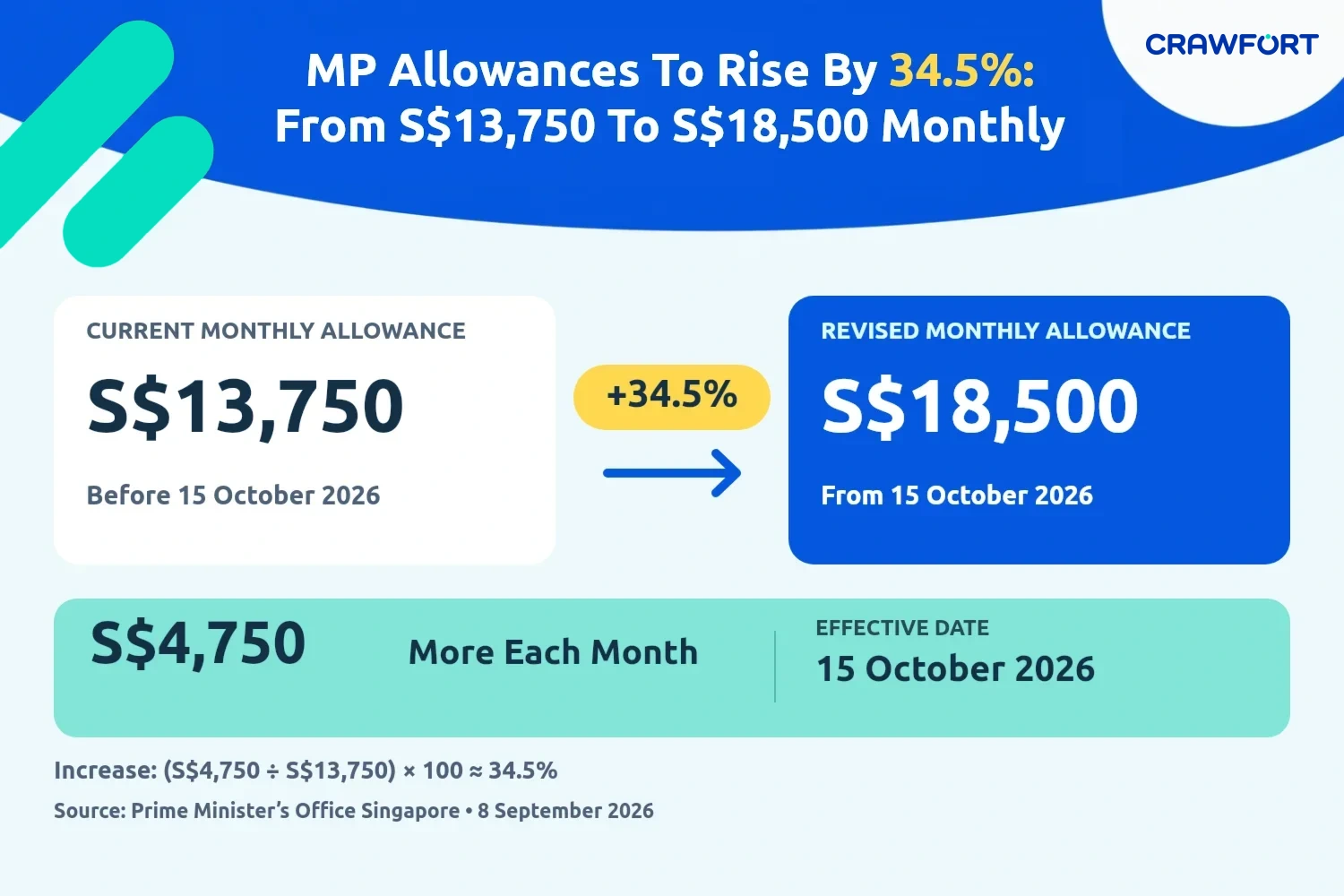
Members of Parliament in Singapore will receive a monthly allowance of S$18,500 from 15 October 2026, an increase of S$4,750 from the current S$13,750. That works out to a rise of approximately 34.5%.
Prime Minister Lawrence Wong announced the adjustment in Parliament on 8 September. The Prime Minister’s Office announcement on the revised salaries and allowances confirms the amount and implementation date.
The headline figure is the monthly payment. Understanding the full change also requires looking at annual components, different arrangements for NCMPs and NMPs, and a proposed review of how allowances are determined.
How The 34.5% Increase Is Calculated
Subtracting the existing allowance from the revised amount gives the monthly difference:
S$18,500 − S$13,750 = S$4,750
To calculate the percentage increase, divide that difference by the original amount:
S$4,750 ÷ S$13,750 × 100 = 34.5454…%
Rounded to one decimal place, the increase is 34.5%. Reports using 34.55% are expressing the same calculation to two decimal places.
The starting amount matters. Dividing S$4,750 by S$18,500 would measure the difference as a share of the new allowance, which answers a different question. A percentage increase uses the old figure as its base.
It is also a cumulative change between two allowance levels. It should not be read as an annual growth rate or as a claim that consumer prices rose by 34.5% in a single year.
For context on the difference between price levels and annual price changes, Crawfort’s explanation of how inflation affects households covers why the period being measured matters.
Why The Annual Figure Is S$259,000
An MP’s annual allowance includes monthly payments, a 13th-month payment and an annual variable component. According to The Straits Times’ breakdown of the annual allowance, the revised annual amount is S$259,000 when a one-month variable component is assumed, compared with S$192,500 previously.
The arithmetic uses 14 months of the stated allowance: 12 regular monthly payments, one 13th-month payment and the assumed one-month variable component.
At the revised rate:
- Twelve monthly payments: S$18,500 × 12 = S$222,000.
- Adding the 13th-month payment: S$222,000 + S$18,500 = S$240,500.
- Adding a one-month variable component: S$240,500 + S$18,500 = S$259,000.
The equivalent old-rate calculation is S$13,750 × 14 = S$192,500. On the same assumptions, the annual difference is therefore S$66,500.
This explains why multiplying the monthly increase by 12 produces S$57,000, a smaller number. That calculation covers only the 12 regular payments; it leaves out the increase in the other two components used in the annual illustration.
The variable-component assumption must remain attached to the total. If the number of months used for that component changes, the annual amount changes too. A comparison should use the same assumption on both sides.
Also Read: How To Calculate Gross Monthly Income In Singapore
Why The Government Is Raising MP Allowances
Coordinating Minister for Public Services Chan Chun Sing said the adjustment accounts for inflation since the earlier review. As CNA reports on the reasons for the allowance increase, the Government accepted the earlier assessment that the allowance level was appropriate at the time and is updating it for the intervening period.
In his ministerial statement on the Government’s response to the salary review, PM Wong linked proper allowances to MPs’ parliamentary and constituency responsibilities. He said the arrangement had helped both the PAP and the Workers’ Party attract strong candidates from different backgrounds.
These explanations address two related questions: whether the payment has kept pace with changing conditions, and whether the terms of service support political recruitment.
The percentage calculation alone cannot settle either question. Assessing the inflation rationale requires a price comparison over the relevant period. Assessing whether the allowance is appropriate also involves judgements about the role, its responsibilities and the terms on which people enter public service.
What Changes For NCMPs And NMPs
Non-Constituency MPs will receive S$5,550 monthly. Their allowance peg rises from 15% to 30% of an MP’s annual allowance, with the change taking effect on 15 October. Mr Chan linked the higher proportion to NCMPs’ full voting rights since 2017 and their parliamentary responsibilities.
Nominated MPs retain the existing 15% peg. The Straits Times reports an annual amount of approximately S$38,900 under the revised arrangement, compared with S$77,700 for NCMPs, assuming a one-month annual variable component.
Why The NCMP Increase Is Larger
Two changes operate together for NCMPs: the underlying MP allowance rises, and the proportion used to calculate their allowance doubles.
Using the stated monthly rates, 15% of S$13,750 is S$2,062.50. Applying the new 30% proportion to S$18,500 gives S$5,550. The difference is S$3,487.50, or approximately 169.1% of the old calculated amount.
Simply describing this as a doubling would miss the higher base. Doubling the old amount alone would produce S$4,125, which is below the revised S$5,550.
Why An Unchanged NMP Peg Can Still Mean More Money
For NMPs, keeping the proportion at 15% does not freeze the dollar amount. Fifteen per cent of S$18,500 is S$2,775, compared with S$2,062.50 using the previous MP rate.
These are calculations from the stated percentages. They explain the effect of the peg without treating NCMPs and NMPs as receiving the same adjustment.
Why A Separate Allowance Framework Is Being Studied
The Government will study whether allowances for community-related roles, including MPs and mayors, should be determined separately from the ministerial salary benchmark. Mr Chan said the considerations for these roles can differ from those for full-time political appointment holders.
The proposal concerns the basis for setting payments. A benchmark provides a reference point; a peg links another payment to that reference through a specified proportion.
Separating the arrangements could allow the Government to assess the relevant roles using a different basis. However, the announcement does not establish what that replacement would be.
It would therefore be premature to describe the study as a confirmed move to inflation-only indexation, a new automatic annual increase, or a particular future allowance level. Those outcomes do not follow simply from the decision to examine the framework.
How This Differs From Ministerial Salary Changes
The wider announcement also updates the MR4 ministerial reference salary from S$1.1 million to S$1.8 million annually. Existing political appointment holders will receive a one-off adjustment of up to 9%, depending on individual circumstances, including performance, rather than immediately moving to the new benchmark.
For a minister earning S$1.1 million, a full 9% adjustment would bring the amount to approximately S$1.2 million. PM Wong said subsequent changes would depend on performance and responsibilities.
These figures describe different things. S$18,500 is the revised monthly MP allowance; 34.5% is the calculated increase in that allowance; and up to 9% describes the separate immediate adjustment for existing political officeholders.
Using one percentage for all three would give readers an inaccurate picture of the announcement. Monthly figures should also be kept separate from annual reference salaries when making comparisons.
How The Review Reached This Point
The committee was appointed in December 2025. In a 6 May update on the review’s progress, Mr Chan said it had submitted its recommendations in April.
The Government then deferred consideration because the Middle East conflict was creating economic uncertainty. It said the report and its response would be released together so Parliament could consider both.
That sequence helps distinguish the committee’s work from the Government’s implementation decision. Recommendations had been submitted before the September announcement; submission did not itself put new payments into effect.
What To Watch In The Parliamentary Debate
Parliament is scheduled to debate the Government’s response on 10 September. The next useful clarification will be how the proposed study is scoped, particularly which responsibilities and comparison measures would inform a separate allowance framework.
Until those details are announced, the confirmed payment changes and the unresolved framework questions should be read separately. That distinction will matter when assessing any further proposals emerging from the debate.