

 Alwin Goh
Singapore’s credit card rollover balance reached S$9.45 billion in Q1 2026, the latest official quarterly figure available as of 27 August 2026. This extended the rise that first drew wider attention when the balance reached S$9.07 billion in Q3 2025—a 10-year high at the time.
However, the problem is not limited to people who miss credit card payments. You can pay the minimum amount on time and still carry a balance that earns interest and takes a long time to repay.
That distinction explains how the national rollover balance can keep rising while reported credit card delinquency remains below 1%. Paying on time prevents an immediate missed-payment problem; paying down the principal is what reduces the debt.
The figures below compare the earlier news figure with the latest official data. A record total balance may show rising credit card debt, but it does not mean every cardholder has a repayment problem.
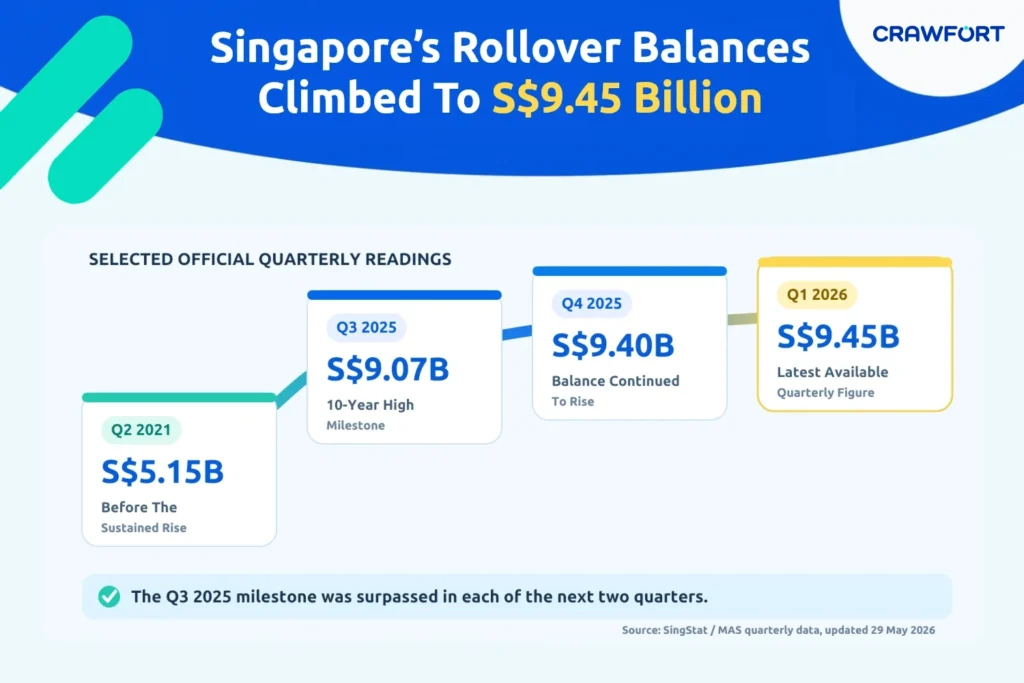
| Period | Rollover Balance | What It Shows |
|---|---|---|
| Q2 2021 | About S$5.15 billion | The starting point for the sustained rise shown in the latest official series |
| Q3 2025 | S$9.07 billion | The 10-year-high milestone reported in December 2025 |
| Q4 2025 | S$9.40 billion | The balance continued rising after the reported milestone |
| Q1 2026 | S$9.45 billion | The latest available quarterly figure as at 27 August 2026 |
Data Checked: 28 August 2026 | Figures are checked against the latest available official sources.
Table of Contents
- What Singapore’s S$9 Billion Rollover Balance Means
- Why A High Balance Does Not Mean Widespread Default
- Why Rollover Debt Becomes Expensive
- When A Card Balance Becomes A Repayment Problem
- What To Do If You Are Carrying A Balance
- When Consolidation Or Credit Counselling May Help
- What The Data Means For Cardholders
- Frequently Asked Questions
What Singapore’s S$9 Billion Rollover Balance Means
A credit card rollover balance is the amount that incurs interest because the card charges were not settled by the due date. It includes both an unpaid minimum payment and the balance left after the minimum sum has been paid.
That makes rollover balance different from the current outstanding balance displayed in your banking app. The current balance may include recent purchases that have not appeared on a statement or are still within the interest-free payment period.
Paying a statement in full by its due date generally prevents those purchases from becoming rollover debt, subject to the card’s terms.
Moreover, the December 2025 CNA report on unpaid card balances noted that the number of principal cardholders had fallen to about 6.1 million in Q3 2025. A larger rollover balance alongside fewer principal cardholders may indicate a heavier average balance, although aggregate statistics cannot show how that debt is distributed between households.
The total also does not explain why people are carrying credit card balances. Some may clear their balance within one or two billing cycles. Others may only make the minimum payment while continuing to spend. This is riskier because interest and new spending can keep the balance high even when payments are made.
Why A High Balance Does Not Mean Widespread Default
CNA reported that credit card delinquency remained below 1 per cent using data available in April 2025. That is an important counterweight to the S$9.07 billion headline: most cardholders were still servicing their debt, so the record rollover balance should not be described as widespread default.
However, the two figures cover different concepts and periods. Rollover balance measures interest-bearing debt. Delinquency measures accounts that have fallen sufficiently behind under the applicable reporting definition. A cardholder who pays the minimum sum on time can avoid being recorded as delinquent while still carrying an expensive balance for months.
Low delinquency is reassuring from a system-wide credit perspective. It does not tell an individual cardholder that their balance is affordable. Your own test is whether the principal is falling steadily without using fresh credit for normal monthly expenses.
Singapore’s unsecured credit safeguards also limit additional borrowing in specified circumstances. Understanding the credit-limit rules that may apply in Singapore can help you see why a high available limit should not be treated as a spending budget.
Why Rollover Debt Becomes Expensive
Once a statement is not paid in full by the due date, finance charges apply according to the card agreement. Interest may be calculated daily, while unpaid interest and fees can increase the next statement. New purchases may also lose the usual interest-free treatment until the outstanding balance is fully settled, depending on the issuer’s terms.
The minimum payment keeps the account from falling further behind only if it is paid on time. It is not a repayment strategy by itself. Part of that payment goes towards interest and charges, leaving less to reduce the principal. If you continue spending on the card, the amount owed may barely move or may rise despite regular payments.
Cash advances deserve particular caution. They can attract a cash-advance fee and interest without the normal interest-free period. Using one card or credit facility to service another can also hide the underlying cash-flow shortfall.
Also Read: Compare a credit card cash advance with a personal loan
When A Card Balance Becomes A Repayment Problem
The national balance cannot tell you whether your own debt is manageable. Your monthly statements can. Look at the movement in principal over at least three months, not only whether the minimum was paid.
Warning Signs To Act On
- You can pay only the minimum sum and the principal is not falling.
- You use one credit facility to make payments on another.
- Groceries, utilities or transport are going on the card because your salary has run out.
- You have missed a due date or expect to miss the next one.
- You do not know the total owed across all cards and unsecured loans.
- You keep using a card after deciding to pay it down.
Do not wait for an account to become delinquent before asking for help. Contacting the issuer early may leave more room to discuss a repayment arrangement. Ignoring statements, calls or letters usually narrows the available choices.
Also Read: What to do if you cannot pay your credit card bill
What To Do If You Are Carrying A Balance
1. Stop Adding New Card Debt
Move recurring expenses to a debit account if sufficient funds are available, remove stored card details from shopping apps and pause non-essential instalment purchases. A repayment plan cannot work if new spending replaces every dollar paid off.
2. Build One Complete Debt List
Record each card or unsecured facility, its balance, finance charge, minimum payment and due date. Include instalment plans and unbilled card transactions. The total may be uncomfortable, but it is the starting point for a workable plan.
3. Protect Essentials And Minimum Payments
Set aside housing, utilities, food, transport, insurance and other necessary commitments first. Then ensure required minimum payments are made by their due dates while you decide how to direct any extra repayment. If there is not enough cash for the minimums, contact the financial institutions immediately.
4. Direct Extra Cash Towards Higher-Cost Debt
Where the terms allow, paying more towards the facility with the highest effective cost can reduce total interest. Before shifting savings or taking another product, compare the interest, fees, tenure, monthly payment and total repayment. A lower monthly instalment may simply extend the debt.
A structured comparison can help if you are deciding whether to use savings or repay debt first. Keep an emergency buffer rather than leaving yourself dependent on the card again after an unexpected bill.
5. Automate What You Can Monitor
A GIRO arrangement or scheduled reminder can reduce accidental late payment, but automation is useful only when the paying account has enough money. Continue checking every statement for new charges, fees and changes in the balance.
Also Read: How to pay credit card bills and avoid missed due dates
When Consolidation Or Credit Counselling May Help
Managing several cards can create different due dates, rates and minimum payments. Consolidating eligible unsecured debts may replace those obligations with one repayment, but it is not automatic debt relief. Approval, pricing and suitability depend on the financial institution’s assessment, and the new repayment still has to fit your budget.
As at August 2026, the Association of Banks in Singapore’s Debt Consolidation Plan criteria include being a Singapore Citizen or Permanent Resident, earning from S$20,000 to below S$120,000 a year, having net personal assets below S$2 million, and owing interest-bearing unsecured debt exceeding 12 times monthly income. Meeting the stated criteria does not guarantee an offer.
If those conditions may fit your situation, you can review how a Debt Consolidation Plan works before comparing participating financial institutions’ terms. Check the monthly repayment, tenure, interest, fees, early-settlement conditions and any shortfall you may still need to pay.
A Debt Consolidation Plan is different from a Debt Management Programme. Credit Counselling Singapore’s Debt Management Programme is a formal restructuring arrangement for suitable debt-distressed borrowers who have sufficient payment capacity, subject to creditor approval. An independent counselling discussion can be useful when you are unsure which route, if any, is realistic.
What The Data Means For Cardholders
The Q3 2025 headline was a warning about the growing amount of interest-bearing card debt, not proof that cardholders across Singapore were defaulting. The later rise to S$9.45 billion in Q1 2026 strengthens the case for watching rollover balances even while delinquency remains comparatively low.
For an individual, the useful measure is not the national total. It is whether the balance is falling, whether payments are made without fresh borrowing, and whether the repayment plan leaves enough for essential expenses. If any of those tests fail, speak to the issuer or a qualified debt counsellor before the next missed payment.
Important note: This article is for general information only and does not consider your personal financial situation. Before taking a loan or refinancing debt, review the contract carefully and make sure the repayments are manageable.



