

 Alwin Goh
When the money does not stretch, most people do the same thing: pay a bit towards every bill so nobody is ignored. It feels fair. It usually fails. You end up with four accounts still overdue, an empty wallet, and no money for groceries or the trip to work.
A shortfall is not a budgeting problem. It is a triage problem. You are deciding which consequence your household can survive this week, and which one it cannot.
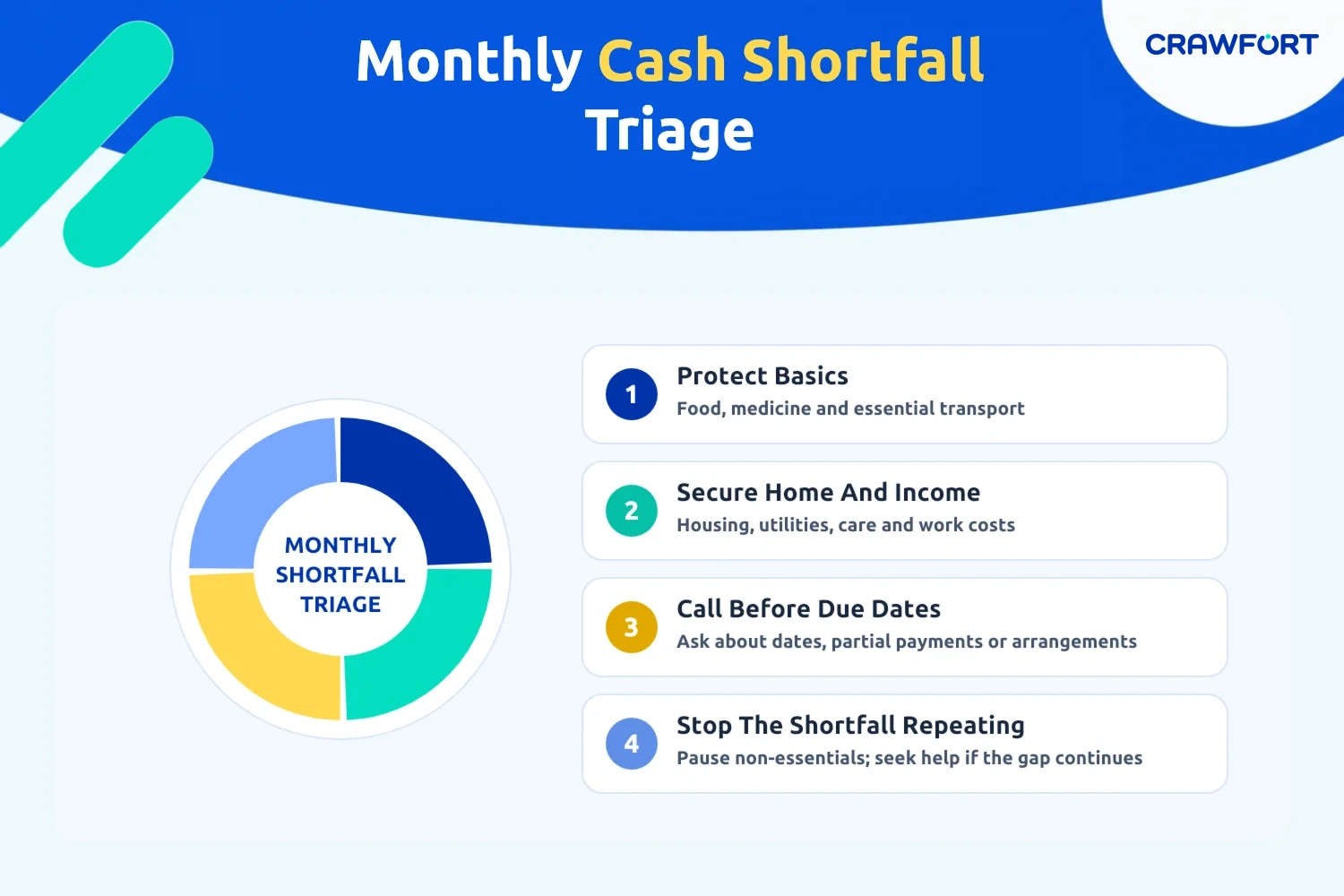
The table below splits the decision into four questions. Answer them in order.
| Question | What To Look At | What To Do |
|---|---|---|
| How much is actually missing? | Cash you definitely have, bills due before your next confirmed pay | Work out one number instead of panicking at the total of every bill |
| What cannot wait? | Food, medicine, housing, power, and whatever keeps your income coming in | Fund the consequences you cannot absorb, in that order |
| What can move? | Provider policies, due dates, instalment options, things you can pause | Call before the deadline and get any arrangement in writing |
| Will this happen again next month? | Whether normal monthly costs exceed reliable income | Treat a repeat gap as structural, not as a reason to borrow again |
Table of Contents
- Why Paying Everyone A Little Backfires
- Step 1: Work Out The Real Gap
- Step 2: Rank Bills By Consequence
- Step 3: Call Before You Miss A Payment
- Step 4: Fix Next Month, Not Just This Week
- How A Small Gap Becomes A Debt Spiral
- Where To Get Help In Singapore
- Your First 30 Days
- Make Next Month Easier
- Frequently Asked Questions
Why Paying Everyone A Little Backfires
Percentage budgets assume there is income left to divide. When essential costs already exceed what you earn, percentages cannot tell you which outcome hurts least.
And the outcomes are not equal. A late fee on a card is annoying. Losing your electricity supply, missing medication, or being unable to get to work are different orders of damage. Spreading S$220 across five bills protects nothing. Putting it against the one bill with the worst consequence protects something real.
There is also a practical reason to keep this simple: money stress eats your attention. When you are worried, you make worse decisions, not better ones. So use one list, one date range, one order. Skip the advice about building six months of savings for now. That comes after the bleeding stops.
Step 1: Work Out The Real Gap
Ignore the total of every outstanding bill. That number is frightening and useless. Look only at the window between today and your next confirmed pay date.
Write down money you actually have. Not a bonus you are hoping for, not overtime that has not been approved, not cash a friend might return. Then list every essential cost and bill falling due inside that same window.
Real shortfall = priority bills due before your next pay − cash you can safely use
Say S$1,450 falls due before payday and you have S$1,230 you can rely on. Your shortfall is S$220. That is the number you negotiate around, reduce, or delay. It is far more manageable than the S$6,000 of total balances sitting across your accounts.
Check your GIRO deductions and recurring card charges too. These take money automatically, which means a subscription can quietly outrank your groceries simply because it is scheduled earlier.
Also read: what happens when a repayment date lands on a weekend or public holiday
Now look back over two or three ordinary months. Include costs that are not monthly, like annual insurance or school fees, by setting aside a realistic monthly share. If those months were negative too, this month’s emergency is not really an emergency. It is a pattern.
Also read: how to tell a one time cash gap from a recurring budget deficit

Step 2: Rank Bills By Consequence
Do not rank by size, by how many reminder messages you have received, or by which one embarrasses you most. Rank by what breaks if you do not pay it.
- Health and daily survival. Food, essential medicine, and transport to work, school or medical appointments. Nothing outranks this.
- Your home and essential utilities. Rent, mortgage or HDB payments, electricity and water. Read the actual notice rather than assuming every provider behaves the same way.
- Your ability to earn. Basic phone and data, childcare, caregiving, work tools. Cutting these to pay a bill can cost you your income.
- Time sensitive obligations. An insurance premium about to lapse or a court directed payment. Check the date and ask what a delay actually changes.
- Debt repayments. Make minimum payments where you can. Do not skip food or medicine to pay extra towards a card. If even the minimum is impossible, call the creditor.
- Everything optional. Subscriptions, memberships, delivery apps, upgrades. Pause them while you stabilise.
This order changes if you are holding a disconnection, repossession, legal or policy lapse notice. A formal deadline beats a general rule. Read the notice, note the exact date, and move that bill up.

Step 3: Call Before You Miss A Payment
Once you know what you cannot pay in full, say so. Silence costs you the chance of an arrangement, and fees keep running in the background while you avoid the phone.
Keep the call short and factual. What changed, what you can pay now, when your next confirmed income arrives, what schedule you can actually hold. Then ask:
- Will a partial payment stop or delay the consequence?
- Can the due date shift to match my pay date?
- Is there a temporary instalment or hardship arrangement?
- Will interest, late fees or service restrictions continue?
- How will this be recorded on my account?
Get it in writing. Note the officer’s name, the date and a reference number. A partial payment you made on your own initiative, without agreement, still leaves the account overdue.
Step 4: Fix Next Month, Not Just This Week
Before you add a single new commitment, calculate next month. Sort your spending into three buckets: fixed and essential, reducible, removable.
Start with the big recurring amounts. Renegotiating one contract or repayment usually beats tracking every kopi. Small cuts still count, especially repeatable ones, but give each saving a job: this S$40 covers transport in the last week, this S$60 prevents one late fee.
Do not force a percentage rule onto a budget that is already negative. Consequence and affordability come first; ideal ratios come later.
Also read: a fuller financial health checklist for reviewing cash flow, debt and savings
If the revised budget is still negative after honest cuts, name the leftover amount out loud. That gap needs a real fix: more income, a renegotiated major commitment, formal assistance, or debt help. Moving it onto a credit card does not remove it. It just adds interest to it.
How A Small Gap Becomes A Debt Spiral
Borrowing improves today’s balance and weakens every month after it. The money arrives once. The repayment comes back every month as a new fixed cost.
Take a household earning S$3,200 a month with S$3,380 of ordinary expenses and commitments. It is already S$180 short every month. Add a loan with a S$220 monthly instalment to clear this month’s bills, and next month’s gap becomes S$400 before anything else goes wrong.
That is an illustration, not a quote. The real test is simple: does your budget have a genuine surplus that can carry the new instalment? A bridge can work when the need has a clear end and the repayment fits your future income. It does not work when repayment depends on another loan, on income you have not confirmed, or on skipping essentials.
If you do borrow, know the limits. For licensed moneylenders in Singapore, the Registry of Moneylenders caps interest at 4% per month, late interest at 4% per month on the late amount, the late fee at S$60 for each month of late repayment, and the upfront loan approval fee at 10% of the principal. Total charges on a loan cannot exceed the principal itself. These caps are current as of September 2026 and are set out in the FAQs for borrowers.
Caps limit the damage. They do not make a loan affordable. Compare the cash you actually receive, the fees, the interest, the number of instalments, the total repayment and the late payment terms. A smaller instalment over a longer loan tenure often costs more overall.
Also read: seven checks that keep an urgent loan down to the amount you actually need
Where To Get Help In Singapore
If you have already cut everything optional, there may be nothing left to cut safely. Asking for help is not a last resort at that point. It is the next step in the plan.
The Ministry of Social and Family Development runs ComCare, which provides financial assistance and social support to individuals and families who need help with daily living expenses. Short to Medium Term Assistance covers people who are temporarily unable to work, looking for a job, or on a low income. There is also interim assistance for urgent, temporary relief. Eligibility is assessed case by case, and you can apply through SupportGoWhere with Singpass or at a Social Service Office.
If unsecured debt is what is eating the budget, Credit Counselling Singapore offers counselling that reviews your income, spending and payment capacity, then works out which options fit. A Debt Management Programme is not automatic. Suitability is assessed, and proposals still need creditor approval.
Learn more: what to expect from credit counselling in Singapore
Your bank, insurer, landlord or utility provider may also have arrangements they do not advertise. Ask early, bring complete documents, and keep copies of everything you submit.
Your First 30 Days
Today: Make The Gap Visible
Write down available cash, your next confirmed pay date, every bill due before it, and the minimum you need for essentials. Check GIRO and recurring card deductions so they do not jump the queue.
Within 48 Hours: Protect And Contact
Set aside money for basics first. Then call the providers you cannot pay as agreed. Start any assistance application now, while payslips, bank statements and notices are easy to gather.
Before Payday: Assign The Money In Advance
Decide where your next pay goes before it lands. Shift due dates where providers allow it, cancel what you are pausing, and set aside a monthly share for bills that are not monthly.
By Month End: Check Whether It Worked
Compare what actually came in and went out against your plan. If the gap is still there, do not paper over it with new borrowing. Escalate to counselling, assistance, or a bigger change to a recurring commitment. Once the budget is no longer negative, start a small buffer that covers one common expense. A reachable S$300 beats an ideal S$15,000 you will never fund.
Make Next Month Easier
Put one figure at the top of next month’s plan: your surplus or shortfall after essentials and existing commitments. If it is negative again, do not repeat the same scramble. Move from triage to negotiation, assistance, counselling, or a real change to a big recurring cost.
A good decision does not have to fix your finances in one move. It only has to protect daily life now without making next month worse.
Instead of shuffling due dates again next month, you can find out where you stand in minutes. Apply through the Crawfort app, fills in your details, and see your result in the app itself. Check what a personal loan would cost you, and borrow only what your budget can carry.
Important note: This article is for general information only and does not consider your personal financial situation. Before taking a loan or agreeing to a restructuring plan, review the contract carefully and make sure the repayments are manageable.



