Alwin Goh

A lender cannot assess an income figure it cannot verify. Whether you are applying for a personal loan, home loan or another credit facility, you will usually need documents showing how much you earn, where the money comes from and whether that income is reasonably consistent.
The exact requirements differ between lenders and loan products. A salaried employee may qualify with recent payslips or CPF records, while someone who is self-employed could be asked for tax assessments covering a longer period. Preparing the right documents before applying can reduce delays, follow-up questions and avoidable rejection.
The documents lenders commonly consider are summarised below. Treat this as a starting point and check the lender’s current application requirements before submitting anything.
| Applicant Profile | Common Proof Of Income | What The Document Helps Show |
|---|---|---|
| Salaried Employee | Recent payslips, CPF contribution history or salary-crediting statements | Current salary and employment consistency |
| New Employee | Latest payslip and employment contract or confirmation letter | New salary and employment start date |
| Commission-Based Employee | Payslips, commission statements, CPF records and Notice of Assessment | Variable earnings over time |
| Self-Employed Applicant | Recent Notices of Assessment, business records and bank statements | Declared income and business cash flow |
| Freelancer Or Gig Worker | Tax records, invoices, contracts and bank statements | Sources and consistency of earnings |
| Foreign Employee | Payslips, employment contract, bank statements and valid work pass | Employment status and income received in Singapore |
Table Of Contents
- What Counts As Proof Of Income?
- Common Proof Of Income Documents In Singapore
- Which Documents Should You Submit For Your Employment Type?
- What If You Have No Payslip Or CPF Contributions?
- How To Prepare Your Documents
- Common Problems That Can Delay An Application
- Does Proof Of Income Guarantee Loan Approval?
- What To Check Before Applying
- Frequently Asked Questions
What Counts As Proof Of Income?
Proof of income is any acceptable record that lets a lender verify your earnings. A useful document should normally identify you, show the source of the income and cover the period requested by the lender.
The strongest applications tend to contain records that agree with one another. For example, the salary on your payslip should broadly correspond with the amount credited to your bank account and the CPF contribution recorded for that month. Differences may be legitimate, particularly where bonuses, commissions, unpaid leave or reimbursements are involved, but you may need to explain them.
Income proof is separate from identification and address documents. Your NRIC, passport, work pass or utility bill may establish who you are and where you live, but they do not establish how much you earn.
You should also check whether the application asks for gross, basic or net income. If you are unsure how the figures differ, this explanation of how to calculate gross monthly income can help you enter the right amount.
Common Proof Of Income Documents In Singapore
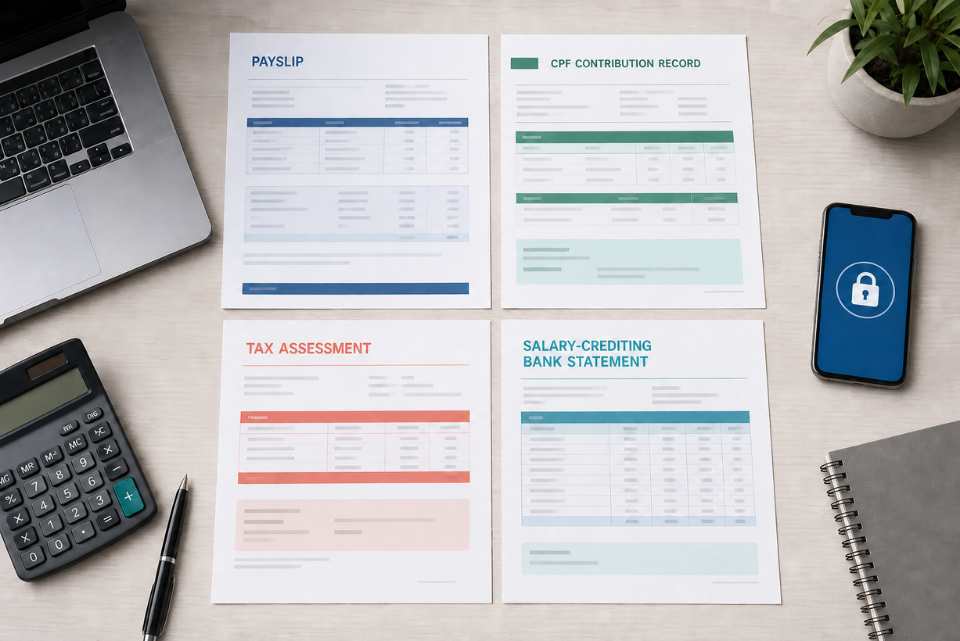
Recent Payslips
Payslips are commonly used because they show your employer, salary period, basic pay, allowances, deductions and net pay. Depending on the lender and loan, you may be asked for one or several consecutive months.
The Ministry of Manpower states that employers must issue itemised payslips to employees covered by the Employment Act. If you have misplaced yours, ask your employer’s payroll or human resources department for copies.
Check that each payslip contains your name, employer’s name and the relevant salary period. Screenshots with missing details may not be accepted.
CPF Contribution History
For employees receiving CPF contributions, contribution history can help verify your employer and recent earnings pattern. CPF Board allows members to view and save CPF contribution details through its digital services.
Download the period requested by the lender rather than assuming the latest month is sufficient. CPF records may be less useful where your income is not subject to CPF contributions, you have only recently started work or part of your remuneration is variable.
Never give a lender your Singpass password. Log in yourself and submit the authorised document through the lender’s official channel.
IRAS Notice Of Assessment
Your Notice of Assessment, commonly called an NOA, is your tax bill. IRAS explains that it shows the types and amount of income taxed, deductions claimed and tax payable or repayable.
Because an IRAS Notice of Assessment covers income earned in the preceding calendar year, it may not reflect a recent promotion, job change or fall in earnings. A lender may therefore request a recent payslip or bank statement alongside it.
The NOA is particularly useful for commission-based and self-employed applicants whose income changes from month to month. Some lenders request more than one year so they can assess a broader earnings pattern.
Salary-Crediting Bank Statements
Bank statements can show that salary payments were actually credited to an account in your name. They are also helpful where the lender needs to compare salary deposits across several months.
Use official statements displaying your name, account details, transaction dates and incoming salary entries. A cropped transaction screenshot may not provide enough context.
Bank statements alone may not always establish the nature of a payment. Transfers from clients, family members or your own accounts can look similar without invoices, contracts or other supporting records.
Employment Contracts And Employer Letters
An employment contract or employer letter may support an application if you recently joined a company and do not yet have several payslips. It should state your employer, position, start date and remuneration.
This document does not automatically replace the lender’s required income records. Ask whether it will be accepted before submitting your application, particularly if you are still on probation or have not received your first salary.
Which Documents Should You Submit For Your Employment Type?
Salaried Employees
A salaried employee will usually have the clearest document trail. Prepare recent payslips and check whether the lender accepts CPF contribution history, an NOA or salary-crediting statements as an alternative.
For example, HSBC’s published supporting-document requirements list different combinations of CPF records, computerised payslips and Notices of Assessment. This illustrates why you should follow the checklist for the particular lender and product rather than rely on a universal list.
Commission-Based Employees
Submit records covering enough time to show how your income varies. These might include payslips, commission statements, CPF history, bank statements and recent NOAs.
Do not present your best month as your usual monthly income. Use the definition and averaging period stated on the application form. If a large commission creates a noticeable difference between two documents, include an explanation where the lender permits one.
Self-Employed Applicants And Freelancers
Self-employed income often requires a longer record because it may not arrive as a fixed monthly salary. Lenders may request recent NOAs, business or personal bank statements, invoices, contracts and records of recurring client payments.
Keep personal transfers separate from genuine business income where possible. Labelled invoices and corresponding bank deposits give an assessor more context than a statement containing unexplained incoming transfers.
If your declared income has changed substantially since your latest NOA, prepare current records that explain the change. The lender will decide whether those documents meet its assessment requirements.
Foreign Employees
Foreign employees may need to provide recent payslips, salary-crediting statements and an employment contract, together with a valid passport, work pass and proof of address. Requirements can differ according to nationality, pass validity and loan type.
Make sure your name is consistent across your passport, work pass, bank statements and employment records. Where documents are not in English, ask whether a certified translation is required.
Learn more about borrowing safely from a licensed moneylender in Singapore.
What If You Have No Payslip Or CPF Contributions?
Not having a payslip or CPF record does not necessarily mean that you have no acceptable proof of income. It does mean that you should check with the lender before applying.
- An IRAS Notice of Assessment
- Salary-crediting bank statements
- An employment contract or employer certification letter
- Commission or platform earnings statements
- Client invoices and payment records
- Business bank statements and contracts
Do not create, alter or inflate documents to fill a gap. If the lender cannot verify your income from the records available, it may ask for more information, offer a different amount or decline the application.
Learn more about loan options if your credit history is less than perfect.
How To Prepare Your Documents
1. Read The Current Checklist
Use the checklist for the exact lender and loan product. A home loan, bank personal loan and loan from a licensed moneylender may have different requirements.
2. Use Complete And Recent Records
Download official PDFs where possible. Check that every document is legible and includes your name, issuing organisation and relevant dates.
3. Make Sure The Figures Are Consistent
Compare your application form with your payslips, CPF history, NOA and bank statements. Correct accidental errors before submission. If the figures differ for a valid reason, such as a bonus or unpaid leave, prepare a short factual explanation. Trying to hide a discrepancy is more likely to create questions.
4. Submit Documents Securely
Use the lender’s official website, application portal or branch. Do not send financial records or Singpass details to an unsolicited contact through a messaging app.
If you are dealing with a licensed moneylender, the Registry of Moneylenders advises borrowers to verify the lender’s licence and understand the loan contract. A licensed moneylender should conduct proper due diligence rather than grant a loan solely through a phone call, text message or email.
Common Problems That Can Delay An Application
A clean application is usually a consistent one. Delays often arise when:
- The name on a bank statement does not match the applicant’s identification
- Payslips are cropped, blurred or missing the salary period
- The application states net income where gross income was requested
- CPF records cover the wrong period
- Salary credits do not match the payslips and no explanation is provided
- Self-employed income consists of unexplained transfers
- An old NOA is submitted without more recent supporting documents
- Required pages or documents are missing
Submitting several documents does not compensate for inaccurate information. Check the lender’s instructions and provide the requested records in the requested format. You can also review these common reasons personal loan applications are rejected before applying.
Does Proof Of Income Guarantee Loan Approval?
No. Proof of income helps a lender verify your earnings, but approval depends on its full assessment.
The lender may also consider your existing debts, repayment commitments, credit history, employment circumstances, requested amount and internal lending criteria. Providing complete records does not guarantee approval or a particular loan amount.
Your own affordability check matters as well. Work out how the instalment would fit alongside rent, household expenses, insurance and existing debt. This guide to setting a manageable loan repayment amount provides a practical starting point.
What To Check Before Applying
Gathering your documents is only one part of the decision. Before borrowing, compare the interest charged, fees, repayment period, monthly instalment, total repayment amount and consequences of late payment.
If the repayments would already stretch your monthly budget, a successful application does not make the loan affordable. Consider reducing the amount, delaying the expense or exploring non-borrowing alternatives first.
Once you have checked your budget and paperwork, you can review Crawfort’s available loan options and confirm the relevant eligibility, document and repayment requirements. Any application remains subject to assessment.
Prepare The Evidence Before You Apply
Start with the lender’s current checklist, then choose documents that show both the amount and source of your income. Payslips, CPF contribution history, tax assessments and bank statements are most useful when their names, dates and figures match.
Where your income is irregular, provide enough history and context for an assessor to understand it. Clear documentation cannot guarantee approval, but it can prevent avoidable gaps from holding up an otherwise complete application.
With your documents ready, applying takes only a few minutes. Apply for a loan with Crawfort today and get approved in as fast as 8 minutes.
Important note: This article is for general information only and does not consider your personal financial situation. Before taking a loan, review the loan contract carefully and make sure repayments are manageable.