Alwin Goh
Singapore’s core inflation eased to 1.5% year on year in October 2026, from 2.0% in September. Headline inflation slowed to 1.9% from 2.2%, the Monetary Authority of Singapore (MAS) and the Ministry of Energy, Trade and Industry (METI) said in their inflation release on 23 November 2026.
Smaller increases in services prices and in electricity and gas prices brought the core rate down. The all-items Consumer Price Index (CPI) fell 0.3% from September to October, and core prices didn’t move. Two figures stand out for household bills. The regulated electricity tariff is lower than it was in September, while health insurance still costs more than it did a year ago.
Table of Contents
How To Read October’s Inflation Figures
The 1.9% headline figure compares October 2026 with October 2025. The 0.3% fall compares October with September 2026. So prices across the basket came down from the month before, but they’re still higher than a year ago.
Core prices were flat in October, so why did the annual rate drop by half a point? Last year explains it. Core prices rose 0.5% from September to October 2025, according to the October 2025 inflation release, and this year’s comparison starts from that higher point.
Headline inflation covers the full basket of consumer goods and services. MAS core inflation leaves out accommodation and private transport, so food, electricity and health insurance all count towards it.
Each item has a weight based on its share of household spending. Food makes up just over a fifth of the headline index and health insurance a little over 2%, according to SingStat’s October CPI breakdown. If food takes up a bigger share of your own budget, a rise in food prices will weigh more on you than the index suggests. Your spending also changes with how much you use and what you buy, while the CPI tracks prices for a fixed basket.
How Does The Lower Tariff Change Your Electricity Bill?
Electricity and gas prices were 1.0% higher than a year earlier in October, down from 8.7% in September. MAS and METI said the drop in electricity inflation was largely due to the lower regulated electricity tariff.
That 1.0% covers both electricity and gas. Your bill shows the electricity tariff in cents per kilowatt-hour (kWh). For households on the regulated tariff, the rate fell from 31.91 to 28.59 cents per kWh before GST on 1 October, under SP Group’s October to December tariff revision.
Buying from a retailer instead? Check whether your contract fixes the rate or pegs it to the regulated tariff, because a fixed rate won’t follow SP Group’s cut. On a plan that charges different rates at different times of day, you’ll also need the kWh you used in each time band.
Using More Power Can Cancel Out The Cut
These numbers are only an example. Say your household uses 400 kWh. At the September rate, that comes to S$127.64 for electricity, and at the October rate it drops to S$114.36. Use 450 kWh in October, though, and the charge climbs to S$128.66, which is more than the September bill. All three figures are before GST and any bill credits.
Start with the electricity line on your statement and compare the rate, the kWh and the dates the charge covers. A billing period that runs across 1 October may be split between the old and new rates. Credits such as the October U-Save rebate also change the amount you pay, so look at the electricity charges before credits to see how the cost of the power itself changed.
Is Health Insurance Still Costing More?
Services inflation slowed to 1.1% from 1.7%. MAS and METI put this down to smaller increases in airfares, health insurance and healthcare services. SingStat’s figures show health insurance was still 4.3% higher than in October 2025, though it was flat from September. Outpatient care cost 1.2% less than a year ago, while inpatient care cost 2.6% more.
You can check this against your own clinic bills. Take two bills for the same kind of visit and compare the total charge with what you paid after subsidies or insurance, so you can see which part changed.
A renewal quote shows what your insurer will charge for the next period. Your age band and what the policy covers can both affect the amount, and so can the insurer’s current prices. Integrated Shield Plan insurers review the premiums of their plans and riders every year, the Ministry of Health (MOH) said in a parliamentary reply on premium increases.
Put last year’s renewal notice next to the new one and compare premiums for the same length of cover. With a rider, look at the plan and rider charges one at a time. A change in age band or cover makes the two years harder to compare, so ask the insurer how much of the increase comes from each. If the notice shows a MediSave deduction, check how much you’ll still need to pay in cash.
Add the cash amount and renewal date to your monthly family budget worksheet, then divide the amount by 12 to get a monthly figure over a full year. Is the payment due sooner? Divide what you still need to set aside by the number of months left before it’s due.
How Did Food And Other Household Costs Change?
Food prices were 2.3% higher than in October 2025, after a 2.4% rise in September. SingStat’s detailed figures give separate reference points for groceries and for meals out.
Groceries

Groceries fall under the SingStat food category that leaves out food and beverage serving services. Prices in that category rose 3.0% year on year. Fish and other seafood went up 6.6% and vegetables 4.1%, but meat rose only 0.7%. If fish or vegetables make up a large part of what you buy, your grocery bill may have gone up faster than the food average.
Compare the price per kilogram or litre for items of the same grade or type, because a smaller pack can cost more per kilogram at the same shelf price. Detergent or toiletries on the same receipt are worth tracking apart from food. Otherwise a month of stocking up on household supplies can look like a jump in your food bill.
Hawker Meals
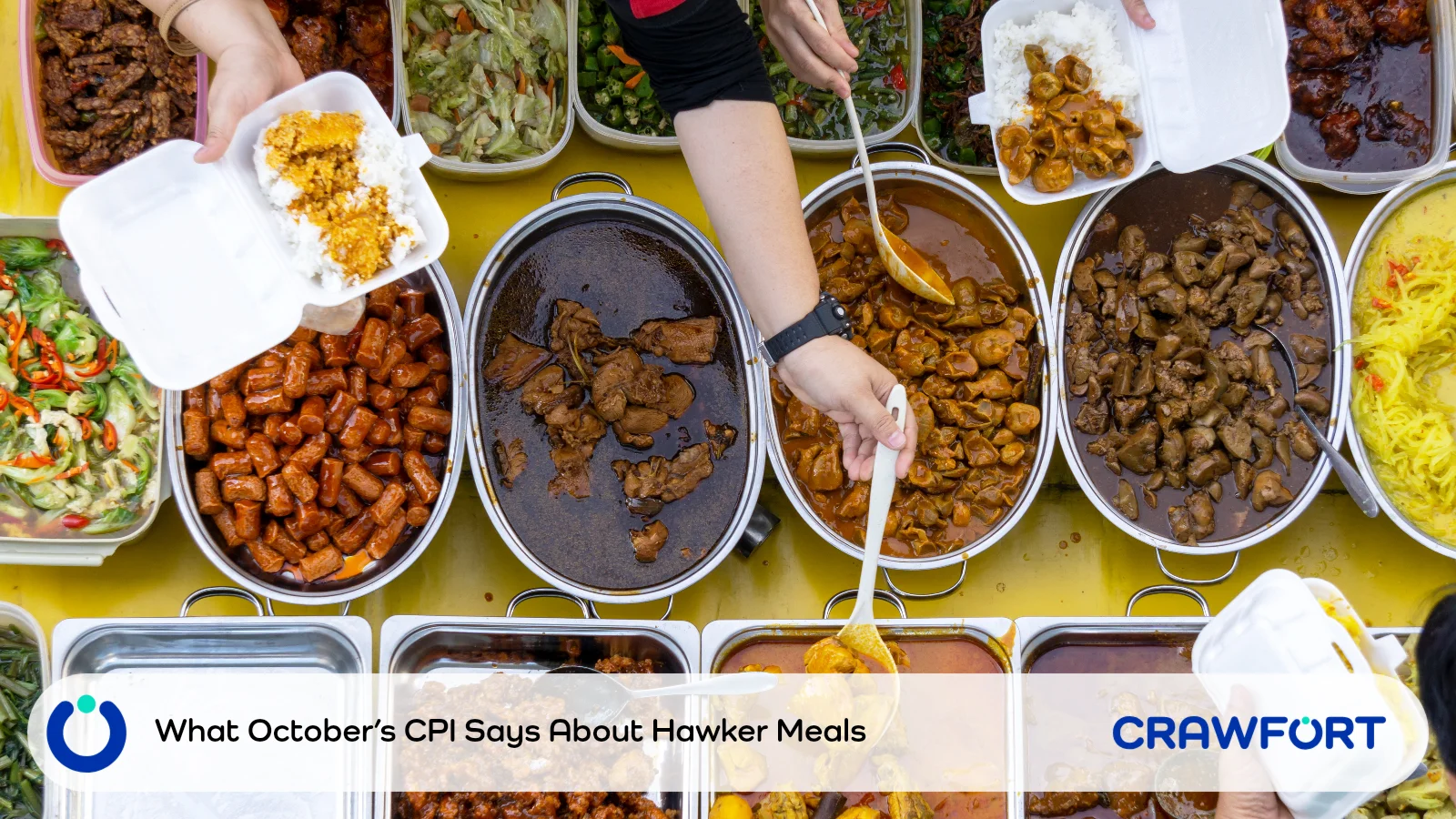
Prices at hawker centres, food courts, coffee shops and kiosks rose 2.6% year on year in SingStat’s figures. Restaurants, cafes and pubs rose 1.3%. To see how this shows up in your budget, compare a meal you buy often at the same stall, with the same portion and add-ons. Then count how many times you bought it that month, since more days in the office can push up your lunch spending before the stall changes its price.
Furniture, Rent And Cars
Inflation for retail and other goods rose to 1.6% from 1.2%. MAS and METI said furniture prices went up, and household appliance prices fell more slowly. Private transport inflation slowed from 7.1% to 6.7% as car prices rose more gradually.
Accommodation inflation held at 0.9%, the same as in September, as housing rents rose at a similar pace. The index covers actual rents plus an estimate of what owner-occupied homes would rent for. Renting and close to the end of your lease? Plan your budget around the rent in your new agreement. For owner-occupiers, the estimated rent is a statistical measure, and SingStat says it has no effect on what you spend in cash.
Will Core Inflation Pick Up Again In 2027?
MAS and METI kept their forecast for core inflation at an average of 1.5% to 2.5% in 2027, with headline inflation in the same range. They expect core inflation to pick up in the first quarter, then ease more noticeably from mid-2027, according to the joint release’s inflation outlook.
Energy prices have eased recently but are still volatile and above year-ago levels. MAS and METI also expect global and regional food prices to rise, as costlier inputs and bad weather affect production.
The regulated electricity rate in this article covers usage up to 31 December 2026. SP Group has said global fuel prices have risen since September 2026 because of tensions in the Middle East, and if that persists, tariffs are expected to go up next quarter. On the regulated tariff? Use the new rate for January usage once SP Group announces it. For a health insurance premium that’s already been quoted, go by the amount and effective date on your renewal.